
















A Necessary Response: The Climate Action Handbook for Urbanists
In 2026, CNU released its most recent publication, reflecting years of thought leadership on how we design and build our communities can have real and lasting impacts on climate resilience. If you missed our initial sale of the handbooks at CNU 34, you can now buy a copy directly from CNU.
A Necessary Response: The Climate Action Handbook for Urbanists presents 37 practical actions focused on fostering urban resilience, adaptation, and mitigation. Designed specifically for those shaping policy and building communities, the handbook addresses the why, the what, and the how of the connection between urbanism and climate action. Whether readers are practicioners or advocates, this book a practical framework for responding to climate challenges through better urbanism.
"As the world reckons with complex responses to climate change," observes CNU's President Mallory Baches, "one achievable, immediate solution is to be intentional with how we design our local communities. This book provides the action plan."
Handbook Summary
Published in partnership with Andelani Press, the Climate Action Handbook consists of three parts. It opens with the connection between urban design and the climate crisis, making the case for New Urbanist climate solutions; including mitigation, disaster recovery, and how we measure the impact of urban interventions. Part two is the collection of response tools that the new urbanist movement has gathered over the last three decades, listed as 'New Urbanism Supported Actions'. The final section is fully focused on implementation - from public engagement to decarbonization to climate migration - followed by eight case studies of communities that illustrate the implementation of one (or more) of the responses from the second section. A Necessary Response: The Climate Action Handbook for Urbanists demonstrates that new uranism is in fact climate action.
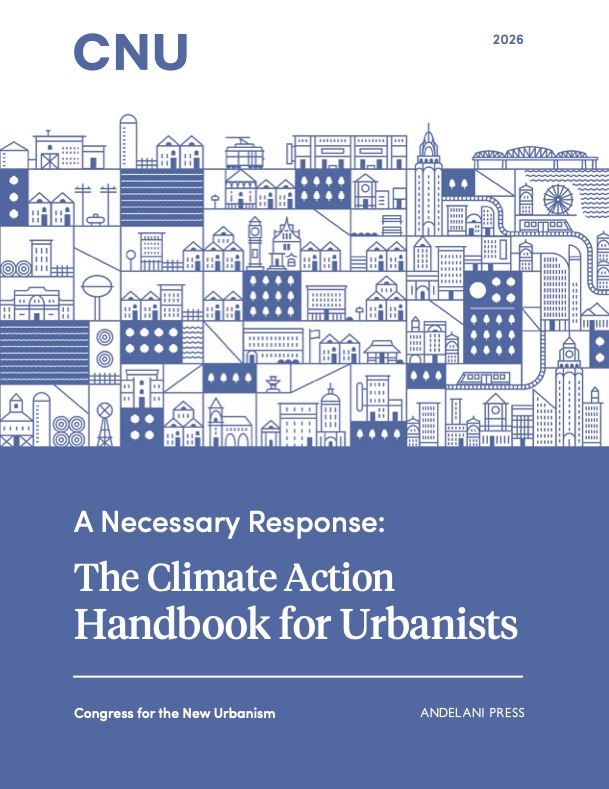
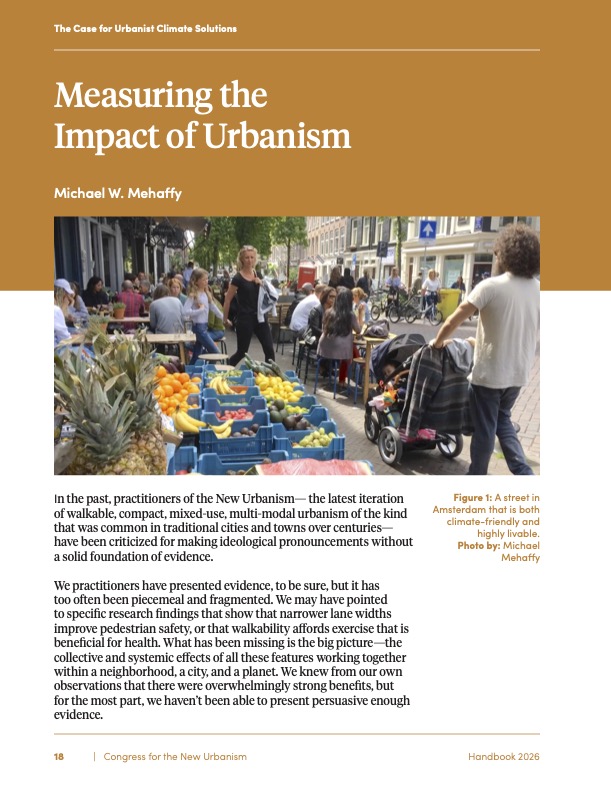
Sample Pages from the Publication:
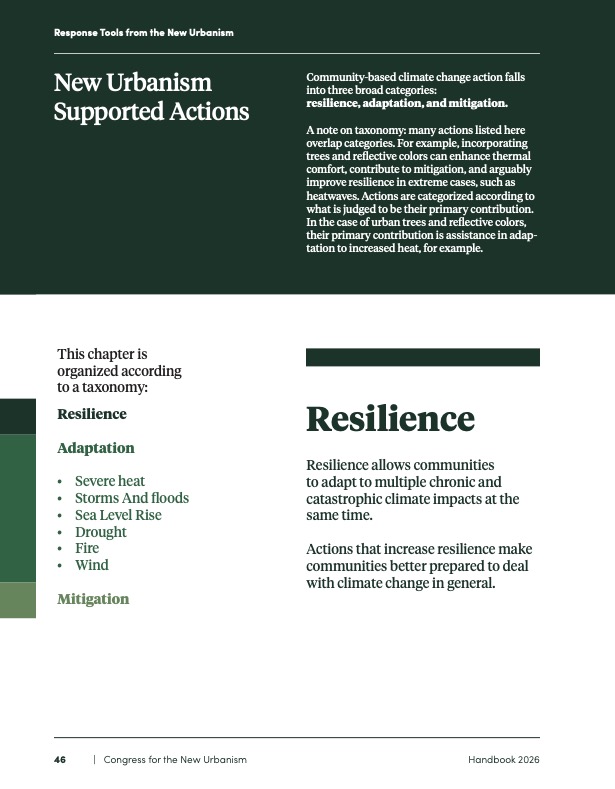
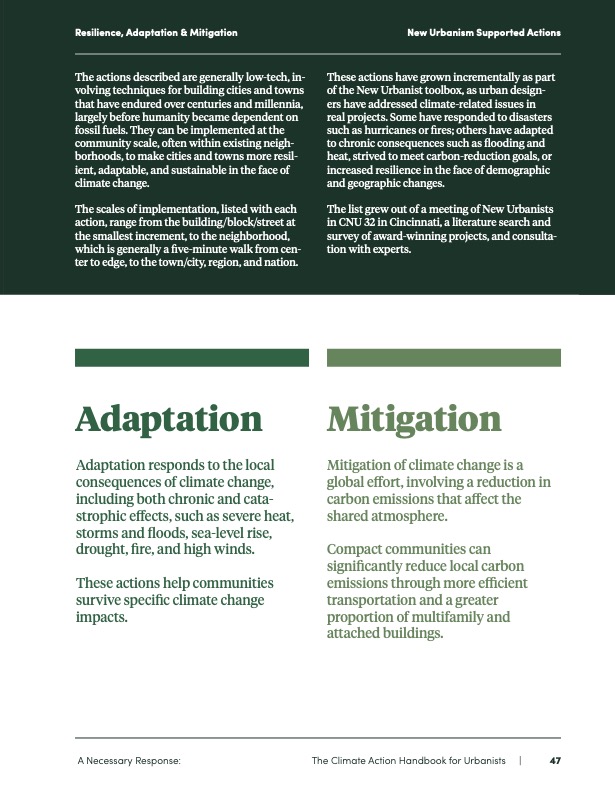
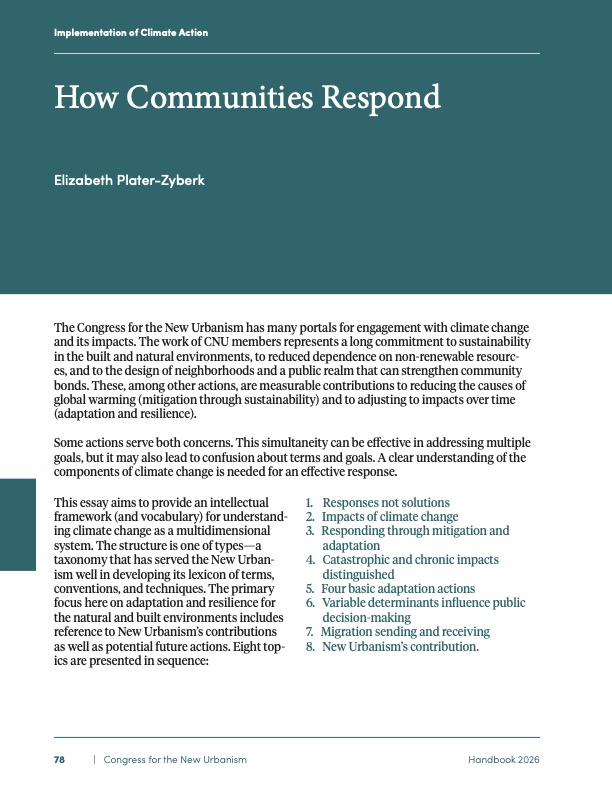
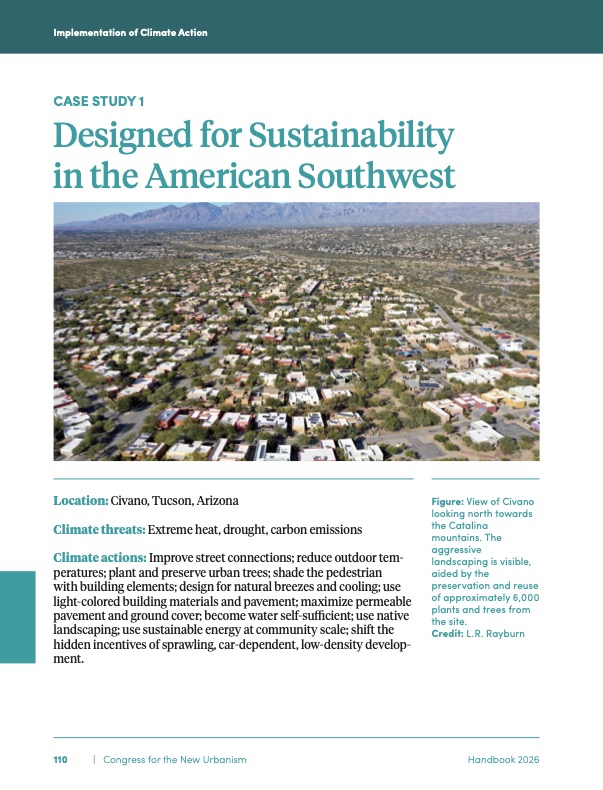
Left to right, top to bottom: Front Cover; Measuring the Impact of Urbanism (page 18); New Urbanism Supported Actions (page 46); Adaptation and Mitigation Taxonomy (page 47); How Communities Respond (page 78); Civano Case Study (page 110).
 .
.  .
. 
 .
.  .
. 
On the Park Bench Webinar: Urbanism and Climate Action
The authors of CNU's new Climate Action Handbook discussed the future of urbanism and how its tools can address the multiple issues related to climate change. The panel included Mallory Baches, Elizabeth Plater-Zyberk, Ricardo Alvarez-Diaz, Doug Farr, Jennifer Hurley, Michael Mehaffy, and Robert Steuteville. Watch now: