A town extension for the ages


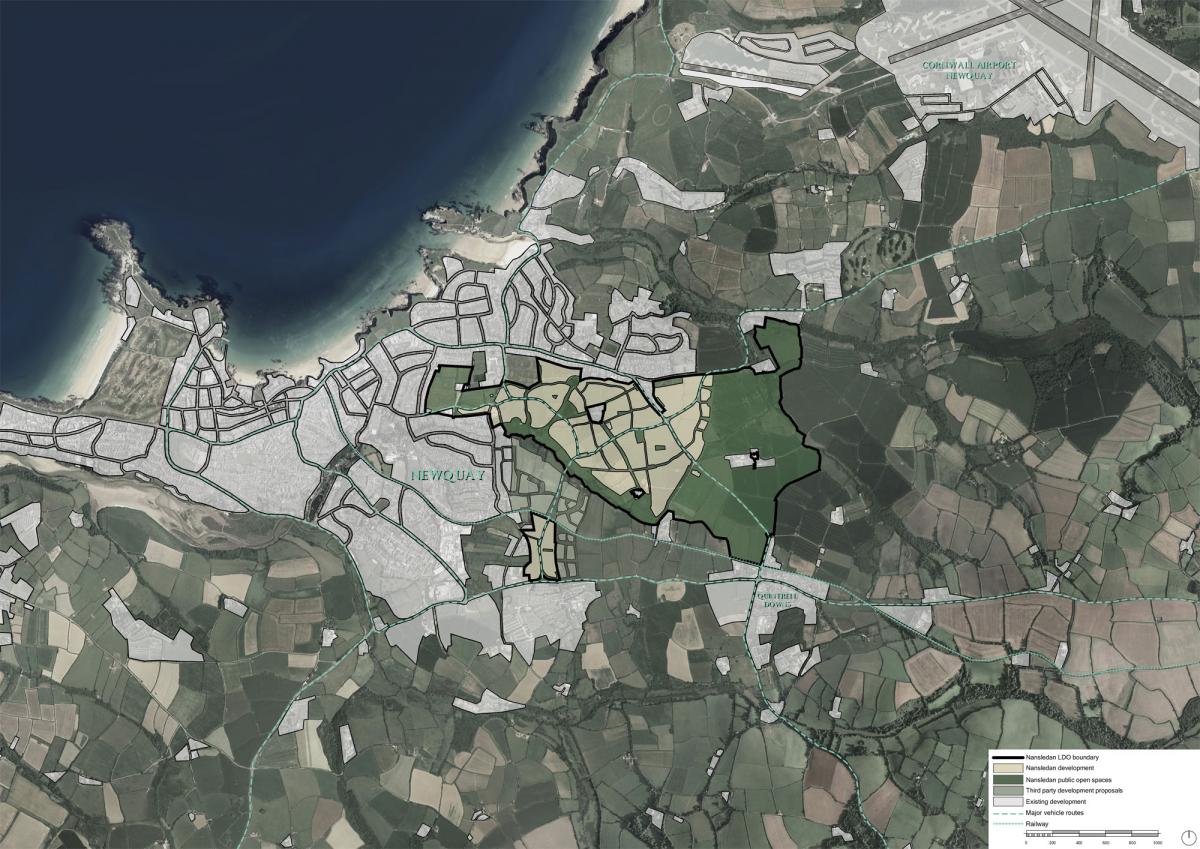
Nansledan is an extension of the town of Newquay in Cornwall, UK, restoring a sustainable, efficient pattern of growth, in keeping with the original settlement. Newquay refers to a “new quay” that was built on the north Cornwall coast in 1439—so the town of 24,000 people has sustained itself for nearly six centuries.
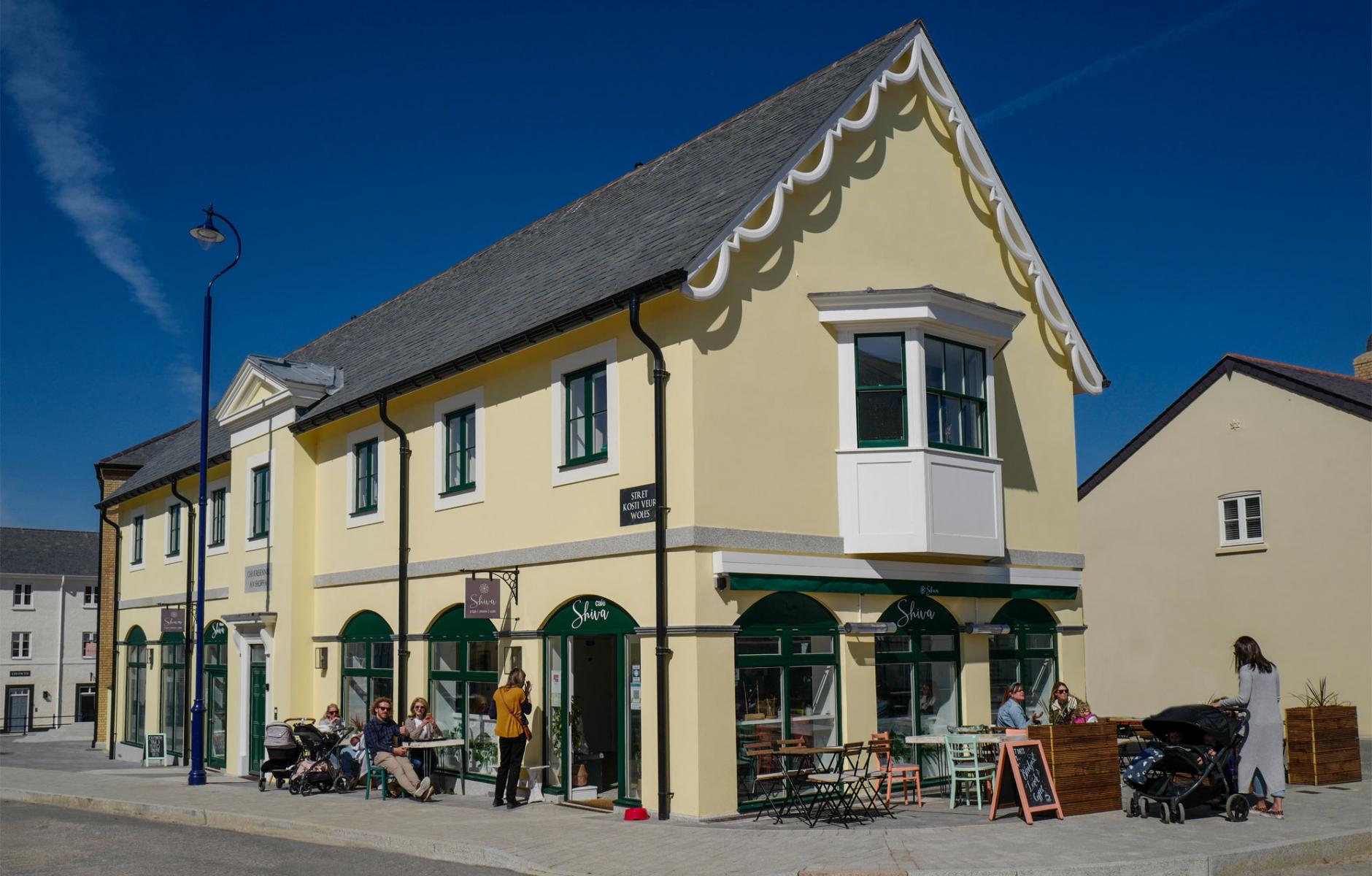
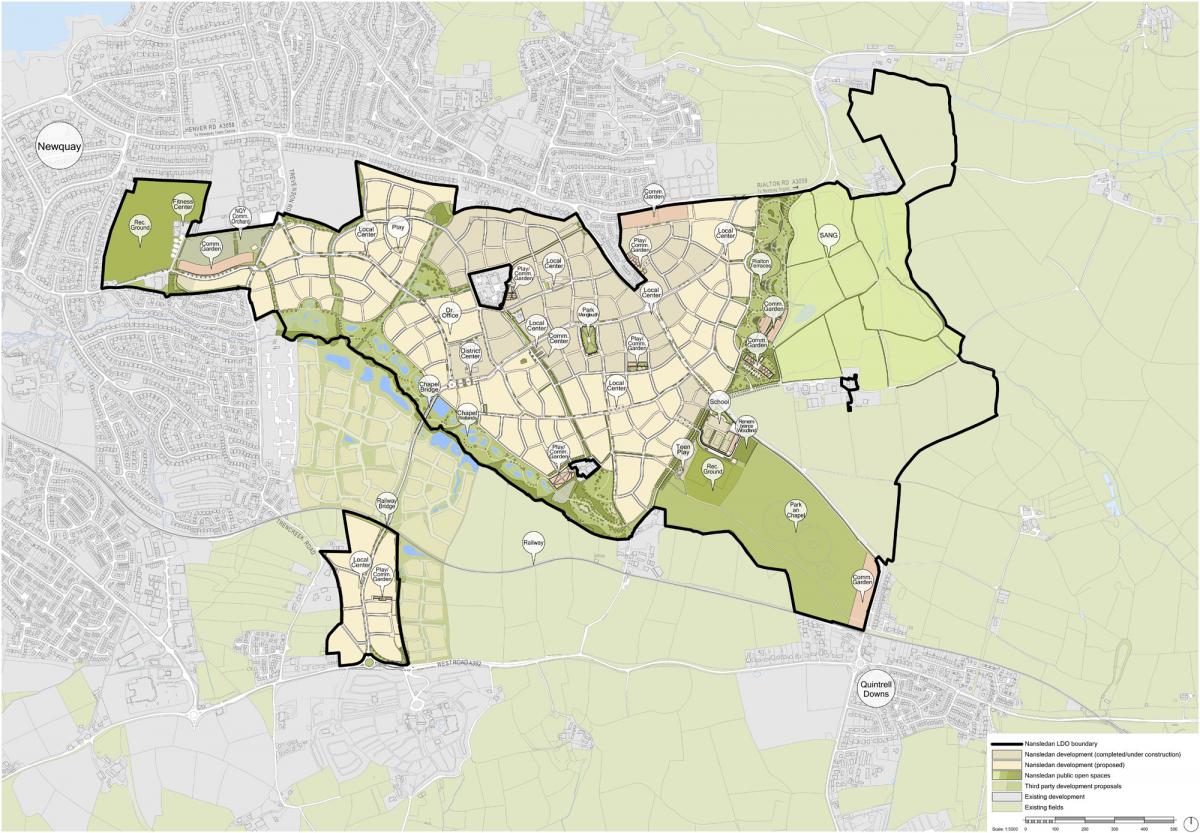
Nansledan is a 620-acre, compact, mixed-use, mixed-income development on land owned by the Duchy of Cornwall, which is also building the renowned Poundbury in Dorset, 140 miles to the east. The pattern of small blocks and walkable streets is distinct from the recent developments around Newquay, which feature cul-de-sacs and larger blocks. Nansledan is a worthy successor to the older, historic parts of town, where the streets form the foundation of a strong public realm, and building frontages shape it, making walking a pleasure.
Nansledan’s principal design firm, ADAM Architecture, was recognized by the 2026 Charter Award jury. Launched in 2013, the project has seen 900 homes built to date, in addition to 40 businesses, including shops, cafés, bars, offices, a fitness center, and a church. By 2045, the town is planned for:
- 3,700 homes, of which 30 percent are affordable;
- 936,260 square feet of employment space delivering up to 3,700 jobs (one per household);
- 328 acres of open space;
- A new main street and district center;
- Eight walkable neighborhoods designed around local centers.
“Nansledan serves as a potent demonstration of the relevance of traditional placemaking to creating new mixed-income communities that are walkable, sustainable, and beautiful,” notes Eric Osth, a board member of the Institute of Classical Architecture & Art in New York City. “This innovative development seamlessly integrates much-needed affordable housing alongside market-rate residences in the familiar form of a remarkable traditional town. The Nansledan model is at the forefront of the drive to address the contemporary housing crisis, and we hope it will inspire additional communities in the UK, the United States, and worldwide.”
The development is strong in its civic buildings and infrastructure, the public realm, and public open space. The design team’s list of civic provisions is impressive:
- Local centers. Nansledan is divided into eight neighborhoods, each with a five-minute walk to a local center. These micro-civic hubs are arranged around a square or green and combine a mix of uses, helping residents to meet daily needs on foot. One of these centers, Kresennik Pennfenten, is marked by an 18-foot granite obelisk as a civic focal point.
- Market Street. This district center is within a 15-minute walk of all residents. The first phase, opening in 2026, includes an 8,000 square foot public event square and a 7,700 square foot traditional market hall, alongside other mixed-use focused on local craft. Market Street is located on a primary traffic route through the development.
- Newquay Community Orchard. Established in 2015 on seven acres of Nansledan land, this not-for-profit initiative is focused on holistic wellbeing, and provides orchards, and community gardens alongside a community building that hosts education programs, wellbeing support, and a café.
- Skol Nansledan. Opened in 2019 as Newquay’s first new school in 30 years, this elementary school accommodates 420 pupils in two classrooms per grade on an 11.5-acre site.
- Nansledan Community Centre. Operated by the community association, this 860-square-foot bookable venue provides flexible space for meetings, events, and activities within one of the local centers.
- Stone-clad bridges. Two graceful stone-clad bridges opened in May 2025 cross the Nansledan valley. Designed for 20,000 vehicle trips per day, they facilitate both a bypass for Newquay and a new main street for Nansledan. More than infrastructure, they serve as architectural landmarks—symbols of identity and civic pride in the landscape.
- Railway Station. A replacement railway station and park-and-ride facility provide residents with convenient walkable access to the railway network, alleviating congestion at the adjacent terminus in Newquay.
- Remembrance Woodland. Opened in 2021, this one-acre woodland of 100 trees offers a tranquil outdoor space for remembrance and reflection of those who have served in the armed forces.
- Future civic spaces. With the development partially complete, additional civic spaces remain to be realized. The master plan allocates sites for a doctor’s office, pharmacy, church, and five more local centers.
The development includes 328 acres of public space (more than half of the total land area and eight times the amount required for a project of this size), and 65 percent of it is complete or under construction. These public spaces can be broadly categorized in three ways:
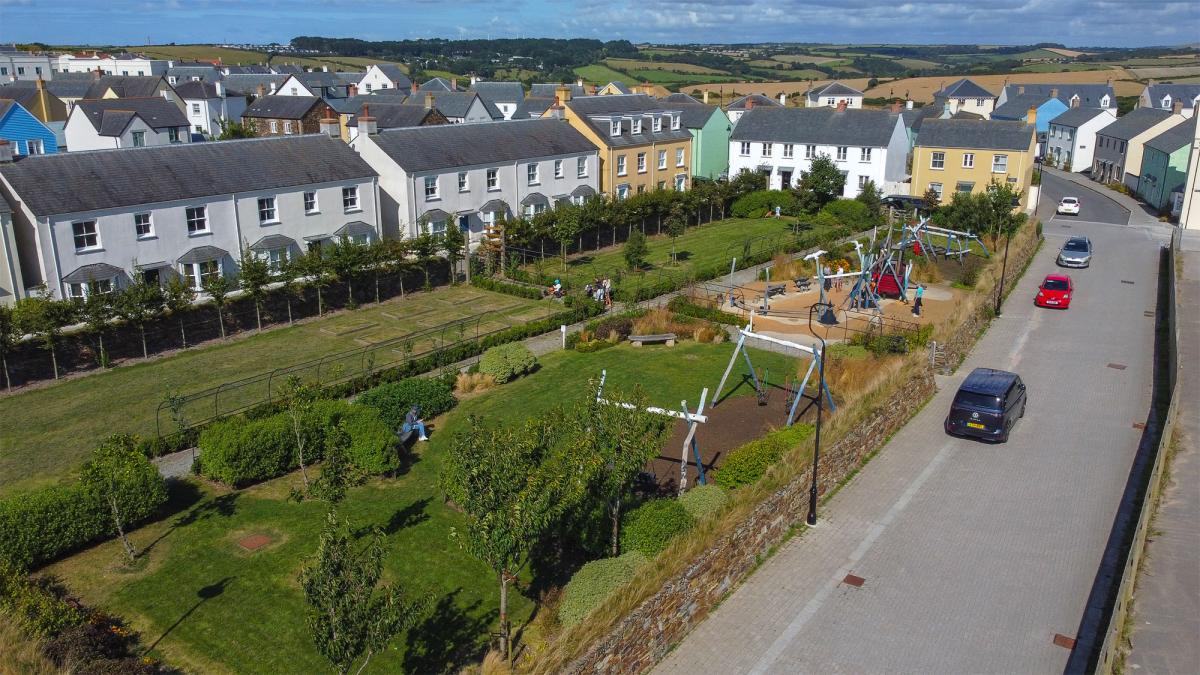
Play and recreation spaces. There are three play areas currently, two for younger children and one for older children and teens, with a skate park and pump track. Two full-sized playing fields are adjacent to the elementary school. Nansledan has taken over the lease of a fitness center, with an adjacent 18 acres of fields for a range of sports. “Over one mile of the development’s original hedgerow tracks has been retained and integrated into Nansledan’s connected walking and cycling network,” the design team explains. Finally, the 1.1-acre urban park at the center of the development is the key space for public activities.
Natural and semi-natural landscapes. A 75-acre natural green space provides 2.3 miles of trails through rolling wildflower meadows. A 33-acre wetlands integrates sustainable drainage, trails, and habitat enhancement. Sixty-two acres of open space on the east side defines the development edge and protects “residents’ connection to nature in perpetuity,” the design team explains.
Local food production. “A network of community gardens, orchards, and espaliered fruit trees are planted throughout the open spaces and public realm as part of an ‘edible streets’ strategy,” the team explains. A total of 5.6 acres of community gardens and orchards are frequently combined with play spaces, allowing parents to tend their plots while children play nearby.
Through this carefully planned public realm, Nansledan offers a wide range of housing types and affordability. Affordable units are indistinguishable from the market-rate housing. Nansledan celebrates Cornish culture through a pattern book and design code that ensures all architecture draws from regional vernacular—using locally sourced slate, granite, and lime render.
Two housing projects underway address homelessness. One will provide 24 homes for local adults experiencing homelessness. A second project will provide apartments for young people aged 18-25 who are homeless or at risk of homelessness. Both projects are built to the same high standards as all other housing in Nansledan.
Adding to the town of 24,000 people, Nansledan offers substantial growth that is socially conscious, environmentally sustainable, and that reinforces local culture. And it’s economically sound. The market endorsement of this approach is evident in the 12 percent value premium over comparable developments. The development could handle most of the town's growth for the next two decades.
New mixed-use development at Nansledan, Newquay in Cornwall UK
- ADAM Architecture, Principal firm
- Sam Kirkness, Duchy of Cornwall, Executive director of development
- Peter James, Duchy of Cornwall, Project manager
- Nick Pollock, Duchy of Cornwall, Head of planning
- Hugh Petter, ADAM Architecture, Director
- Peter Matravers, AWP Awcock Ward Partnership, Technical director
- Andrew Smith, Fabrik, Managing director
- Philip Fry, CG Fry, Managing director
- Steve Goldsworthy, Wain Homes, Acting Managing Director – South West
- Eugene Rapson, Morrish Homes, Joint Managing Director
- Peter Hume, Purl Design, Director
- Tricia Langdon, ALA Architects, Architect
- Ross Sharpe, Yiangou Architects, Director
- Cory Babb, ADAM Architecture, Senior Associate Urban Designer
- Andrew Rowland, ADAM Architecture, Architect
2026 CNU Charter Awards Jury
- Eric Kronberg (chair), Principal, Kronberg Urbanists + Architects in Atlanta, GA
- Majora Carter, CEO of Majora Carter Group in the Bronx, New York City
- Marques King, Studio Director + Senior Architect, Pure Architects, Detroit, MI
- Jeremy Lake, Principal, Union Studio Architecture & Community Design, Providence, RI
- Joanna L. Lombard, Distinguished Professor at the University of Miami School of Architecture, FL
- Rico Quirindongo, Director, City of Seattle Office of Planning and Community Development
- Ashley Terry, Director, President of Development at Pivot Real Estate, Oklahoma City, OK