New beach town is a model for regional growth


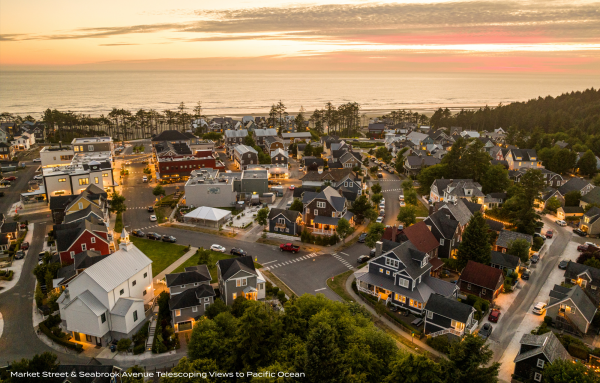
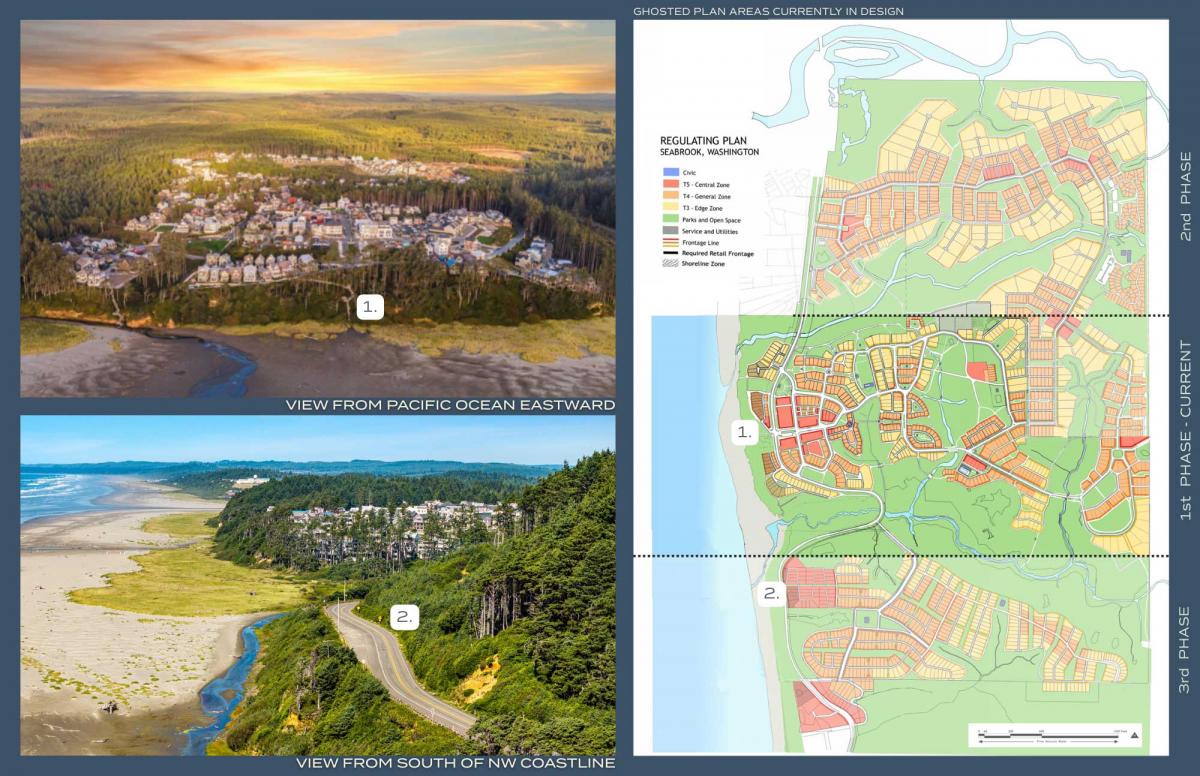
Seabrook, Washington, a much-admired new beach town with a traffic-calmed coastal road running through it, has now received the highest prize for a New Urbanist project. The 588-acre town perches on three promontories overlooking the Pacific Ocean, safe from tsunamis or the potential impacts of climate change. Now that its original neighborhood is mostly complete, including an organic-looking town center with positive regional economic impacts, Seabrook was awarded a Grand Prize in the 2026 Charter Awards.
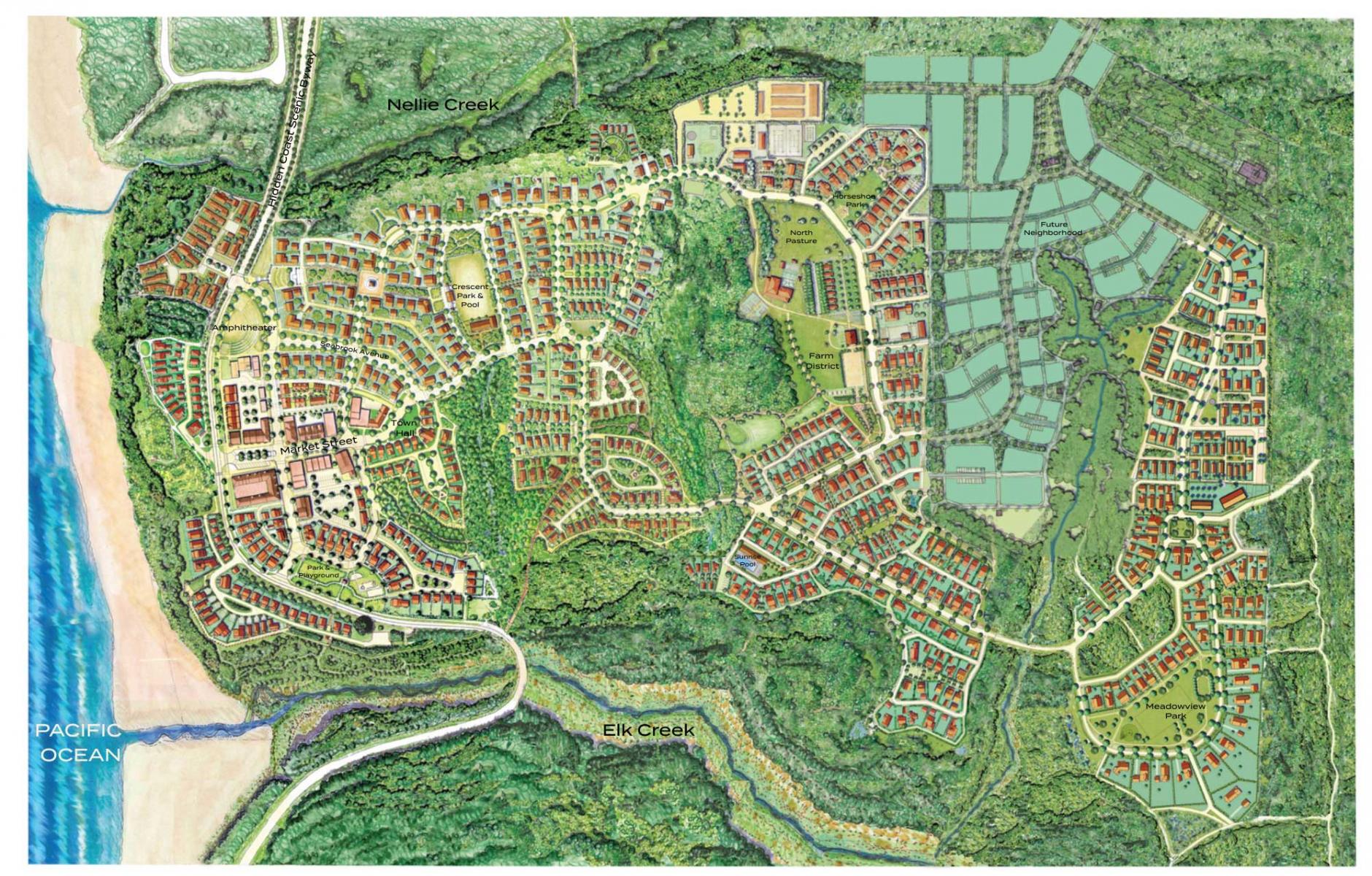
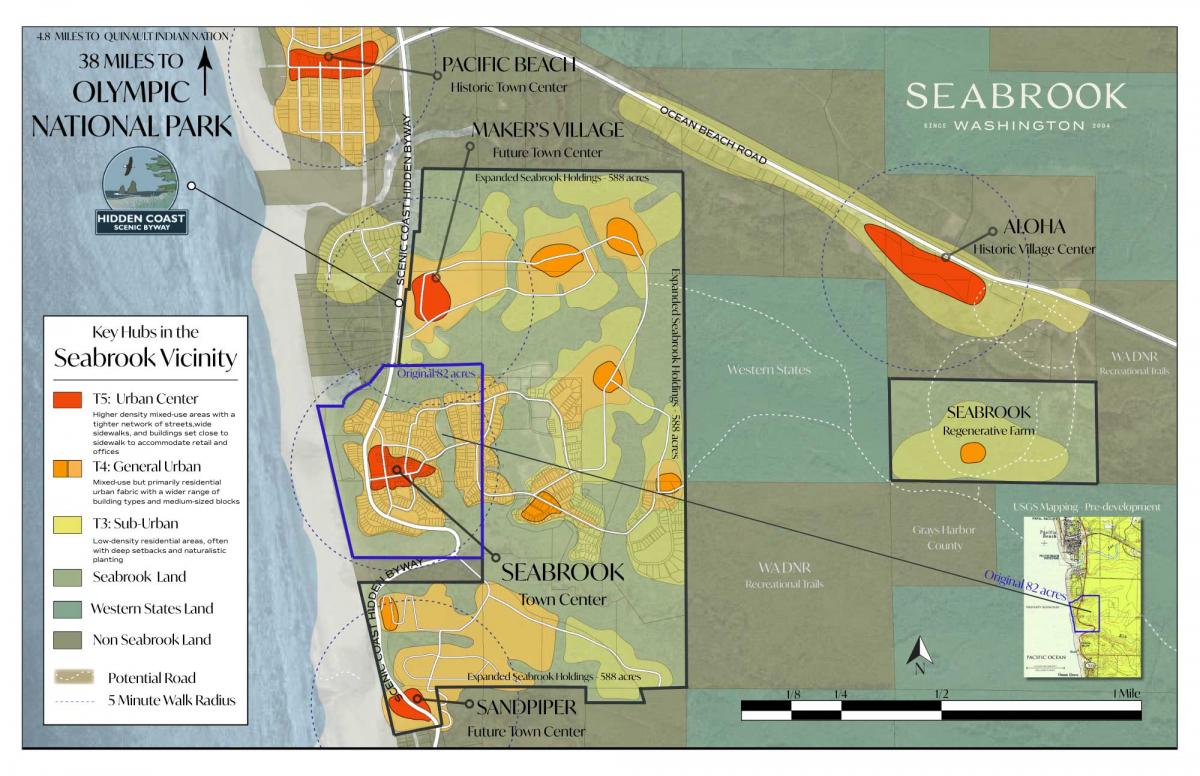
Seabrook broke ground in 2004 on 82 acres, completing 640 homes and nearly 40,000 square feet of commercial space to date. Land acquisitions have added 500 acres to the original plan, so Seabrook Land Company is entitled to build a total of 2,100 houses with commercial and civic uses on 588 acres. Nearly 50 percent of the land is preserved in forest, wetland, and stream corridors.
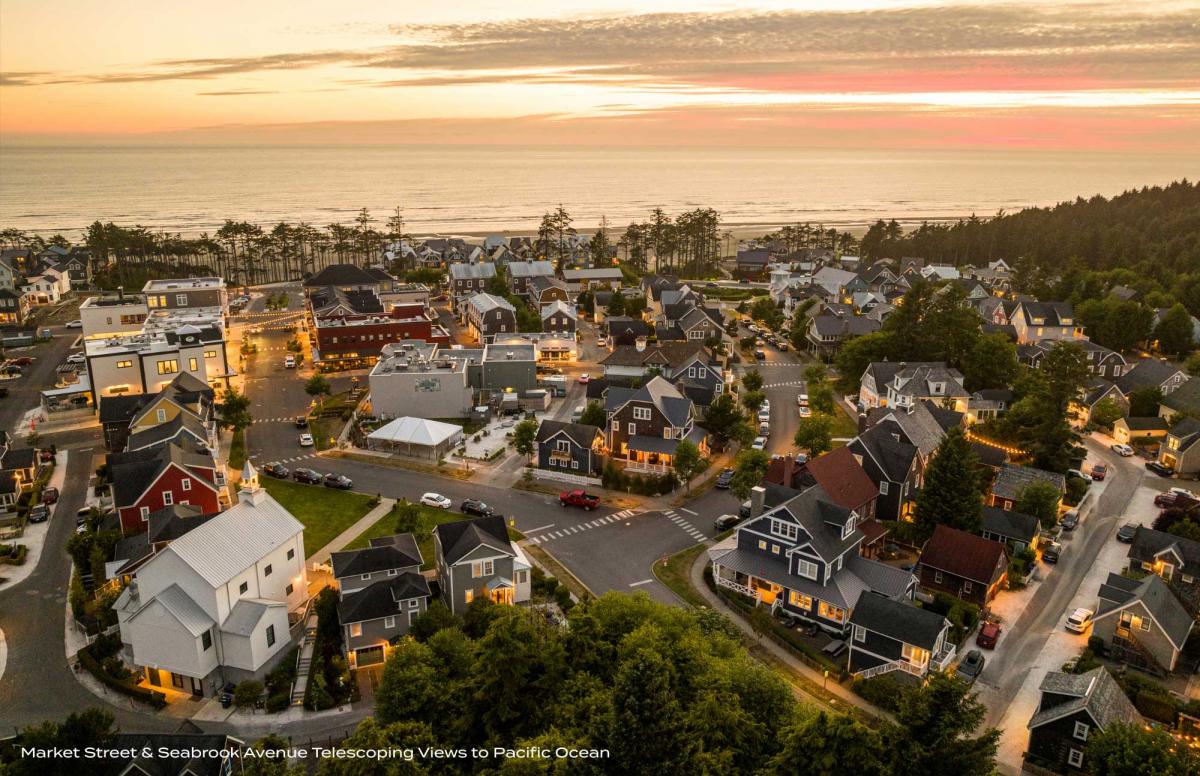
Each promontory along the Scenic Coast Hidden Byway is planned with its own small mixed-use center and walkable scale. In all, Seabrook will add three town centers to the nearby historic towns and villages of Pacific Beach, Moclips, and Aloha.
The town introduces a new model of development to the Washington Coast and Grays Harbor County, where the late 20th Century pattern is exemplified by the sprawling Ocean Shores, located a dozen miles to the south. With its compact, walkable form, Seabrook has been called a West Coast version of Seaside (Florida), albeit in an area that was, until recently, severely disinvested—so much so that much of the county, including the coast around Seabrook, was designated an Opportunity Zone in 2017. Town founders Casey and Laura Roloff launched their business from custom home construction, and prior to that, Casey was a house painter. Seaside inspired the plans for Seabrook.
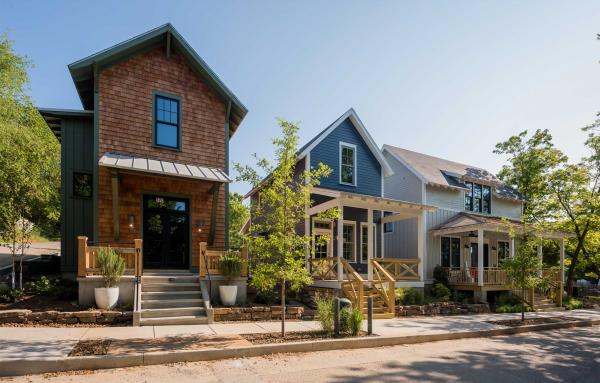
The town has a wide range of housing types, including small and large single-family homes, duplexes, triplexes, rowhouses, townhomes, 4-story condominium-apartment flats, 3-story walk-ups, and accessory dwellings, which are accommodated on 90 percent of the lots.
Civic buildings include a town meeting hall, a natatorium/fitness facility, a walk-in medical clinic (in nearby Pacific Beach, a satellite of the regional hospital, serving the entire community, including the Quinault Indian Reservation, 3 miles to the north), and a future school (also in nearby Pacific Beach, with land secured). The mixed-use town center includes a 13,000-square-foot market/grocer where residents and visitors can purchase daily necessities.
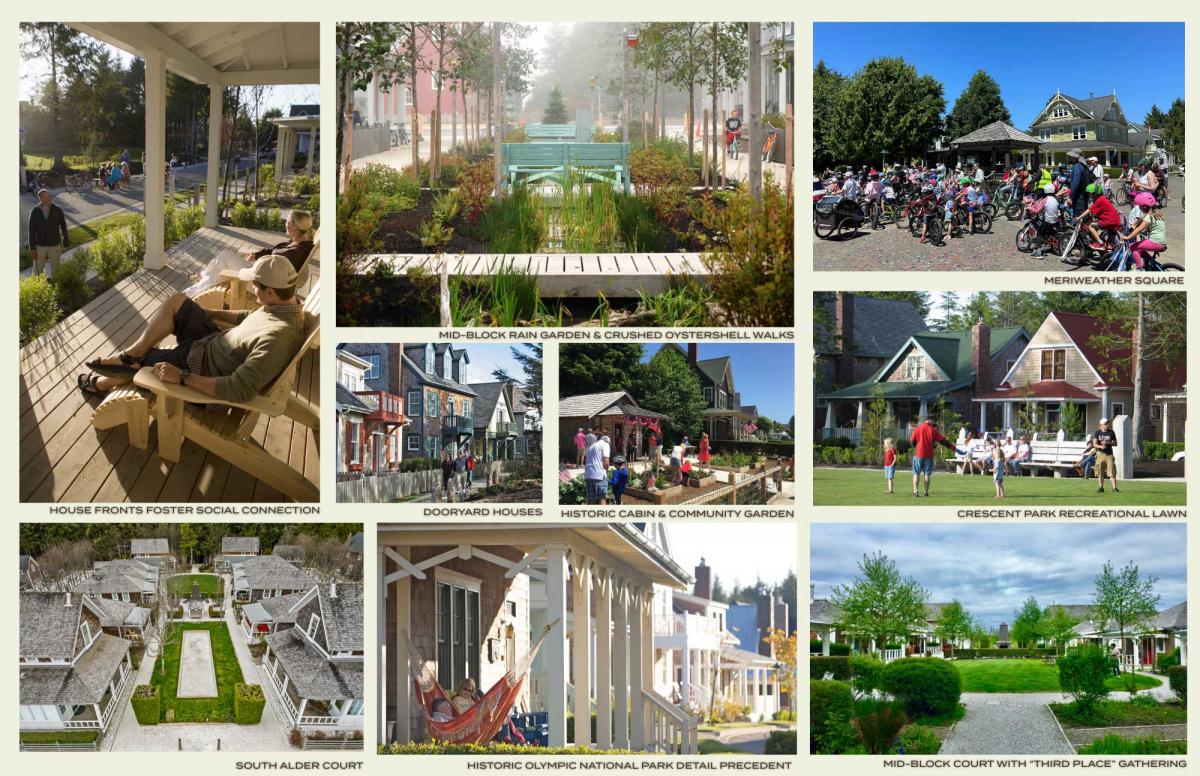
The public spaces in Seabrook are generous, beginning with beach access and a public esplanade overlooking the Pacific. Also, the town has 18.6 miles of developed hiking and biking trails and a range of parks. These include:
- Crescent Park is a central green space that often hosts festivals and includes an indoor pool, fire pits, and shuffleboard.
- Meadowview Park, the town’s largest park, embedded in a neighborhood, features an oval meditation lawn, an observation mound with a fire pit, and a children's slide.
- Kucera Park includes a playground, a pickleball court, and space for seasonal outdoor yoga.
- Barn Hill Park is a newer, seasonal event space featuring a tented venue for community gatherings.
- Numerous "pocket parks" are scattered throughout neighborhoods.
- Meriweather Square is an outdoor meeting space with views into green space.
- An off-leash dog park is a dedicated area for pets located at the town’s edge near the Farm District.
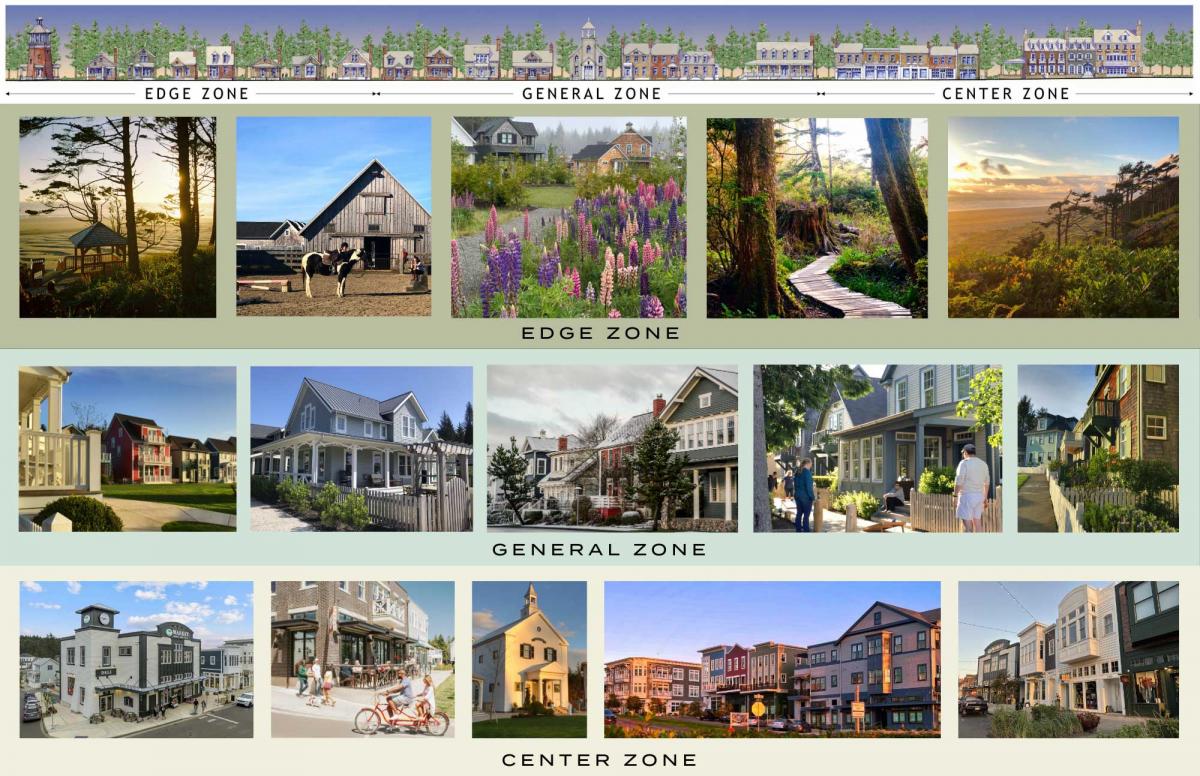
Transect-based design
Seabrook is designed for immersive environments, from the main street commercial district to the town edge that includes a Farm District with an equestrian barn and pastures, and walkable neighborhoods in between. In one location, a historic cabin is preserved with community gardens.
“From its inception, the town rigorously applied the ‘Transect’ model to shape growth of new neighborhoods as well as existing settlements, all within a polycentric ‘web’ defined by natural features, including managed forests, ocean bluffs, stream corridors, and adjacent farmlands,” according to the design team.
The building frontages, especially the porches on the houses and the many parks lined with residences, promote social connections between neighbors. The design team carefully crafted the physical definition of streets and public spaces as places of shared use, a key principle of the Charter of the New Urbanism. Urban design patterns include street views that radiate to the ocean and back into the town toward civic buildings. Even the mid-block areas, including semi-private cottage courts, are carefully designed.
The streets were planned for safety, comfort, interest, and usefulness for pedestrians and bicyclists. Crucially, Seabrook convinced the Washington Department of Transportation to reduce the speed limit from 50 mph to 25 mph along the scenic highway segment through the town and to permit on-street parking along its shoulders. “By adding signaled crosswalks and buildings near the roadway edge, we proved speed reductions were warranted to achieve greater pedestrian safety,” the team reports.
The town is fully open and accessible to all, including via the county public bus system.
Impact on the region
Seabrook has had a significant economic impact on the county, which was declared the most underprivileged in Washington State not long ago. A new bike-pedestrian path along the highway (State Route 109) will soon link the Quinault Indian Nation and Seabrook to Pacific Beach’s new schools, medical clinic, and Boys & Girls Club–all located safely above tsunami inundation zones. The area’s economy was previously based on logging and fishing, until these industries collapsed in the late 20th Century, the team explains.
Seabrook financially donates to the region with its Seabrook Community Fund (1 percent of real estate sales in perpetuity, set up by the town founders). To date, the Seabrook Community Foundation (SCF) has contributed $8M to local schools, residents, and long-term climate resilience planning. “The town’s expanded tax base has created a surge in opportunities for building, supply, and resort service trades, and has allowed for the creation of several locally-owned small businesses,” the team explains.
“The Pacific Beach clinic represents a meaningful investment in health equity and community-centered care,” the team notes, especially because the hospital is 45 minutes away. “By bringing primary care services closer to where people live, work, and gather, we are reducing barriers to access and supporting healthier outcomes for residents across the North Beach area, including members of the Quinault Indian Nation.”
Seabrook represents leadership in urban design, town planning, and development—with a vision not just for a town but for the region as a whole. For that reason, the 2026 Charter Awards jury selected Seabrook as the clear choice for Grand Prize.
Seabrook, WA—a Rural-to-Urban Regional Town Planning Model
- Seabrook Land Company, LLC, Principal firm
- Casey & Laura Roloff, Seabrook Town Founders, Casey Roloff Seabrook CEO
- Laurence Qamar, Seabrook Land Company | Qamar & Associates, Principal Town Planner
- Stephen G. Poulakos, VP of Town Planning & Design | Landscape designer
- Sam Nielson, P.E., VP of Engineering & Entitlements
- Michael Benjamin, MBA Architects, Principal Architect
- Matthew Craig, P.E. | Parametrix, Civil & environmental engineering
- Ryan Carr, VP of Construction
- Jeff Gunderson, COO Seabrook Land Company
- Robert Gibbs, Gibbs Planning Group, retail consulting.
2026 CNU Charter Awards Jury
- Eric Kronberg (chair), Principal, Kronberg Urbanists + Architects in Atlanta, GA
- Majora Carter, CEO of Majora Carter Group in the Bronx, New York City
- Marques King, Studio Director + Senior Architect, Pure Architects, Detroit, MI
- Jeremy Lake, Principal, Union Studio Architecture & Community Design, Providence, RI
- Joanna L. Lombard, Distinguished Professor at the University of Miami School of Architecture, FL
- Rico Quirindongo, Director, City of Seattle Office of Planning and Community Development
- Ashley Terry, Director, President of Development at Pivot Real Estate, Oklahoma City, OK