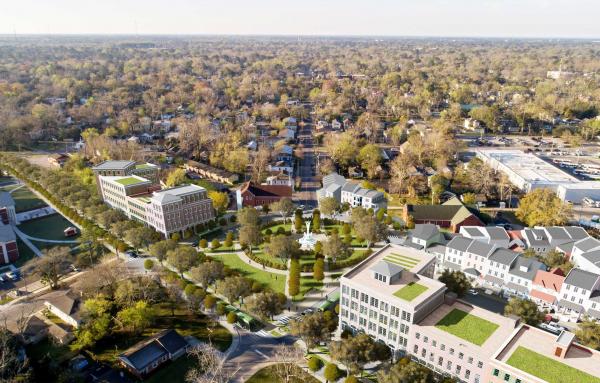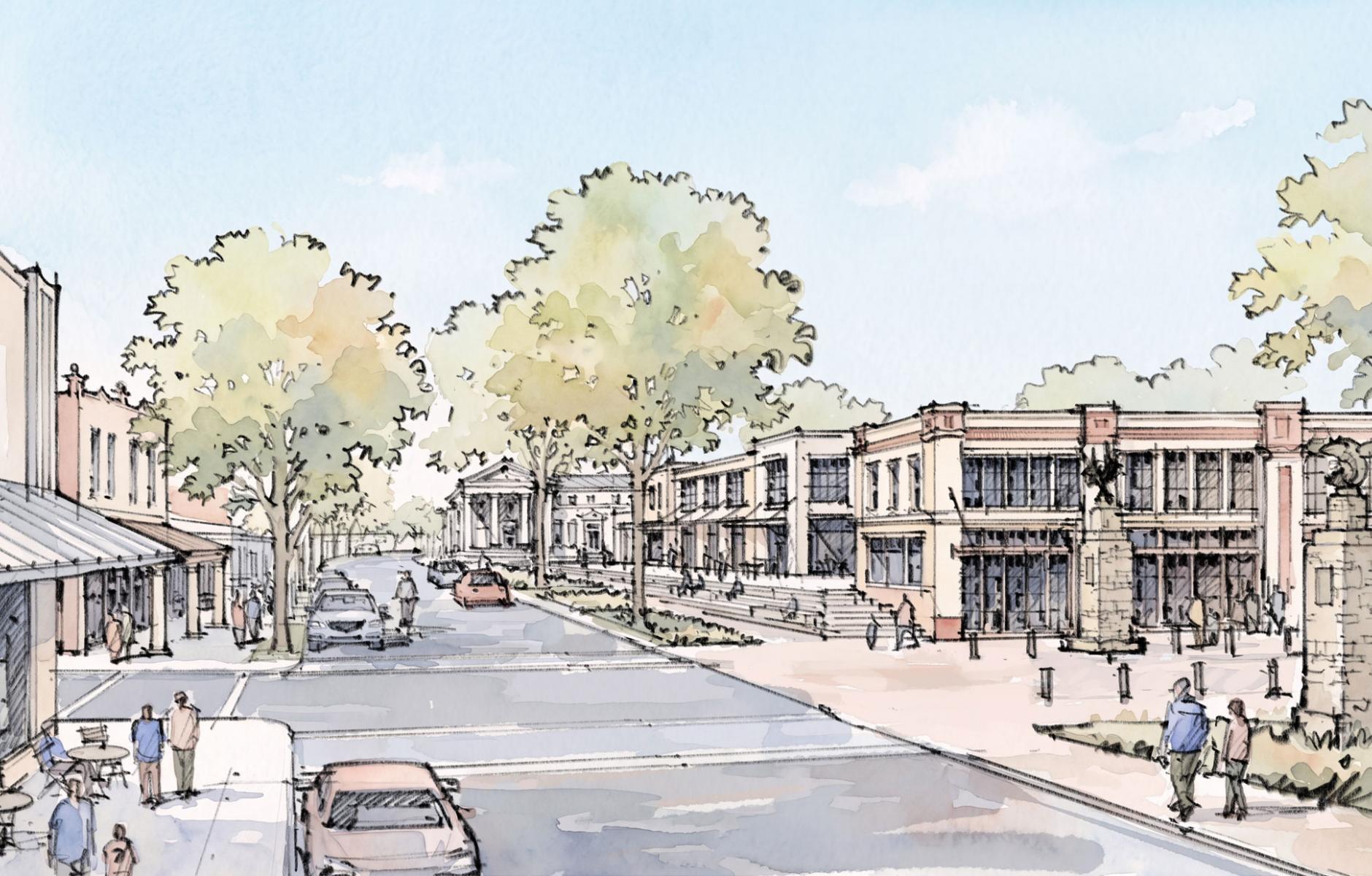
Reclaiming a Main Street as a walkable center for growth


Cave Springs, Arkansas, is a City by jurisdiction but a village in physical terms, surrounded by suburbanizing countryside. It is close to the airport in Northwest Arkansas, one of the fastest-growing regions in the US, which is why Cave Springs is experiencing tremendous pressure for growth.
The Arkansas DOT plans to widen Highway 112 to 4 lanes, which is currently Cave Springs Main Street. Thanks to actions taken by Mayor Randall Noblett, AR-DOT has agreed to build a bypass with roundabouts around Downtown Cave Springs and cede control of Main Street to the City, unlocking an opportunity to redesign Main Street to be more pedestrian-friendly.
To plan for these changes, A CNU Legacy Project team, led by Michael Watkins Architect (MWA), recently created a plan for the small downtown. Legacy Projects leverage CNU’s planning and design expertise to make a long-term impact on the host region of the annual Congress, which will be CNU 34 in NWA, this week—May 12-16.
A revitalized center could accommodate much of the projected growth for Cave Springs and become an important walkable place for the region, which is turning away from the outdated sprawl of the 20th Century toward a healthier, more fiscally sustainable model that preserves the countryside that gives the region its charm.
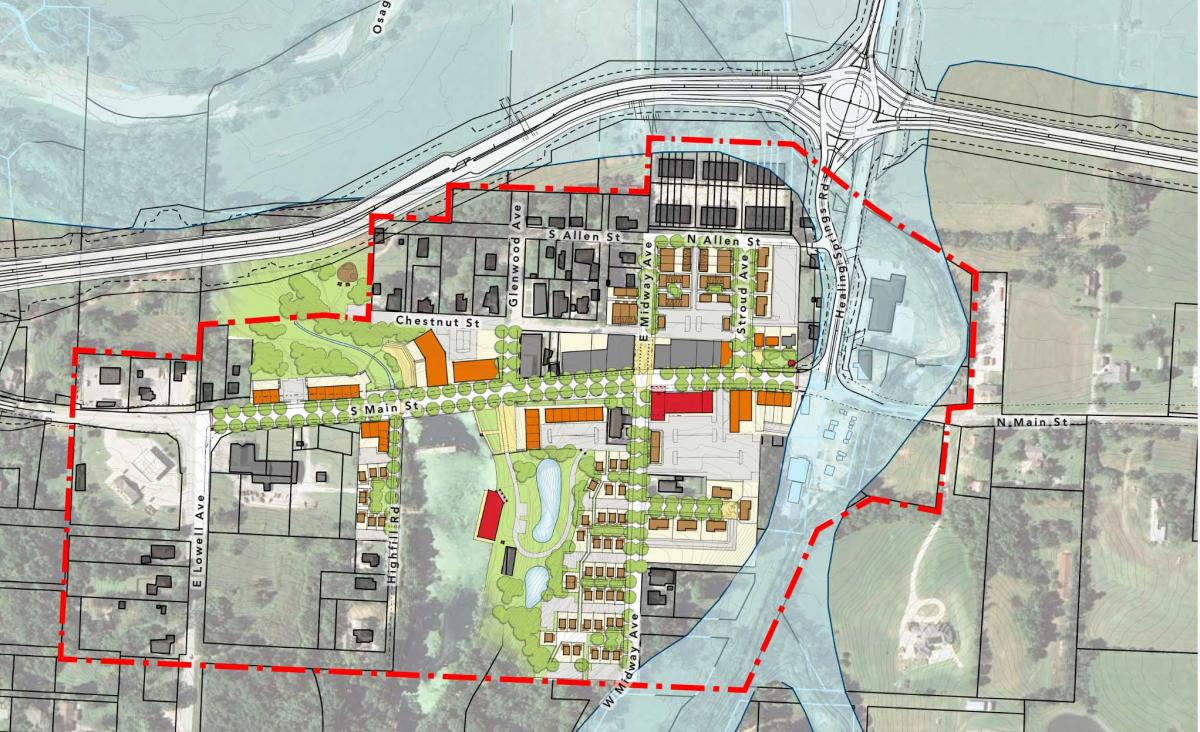
Compared to the existing community, the plan shows how a great new Cave Springs could emerge with more business, housing, and a greater focus on pedestrians.
The CNU Legacy Project builds on an Urban Land Institute plan from 2024. The 2026 plan delves into greater detail and considers changes based on new information, including the results of the residential and commercial market studies conducted by Zimmerman/Volk Associates and LandUse USA, both of which were part of the Legacy Project team. Also, the Illinois River Watershed Partnership (IRWP), which owns two significant open-space parcels on Main Street, is working with the City to develop models of sustainable growth.
In addition to the market researchers, the MWA team included Pattern Zones, which developed fiscal impact analyses; JJ Zanetta, a New Urbanist artist; Crabtree Group Inc., civil engineers; Nelson Nygaard, transportation planners; and Proximity Project.
Features of the plan include:
- Revitalized public spaces. Instead of eliminating T.R. Wallis Park, it could be improved by cleaning it up, providing better furnishings, and containing it spatially with buildings, a corner gazebo, and possibly a low wall between the park and the intersection of Main St and Healing Springs Rd.
- Urban design for a new city hall. This location on the corner of Midway Avenue and Main Street was chosen to take advantage of views up Main Street from the South provided by the wider right-of-way in front of the city’s Community Building. City Hall could have a portico that extends over the sidewalk, increasing its visibility from down the street. The building's placement on the street allows for adequate parking behind it, without impacting the character of Main Street. Pushing some new Main Street buildings back a bit to improve City Hall visibility would also allow bioswales to manage stormwater.
- New businesses on Main Street. The retail study by LandUse USA recommended a small boutique hotel or bed-and-breakfast in downtown that could capitalize on airport traffic. This would be a late-stage addition, as much of downtown would need to be revitalized before a hotel could succeed. IRWP would like to build a new Learning Center on the same side of Main Street as the city’s natural spring (the east side), which would allow for a destination restaurant with a large patio on the west side, similar to The Ramble, a noted New Urbanist park in Fayetteville, Arkansas.
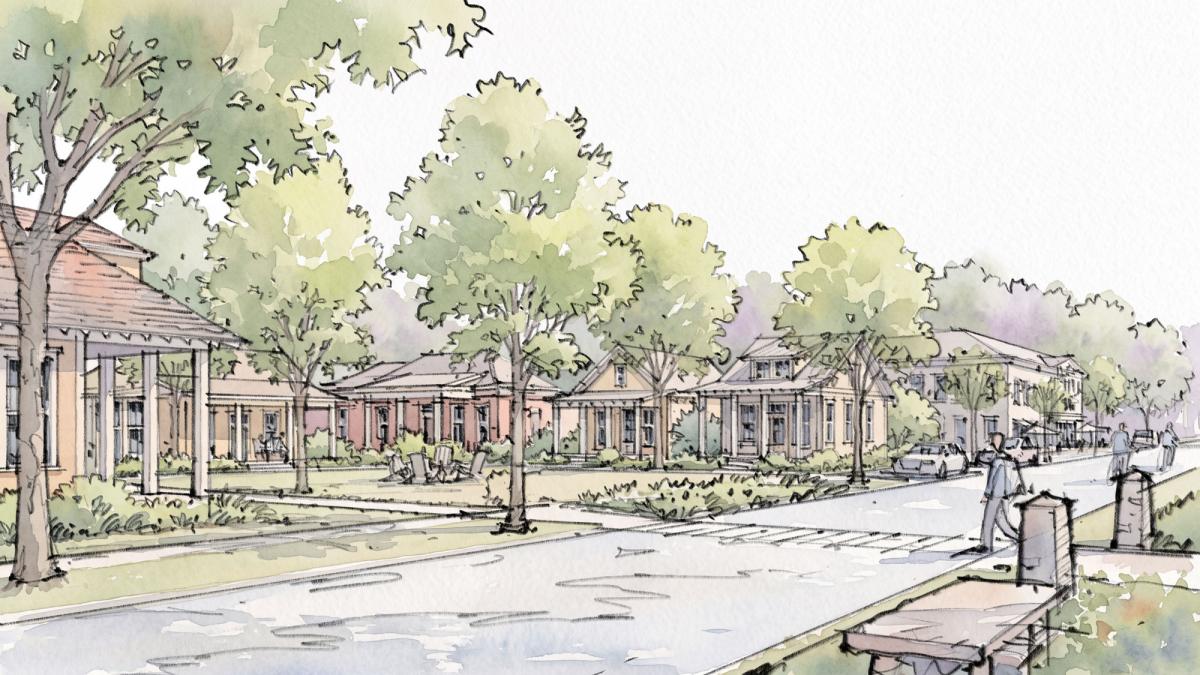
- The addition of cottage courts and other missing middle housing. IRWP is interested in the development of a cottage court overlooking the preserve, which could serve as a model for missing-middle housing in the village. Small, four-unit multiplexes could have the scale and appearance of large single-family houses. Also, townhouses are planned. These building types fit the residential market study and would replace the larger multifamily buildings previously proposed. This housing will support new and revitalized downtown businesses.
- The IRWP seeks models of low-impact, walkable urban development on its land. Since IRWP was interested in using their land to support downtown uses, more infill housing has been proposed on the south side of Midway Ave in the form of cottage courts. These small houses can be supplied at a lower price than houses on large lots, creating more opportunities for people to live downtown. These courts could also have trails that connect to the IRWP open space and the greater trail structure in the area.
- More pedestrian-friendly street design. The streets of downtown Cave Springs are currently designed to promote automobile traffic. Since the goal is to reroute through traffic around the village, new street sections were provided to be more pedestrian-friendly. Current streets could be converted to these new sections over time.
- A secondary study area around the primary study area would allow for the growth of Cave Springs downtown far into the future. This larger study area was not physically designed, but the general principle is to make it walkable, with easy pedestrian access to the downtown. That could start by fixing a key intersection, North Main Street and Healing Springs Road (Highway 264), and making it more pedestrian-friendly. “Fixing that intersection is important to developing anything to the north of downtown,” says Scott Layton, the project manager for MWA. Otherwise, street connections should be made whenever possible to provide future pedestrian routes, he says.
The town is exemplary for pursuing a more walkable community vision, despite the prevalence of car-dependent patterns, says Michael Watkins. “We were happy to support and advance the town’s efforts while standing on the shoulders of others, such as the ULI, who did great work over the past couple of years before our arrival on the scene.” Cave Springs could be a model for other communities across the US, he says. “Small towns and villages in the US need to know that with commitment, determination, strong leadership, and a clear vision, positive change is possible.”
The Cave Springs plan, and other CNU Legacy Projects, will be presented on Friday, May 15, at CNU 34 in Bentonville, Arkansas.