Organizing regional growth around a bike-ped trail


The Razorback Greenway Corridor Plan transforms a 40-mile multi-city trail into the organizing regional framework for development in fast-growing Northwest Arkansas. The Greenway, built over the last 10 years, links seven cities and is one of the most important regional bike-ped trails in the US.
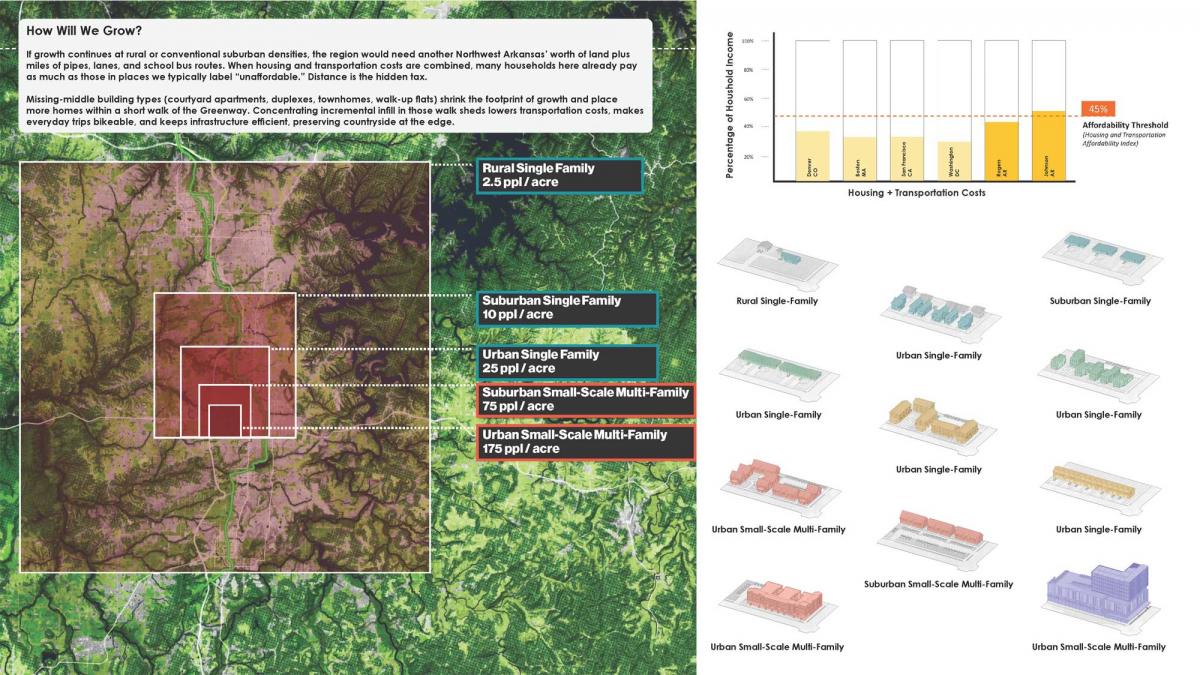
The plan combines broad ecological and policy analysis with specific plans for eight local places, providing a shared playbook for city-by-city implementation. Field Operations and Blockwright won a 2026 Charter Award for the plan. “By treating the Greenway as a continuous public realm rather than a mere amenity, the plan creates civic rooms for social gathering, utilizes ‘sponge parks’ for public stormwater management, and establishes a commuter bike network to reduce auto-dependence,” the design team explains. “Its innovative regional governance framework and policy toolkit, featuring the Greenway Transect and incremental infill, ensure that this shared spine drives sustainable growth, protects watersheds, and provides diverse, walkable housing for over 230,000 residents.”
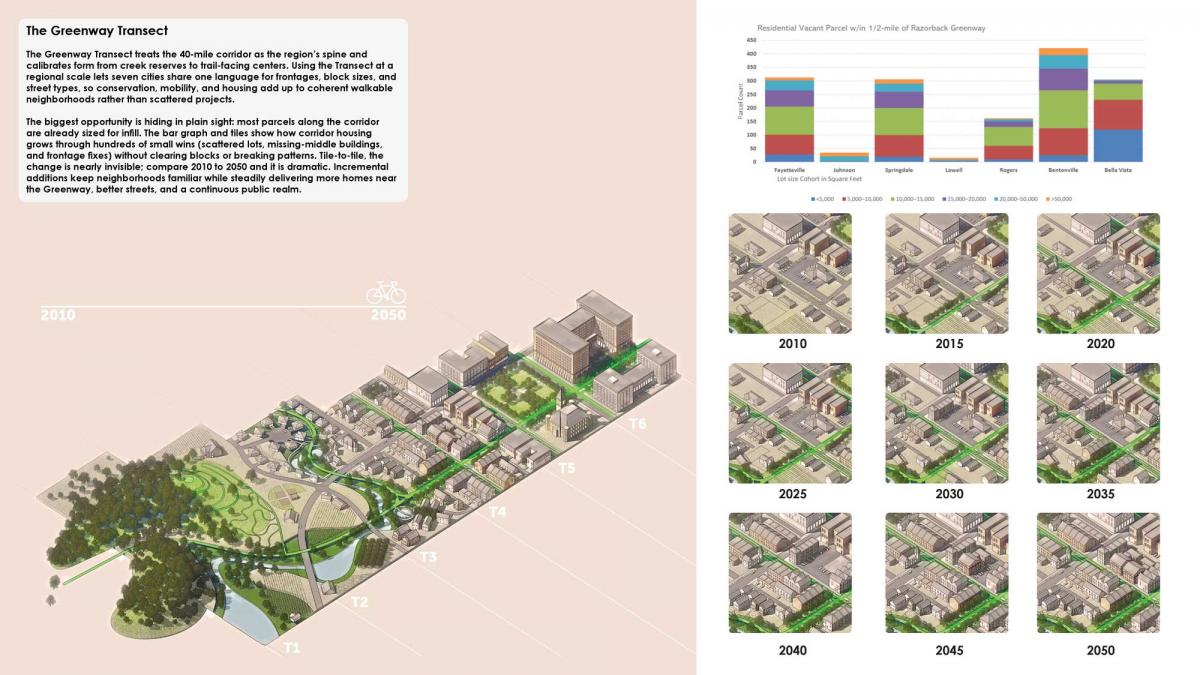
The team explains three key concepts for mixed-use development along the corridor:
- The Greenway Transect (T1–T6) treats the corridor as the region’s spine and calibrates the rural-to-urban character of places, from creek reserves to trail-facing centers. Using the Transect at a regional scale gives seven cities a shared language for block sizes, street types, and frontages, so conservation, mobility, and housing add up to coherent walkable neighborhoods rather than scattered projects.
- Incremental infill is one of the biggest opportunities hiding in plain sight, as most corridor parcels are already appropriately sized for infill. The project illustrates how hundreds of small developments, parcel by parcel, can accommodate significant growth without erasing existing places: a future that’s both resilient and familiar.
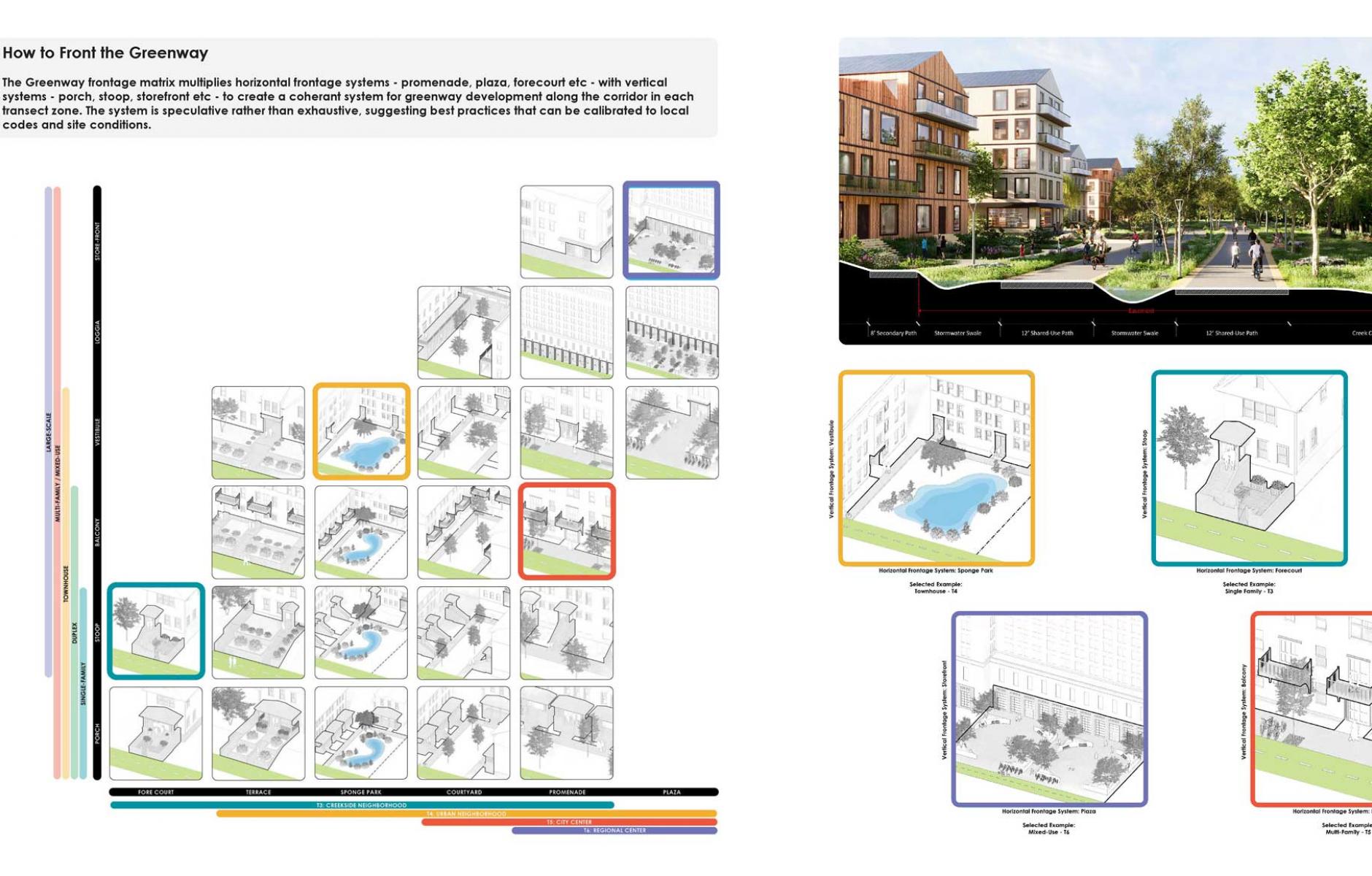
- A frontage and access matrix multiplies horizontal systems (promenade, plaza, forecourt, sponge park) with vertical systems (porch, stoop, storefront) to guide development edge conditions by zone.
The plan allows for an orderly transition from the current built form, often with underutilized parcels or the backs of lots facing the Greenway, to development that fronts the trail and connects to it over time. Transition tools include: eliminate minimum lot area per unit and street-frontage requirements; reduce setbacks (<10 feet); manage parking ratios (≈1:1 in T3–T4; 0.3–1.0 in centers); enable small commercial in higher zones; and provide flexible open-space requirements and affordable-housing bonuses near the spine. Parking/loading diagrams show how both existing and new sites can flip service to alleys or side streets and put front doors on the trail.
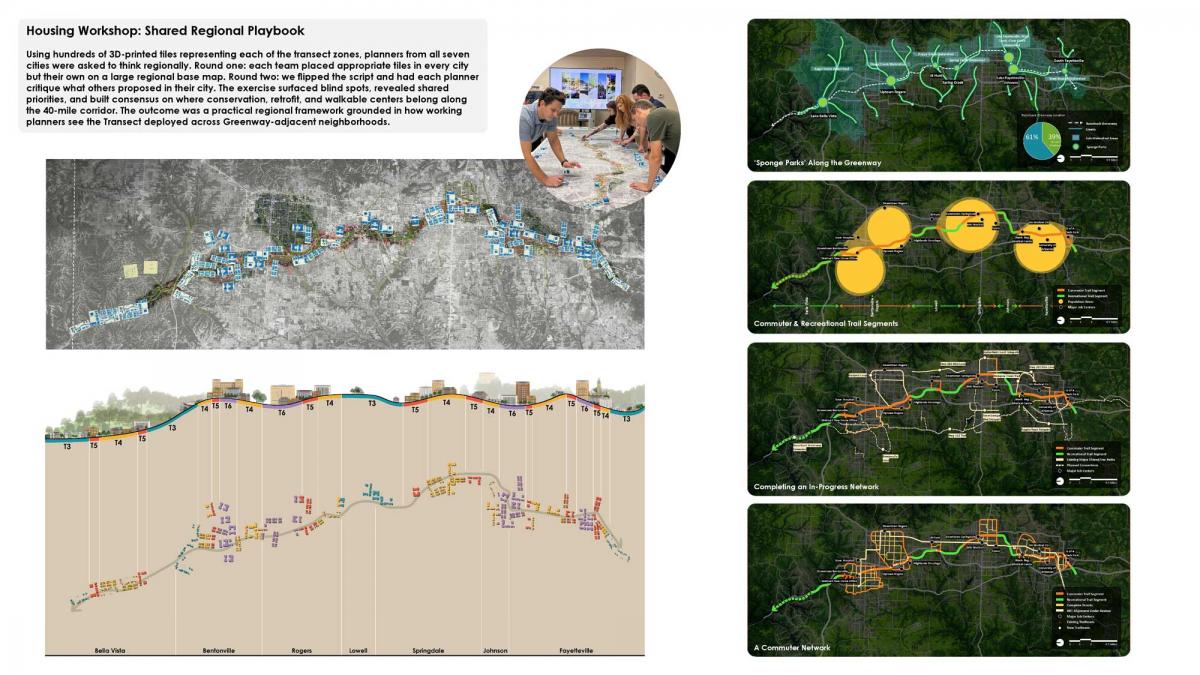
To develop the policy- and site-specific recommendations, the planners conducted a hands-on housing workshop that used hundreds of Transect tiles. Teams from each city placed tiles along the trail in the other cities—not their own—to indicate recommended intensity and character of development. The teams then critiqued the tile placement by other teams in their own city. “This exercise surfaced blind spots, built empathy, and produced a practical, shared regional framework for where conservation, retrofit, and walkable centers belong along the 40-mile corridor,” the planners explain.
Phase one of the Greenway Corridor Plan defines the regional framework and key places. In Phase 2, planners hope to advance policies and design visioning for the key places along the trail. “Together, these elements position the Greenway to do double duty: a beloved recreation asset and the backbone for region-shaping conservation, mobility, and housing,” notes the design team.
The key projects are inspiring because they show how a compact development areas with access to the trail, from villages to walkable neighborhoods to urban centers, could accommodate much of the region’s growth. For example:
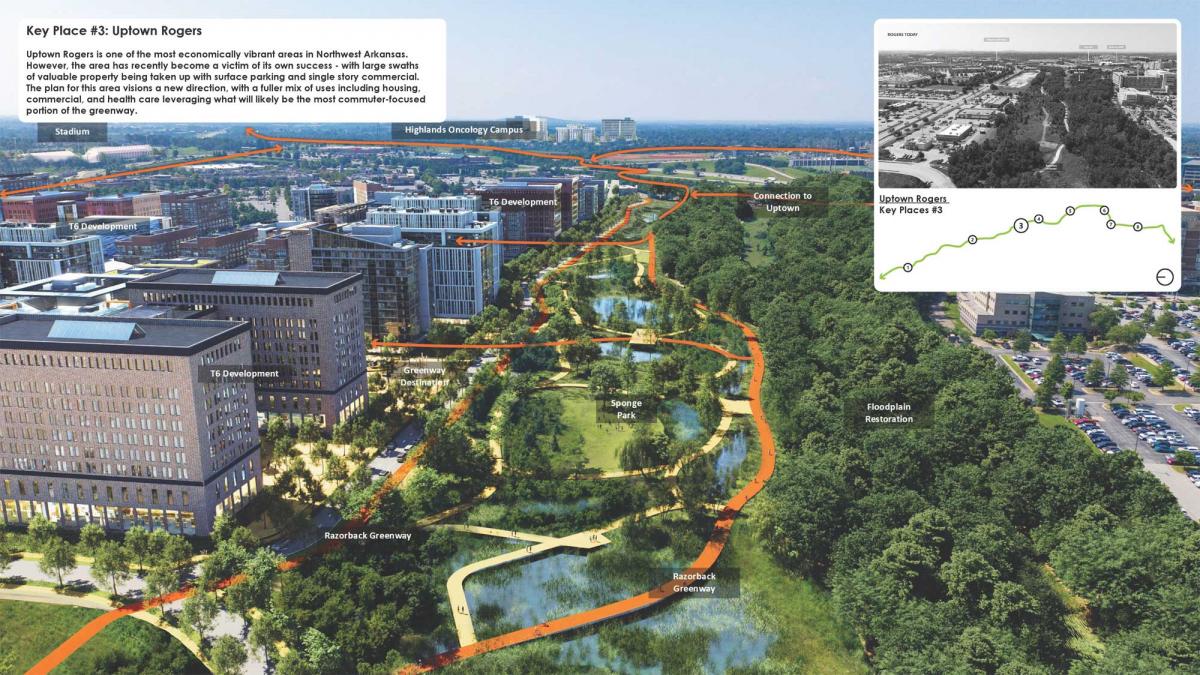
- Key Place #3: Uptown Rogers would make the most of one of the most economically dynamic places in Northwest Arkansas, but is currently being built with too many single-story buildings and parking lots. “The plan for this area envisions a new direction, with a fuller mix of uses including housing, commercial, and health care, leveraging what will likely be the most commuter-focused portion of the Greenway.”
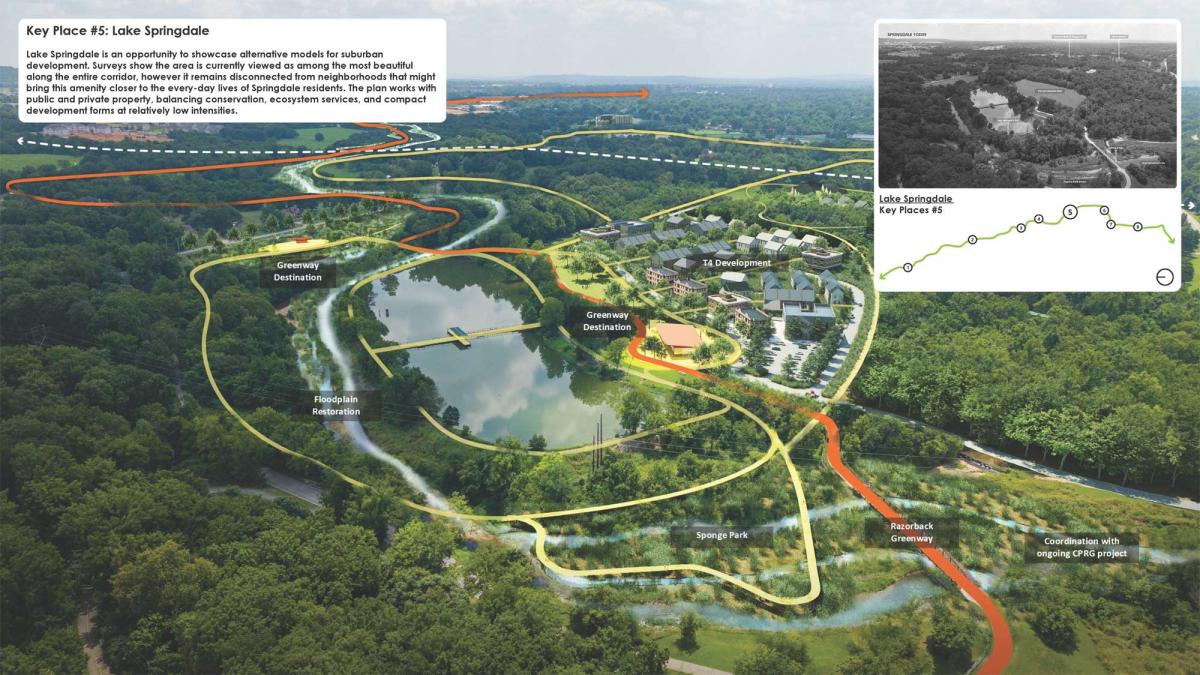
- Key Place #5: Lake Springdale offers a chance to explore alternative modes of suburban development, such as a walkable village, at a destination spot along the Greenway.
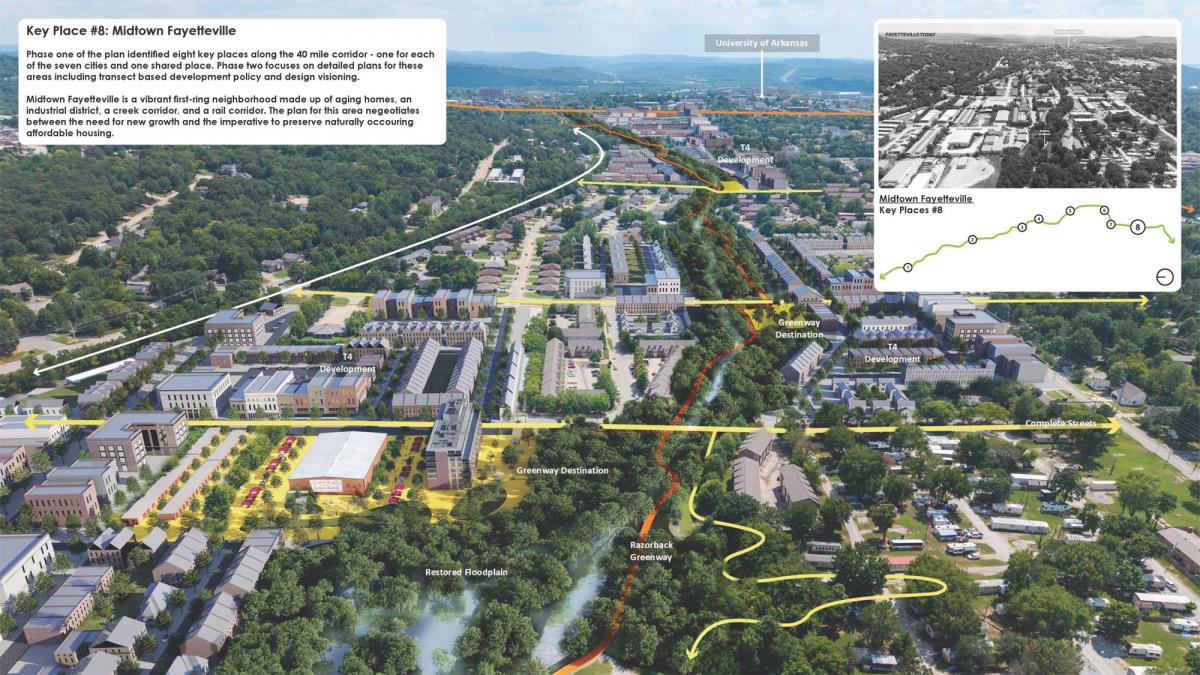
- Key Place #8: Midtown Fayetteville “is a vibrant first-ring neighborhood made up of aging homes, an industrial district, a creek corridor, and a rail corridor. The plan for this area negotiates between the need for new growth and the imperative to preserve naturally occurring affordable housing.”
Northwest Arkansas is one of the fastest-growing regions in the US, with an opportunity to change development patterns to build more livable, healthful, and economically and ecologically sustainable cities. With this plan, the Razorback Greenway becomes the organizing framework for that transformation.
“More people move into Northwest Arkansas every day,” said The Arkansas Democrat-Gazzette. “An extensive system of trails can influence, for example, where they'll live. Easy access to a trail system that makes A-to-B movement—as opposed to just recreational movement—a possibility can change the way the region develops.”
Razorback Greenway Corridor Plan
- Field Operations, Blockwright Principal firms
- Field Operations, Lead consultant
- Blockwright, Housing consultant
- Northwest Arkansas Regional Planning Commission, Client
- Matthew Petty, Project planner
- Mary Madden, Policy analyst
- Neil Heller, Development analyst
2026 CNU Charter Awards Jury
- Eric Kronberg (chair), Principal, Kronberg Urbanists + Architects in Atlanta, GA
- Majora Carter, CEO of Majora Carter Group in the Bronx, New York City
- Marques King, Studio Director + Senior Architect, Pure Architects, Detroit, MI
- Jeremy Lake, Principal, Union Studio Architecture & Community Design, Providence, RI
- Joanna L. Lombard, Distinguished Professor at the University of Miami School of Architecture, FL
- Rico Quirindongo, Director, City of Seattle Office of Planning and Community Development
- Ashley Terry, Director, President of Development at Pivot Real Estate, Oklahoma City, OK