Infill and greenfield: two sides of more sustainable growth


The Impact of New Urbanism in Northwest Arkansas:
CNU is proud to present this article as the fifth of a 5-part series documenting the impact of New Urbanist principles, as presented at CNU34.Northwest Arkansas. Over five articles, we reflect on key reforms including public infrastructure investments, parking and traffic, and context-sensitive density—issues that are critical to the healthy growth of neighborhoods, cities, and towns across Northwest Arkansas, and in so many rapidly growing places across the country. This series serves as a lasting resource to those who may not have been able to attend CNU 34, and demonstrates CNU's commitment to ensuring that Northwest Arkansas has a future built on New Urbanism long after this year's transformative Congress. This series will be available for download as a complete Report on CNU 34.Northwest Arkansas following publication. ~ Mallory Baches, CNU President
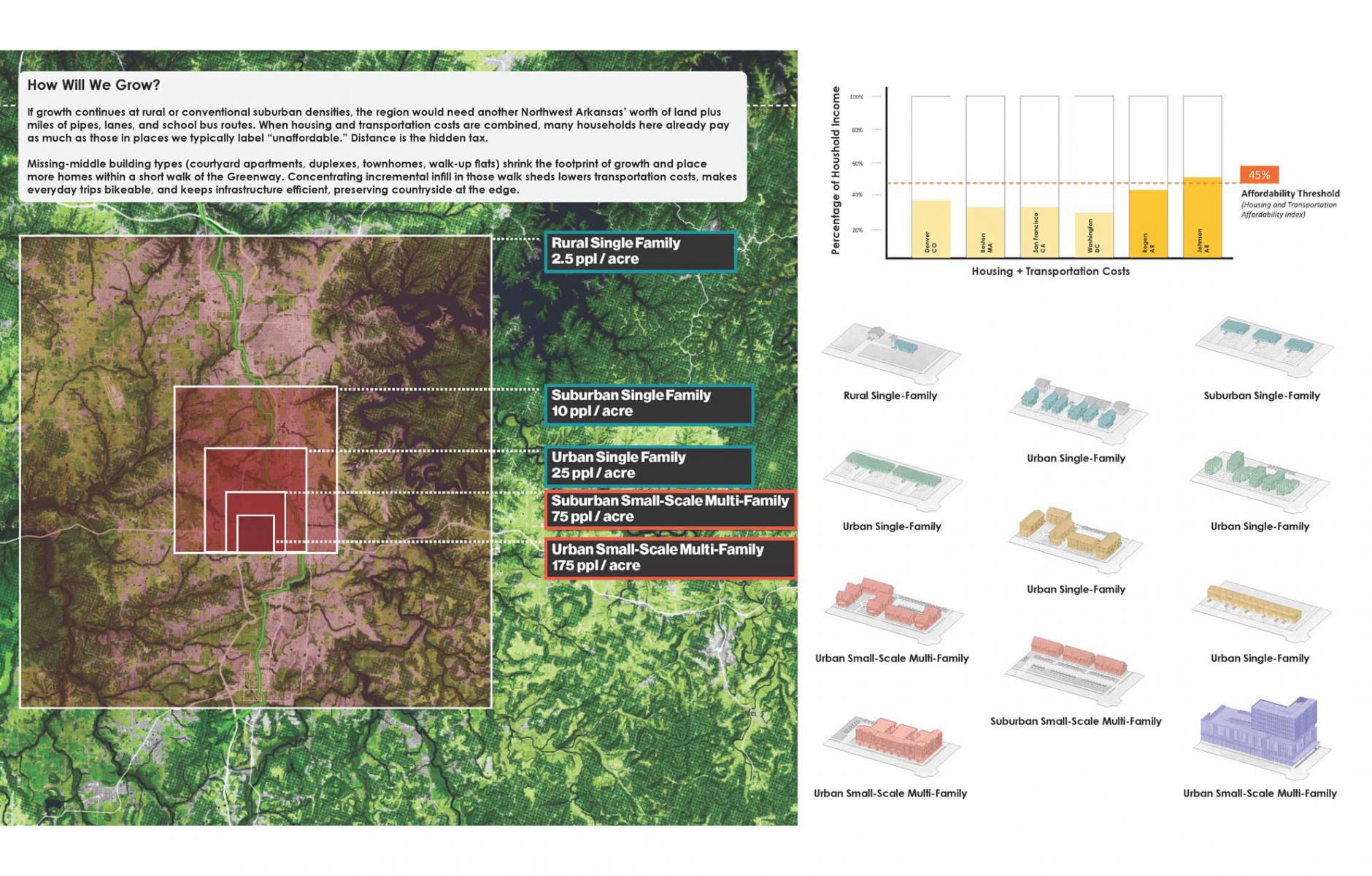
There’s an image from the Razorback Greenway Corridor Plan1 that strikingly illustrates the challenge Northwest Arkansas faces, as its population is projected to grow from 622,000 now to more than a million in 2050. The image at the top shows the amount of land used by that population growth under different forms of residential development.
The most common types of housing in the region are rural and suburban single-family homes, which, as the graphic shows, take up disproportionately large swaths of real estate. “If growth continues at rural or conventional suburban densities, the region would need another Northwest Arkansas worth of land plus miles of pipes, lanes, and school bus routes,” note the planners.
The current patterns of growth are inefficient in their demands for infrastructure and services—and also affect the regional landscape. “These patterns [of development] fragment working lands, create conflicts with rural ways of life, and make farming difficult to sustain,” notes Growing Home NWA2, the regional growth strategy completed in 2026. “At the same time, Northwest Arkansas residents consistently identify natural beauty and rural character as the region’s most important qualities to protect.”
By contrast, “missing middle” types like courtyard housing, townhouses, and small apartment buildings, shown in the image as “suburban small-scale multifamily” and “urban small-scale multifamily,” use land far more efficiently. Even “urban single-family,” built in walkable neighborhoods, takes up less space and uses fewer miles of public infrastructure.
While development used to be concentrated in the region’s four largest cities—Fayetteville, Springdale, Rogers, and Bentonville—it is now spilling out across the region. Development is occurring in more than 30 cities, including the primary cities, as well as in unincorporated areas. Infill strategies alone will not do the job. Northwest Arkansas needs better greenfield growth as well.
Promoting infill
The city’s largest cities are successfully promoting infill development, but this needs to happen on a larger scale, according to Duke McLarty, executive director of Groundwork, a nonprofit that promotes mixed-income, walkable, transit-accessible neighborhoods in NWA. “All four of the major cities are taking steps in the direction of good infill development,” McLarty says. “Nobody is going in the wrong direction. The pace at which they are moving raises concerns about whether they have the impact they could. I don’t think they are being aggressive enough.”
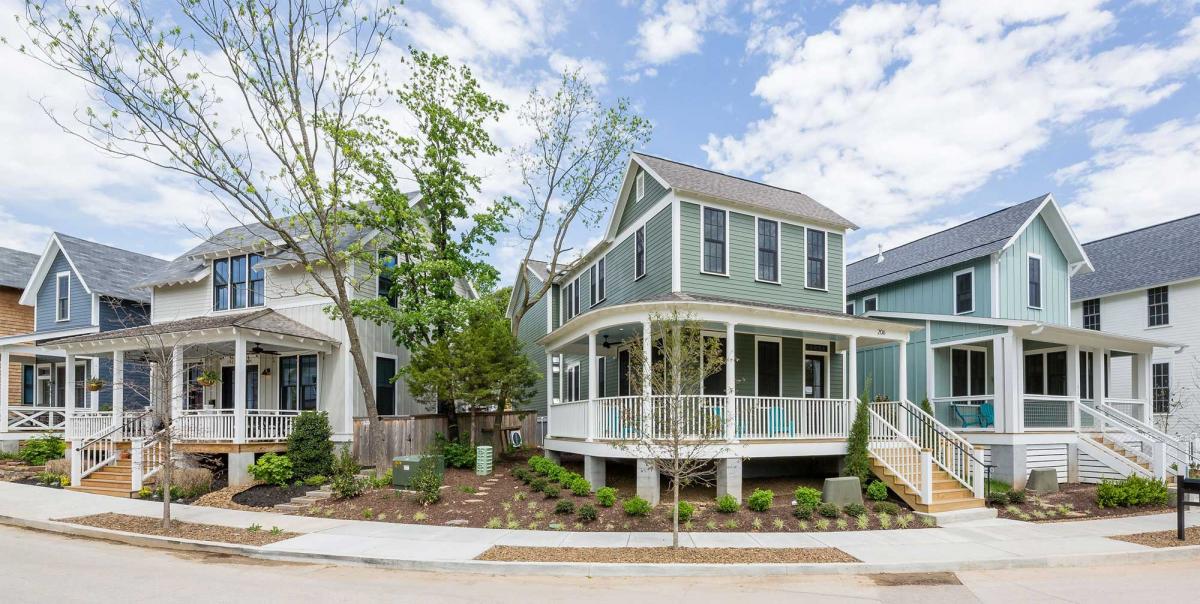
Rogers3 and Bentonville4 have both adopted new zoning and development codes, based on the rural-to-urban Transect—an idea that promotes a full range of walkable place types. Additionally, Rogers has eliminated parking requirements and recently adopted pre-approved building plans that make small-lot and missing-middle housing types easier to build. All of the larger cities have promoted infill development and taken steps to reform zoning, often in downtown areas and specific neighborhoods. You can see the results in the major downtowns, which have seen considerable development and improvements to public spaces over the last decade. NWA’s efforts to promote missing middle housing are reported in “How housing affordability relates to choice.”
Not all infill development in the largest cities is well designed or sustainable, McLarty emphasizes. A substantial portion is still conventional suburban single-family in places that lack walkability, he says. Development opponents, sometimes called NIMBYs (not-in-my-backyarders), are often effective in stopping compact growth, he adds. To gain community buy-in, effective communication strategies must convey the value of walkable urbanism to skeptical stakeholders and the public.
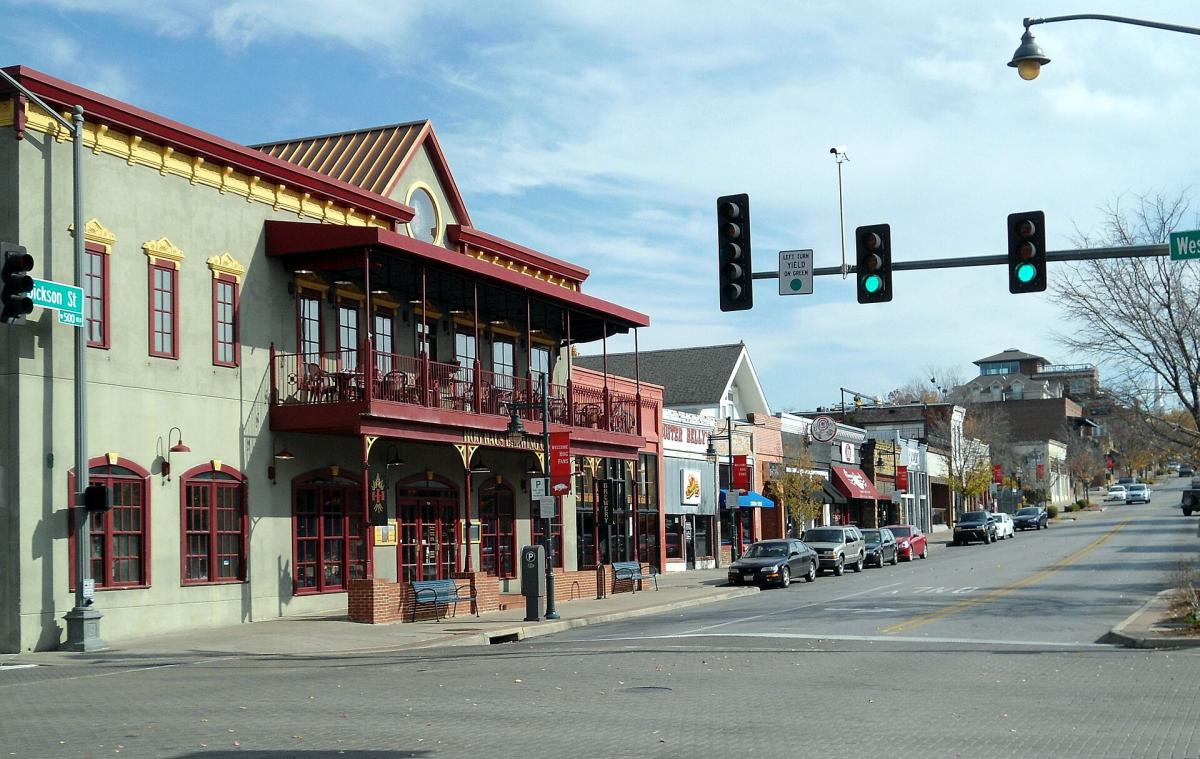
At the same time, the majority of the region’s growth has shifted to the outlying municipalities, which are largely growing in conventional suburban patterns. This growth needs to be shifted into compact, walkable centers and neighborhoods. If not, the region risks blurring all of the lines between its developed areas, countryside, and natural areas into one massive sprawling region.
Reforming greenfield growth
The shift in greenfield development is beginning. The region has a few models to show the way, including Johnson Square5, a traditional neighborhood being built by Ward Davis, a New Urbanist and Lifetime Member of CNU, in the City of Johnson. A small city between Fayetteville and Springdale, Johnson was entirely rural in 1990 and has no historic downtown. Being built on both sides of Johnson Mill Boulevard, a suburban arterial, Johnson Square is designed around a central green. The community demonstrates the range of housing types needed over the next couple of decades, including single-family houses on urban lots, multiplex units, townhouses, courtyard cottages, and residential units above commercial space in a main-street format.
Johnson Square is one of the “centers in progress” identified by Growing Home NWA. DPZ CoDesign, the lead author of the report, reviewed development patterns across Northwest Arkansas and identified more than 20 places that function as mixed-use centers, or could fill this role with targeted investment. Another 20 sites were identified as potential centers—bringing the total to more than 40 locales to attract compact growth. Growing Home NWA, presented at CNU 34 and commissioned by the NWA Council, is the region's roadmap for sustainable growth.
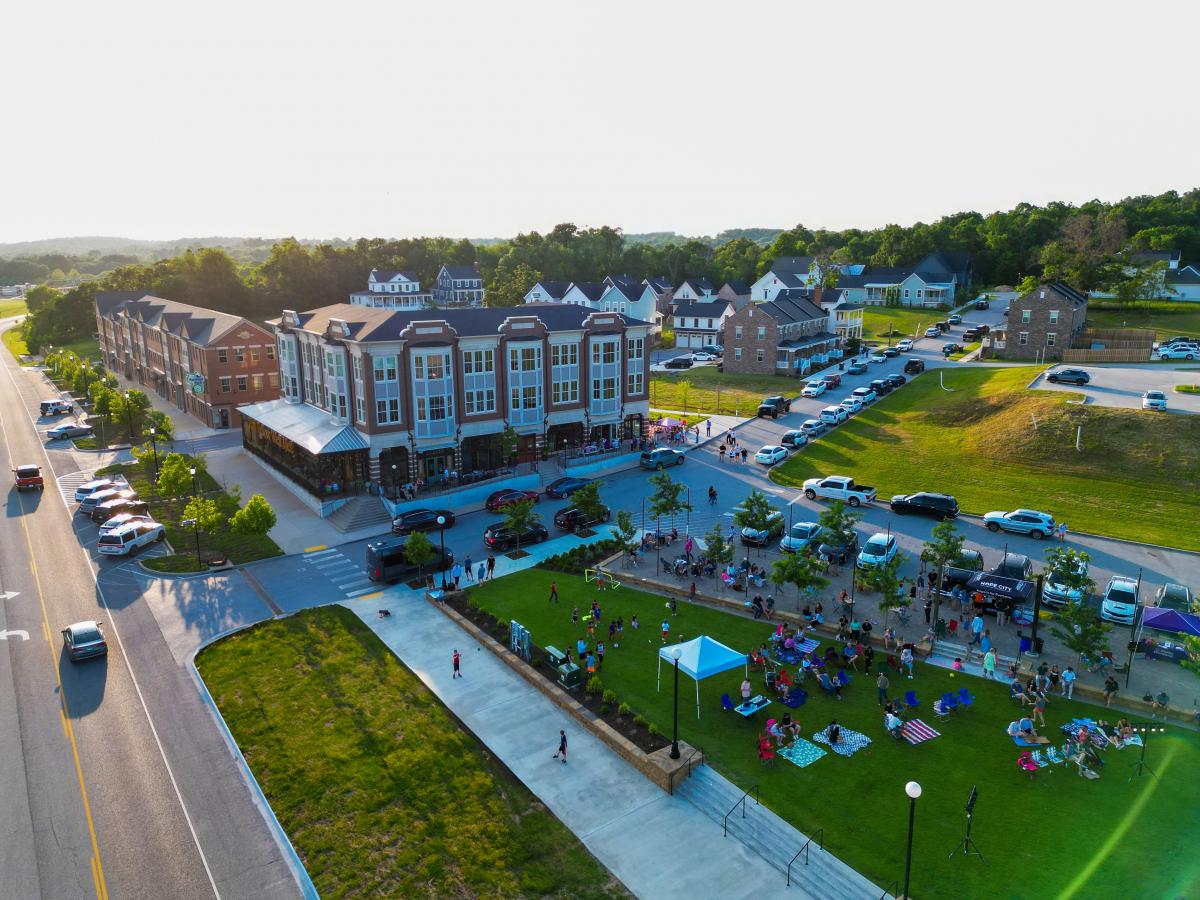
These walkable urban centers include both greenfield and infill sites across the region. They have the potential to accommodate a good portion of the region’s growth through 2050 throughout diverse place types, from villages in the country to major downtowns—serving a broad range of lifestyles. However, it is one thing to identify the ideal locations for growth and set a vision—and another thing to implement growth in these places.
Low-density growth in isolated subdivisions has a 50-year head start—so how can the region promote compact, walkable growth in centers? In the largest cities, the region has already made significant progress over the last 10 years. In the outlying cities, it starts with a vision, notes Wes Craiglow, executive director of the Urban Land Institute Northwest Arkansas, a group that represents developers. The organization has a Plan Local program that focuses on cities with populations under 30,000, recognizing that they have fewer planning resources than larger cities.
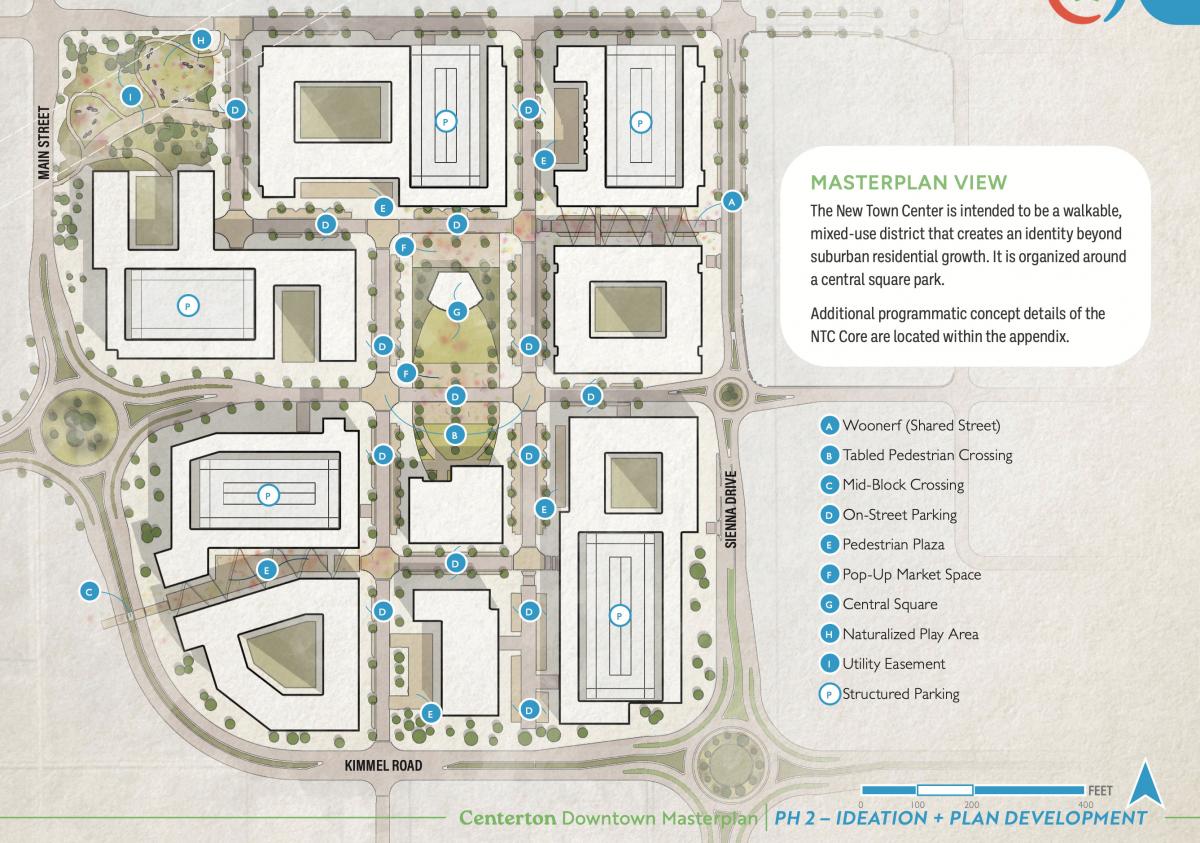
ULI NWA conducts a public process and develops a plan to create mixed-use walkable centers. A good example is Centerton, probably the fastest-growing city in the region (by percentage increase). Located southwest of Bentonville, Centerton has no historic downtown—the city has just been trying to keep up with its proliferation of subdivisions in the last 20 years. Plan Local worked with the city to create a Downtown Master Plan6 that envisions a street grid and downtown built from scratch around a public space.
Another example is Pea Ridge, northeast of Bentonville, where Mayor Nathan See is actively promoting "missing middle" housing as a core strategy to handle the city's rapid population growth while maintaining housing affordability. By collaborating with organizations like Groundwork and the Walton Family Foundation, See is advocating for diversified housing options—such as duplexes, townhomes, and courtyard apartments—that bridge the gap between single-family homes and mid-rise complexes.
Ahead of the recent Congress, CNU sponsored Legacy Projects7, which employ the organization’s placemaking skills to make a long-term impact on the host region. Two of the three Legacy Projects envisioned mixed-use walkable villages in suburban-rural areas. In Cave Springs8, the downtown master plan enables the revitalization of a Main Street corridor and the addition of adjacent missing-middle housing. The state DOT is rerouting a section of highway around the village by installing roundabouts, allowing the center to be reclaimed for pedestrian use. In Elm Springs9, the Legacy Project team designed a 61-acre village at a rural crossroads. Both of these plans involved significant public input. A robust public process is essential to develop a vision—otherwise, opponents will block any proposal. Furthermore, regulations have to change, Craiglow says. “Most cities’ zoning models don’t allow it,” he says.
Sending a signal
But that’s not all, because the city needs to send a clear signal to developers: This is what the city wants. “The planning process can be a signal, but nothing sets the conditions for development like public infrastructure investment,” Craiglow says. “The city needs to go first.” The city’s job is to invest in the public realm. Do new street connections need to be created? Is traffic calming required? Does the plan call for a new public space? A significant impetus for redevelopment of the larger downtowns has been investment in streets and parks.
How that funding is raised is another issue. Arkansas lacks an effective tax-increment financing (TIF) program because school taxes are excluded, McLarty says. But Ballot Issue 3 this November would allow cities to set up “economic development districts” to fund investments in urban centers. “I think it would be incredibly helpful,” he says.

Finally, a willing developer must be found. While most developers in NWA know how to build conventional suburban product, a growing number are willing and able to build more compact forms. “There are developers doing exceptional work, at varying scales, from the neighborhood, the block, to the parcel,” Craiglow says. Some suburban developers are learning urbanism, some are moving in from other regions because they see opportunities, and some people who have never developed are getting into the field, he says.
Development along a corridor is another force that can spur compact housing types. In NWA, the most important new piece of linear infrastructure shaping land use is the Razorback Greenway. The Greenway is 40 miles long and goes through seven cities, including the four largest. It was completed in 2015, but it has already proven to be an important amenity for development. The above-mentioned Corridor Plan, sponsored by the Northwest Arkansas Regional Planning Commission, shows how the corridor in the immediate vicinity of the Greenway could accommodate a substantial portion of the region’s growth in the coming decades. “The biggest opportunity is hiding in plain sight: Most parcels along the corridor are already sized for infill,” the planners note.
Retrofit potential
There’s one other area that offers potential for substantial infill growth: Suburban retrofit. NWA has major corridors lined with suburban commercial and asphalt parking lots, often underutilized. Highway 71b extends 30 miles from Fayetteville through Rogers, a classic “stroad” with commercial frontage along most of its length. To say 71b has capacity for residential development is an understatement. McLarty, whose organization has done planning work along the highway, says that only about 10 percent of 71b is zoned for residential use. That could easily be expanded.
Fayetteville, where the highway is called College Avenue, recently rezoned it to allow residential use. No developers have yet drawn up any plans to take advantage of the rezoning. It appears to be a risk calculation by developers, as no one has proven the concept. They don’t know how hard it will be to get entitlement, or whether the units will be popular. McLarty believes that incentives are necessary to get developers interested, but if this ever takes off, the potential is almost unlimited. There are many such corridors in the region, including Highway 265, which parallels 71 B about a half mile to the east. Since I-49 was built in the late 1990s, these roads carry mostly local traffic.
Across the US, aging suburban retail corridors are being reimagined as vibrant, walkable centers. There are many practical strategies for transforming conventional suburban fabric, retail strips, and big-box sites into mixed-use, human-scaled communities. Design, zoning reform, and public-private partnerships promote incremental infill that can revitalize these areas. These efforts are enabled by recent state laws like Texas SB 840, adopted in September, 2025, allowing by-right multifamily and mixed-use residential development in areas previously zoned for commercial, office, retail, or warehouse use.
With comprehensive policies and plans, infill development could capture up to two-thirds of the market in Northwest Arkansas. Regardless of whether it is infill or greenfield growth, design is important. With design that emphasizes walkable neighborhoods and mixed-use centers, NWA can avoid a future in which the urbanized footprint doubles to accommodate growth over the next quarter-century.
About more than character
This is only partly about preserving rural character. The more important issue is how the region can improve the lived experience of its citizens even as it grows, Craiglow says. This raises questions such as whether you are stuck on a single-loop road or cul-de-sac with nowhere to go unless you drive; whether children depend on someone to drive them everywhere, including to school. Conversely, can they walk or ride a bike to a park? Can you walk out your front door and get to a restaurant, local pub, or buy a gallon of milk? Can you ride your bike to a trail that will take you miles along beautiful scenery? The lived experience of walkable places, connected to nature, is vastly different from that of automobile-dependent subdivisions.
Preserving “character” is a legitimate concern, especially when vast swaths of countryside are being eaten up by needlessly spread-out development, and yet the word sometimes is misunderstood based on a nostalgic view of the past. Craiglow prefers a forward-thinking focus on lived experience. “The character of Bentonville has changed,” he says, and that may upset some residents. “But I can show you how the lived experience in many ways has improved over the last 25 years.” Cities are always changing, but are they changing for the better?
NWA is a proving ground for more sustainable patterns of development, which also raise the quality of life and lived experience. It is important for Northwest Arkansas to succeed in its quest for a better built environment—not just for its own sake, but for the US as a whole. Because if it can’t happen in NWA, where can it happen?
The region has many advantages in implementing mixed-use, walkable development. The region has corporate, philanthropic, political, and nonprofit leadership that recognizes the value of urbanism. The region has a “road map,” Growing Home NWA, based on New Urbanism, to guide leaders. Many of the cities have begun to change their land-use regulations in positive ways. It has a development industry with a growing appetite for mixed-use urbanism. In short, NWA is poised for growth while also preparing for it. This region can lead the way for the nation as a whole.
References
1Steuteville, Robert, “Organizing regional growth around a bike-ped trail,” Public Square, May 6, 2026
2Growing Home NWA website, www.growinghomenwa.com, 2026
3Steuteville, Robert, “District transformation starts with streets, blocks,” Public Square, April 8, 2026
4Steuteville, Robert, “City adopts code for compact, sustainable growth,” Public Square, April 22, 2026
5Johnson Square website, https://www.johnsonsquare.com
6Centerton, Arkansas, website, https://centertonar.us, 2026
7CNU website, Legacy Projects, cnu.org, 2026
8Steuteville, Robert, “Reclaiming a Main Street as a walkable center for growth,” Public Square, May 12, 2026
9Steuteville, Robert, “Mixed-use village planned at rural crossroads,” Public Square, March 12, 2026