Citywide strategy to promote Missing Middle housing


Sacramento, California, is implementing a nationally significant strategy to promote Missing Middle housing to meet a target of 45,580 new housing units citywide this decade. As the author of this strategy, which aims to provide more than 25,000 low- to moderate-income living spaces, Opticos Design was recognized by the 2026 CNU Charter Award jury.
The Missing Middle Strategy addresses rising housing costs in the City of 525,000 people. Affordability plummeted by 44 percent from 2011 to 2020, followed by a 19 percent increase in rents from 2021 to 2022, according to Opticos, which teamed with Cascadia Partners, the financial and displacement-risk analyst for the project.
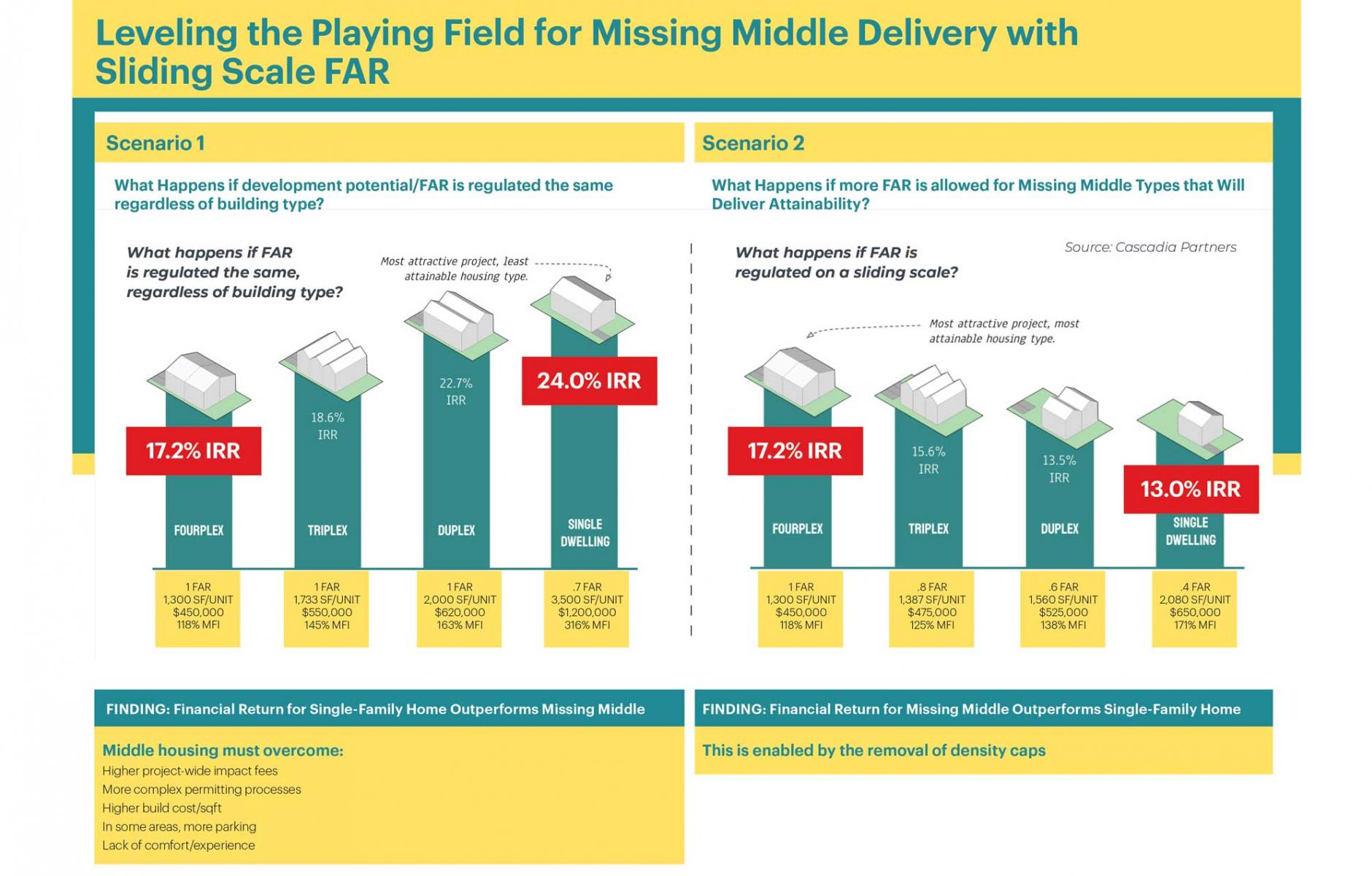
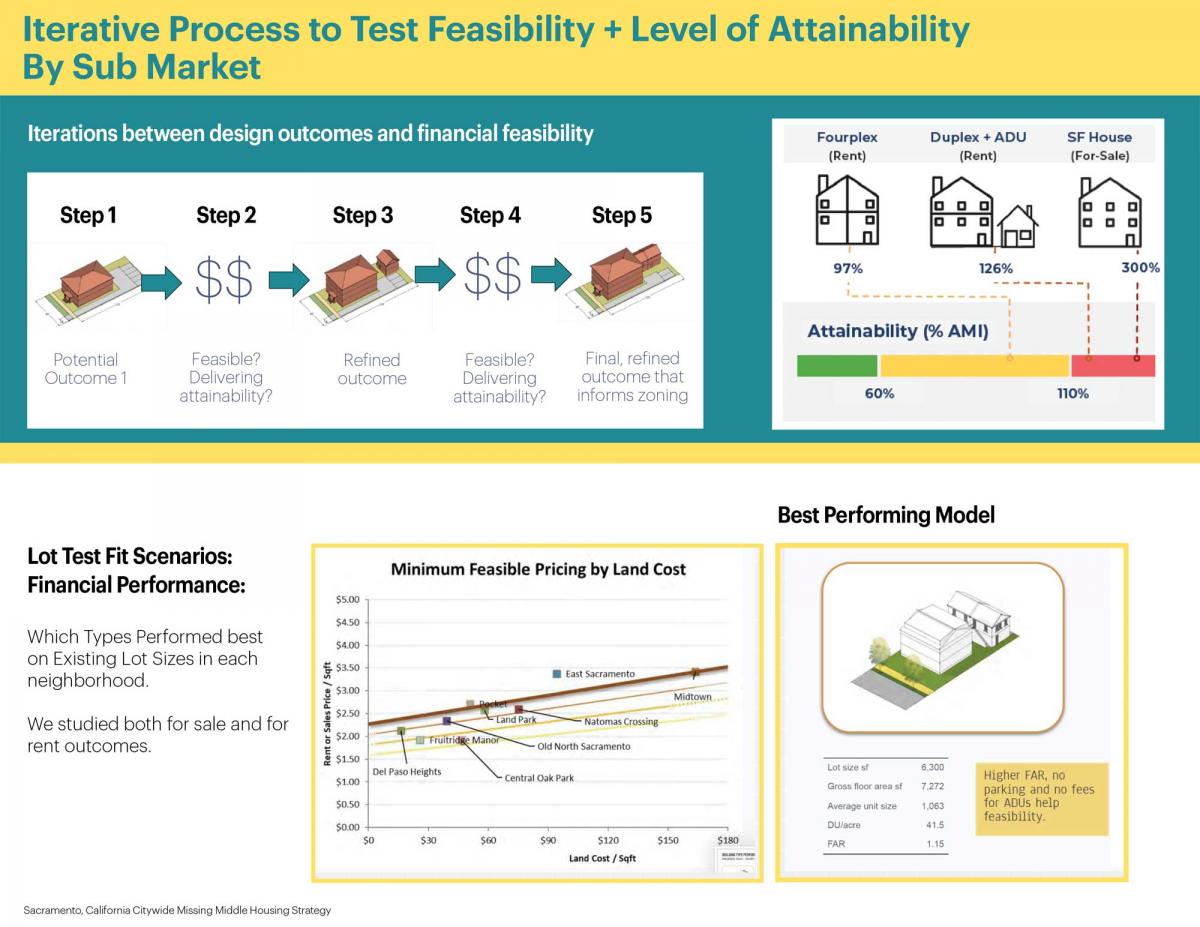
A key feature of the Missing Middle Strategy is the use of a sliding-scale floor-area ratio (FAR) system to promote more affordable Missing Middle types. A citywide pro forma analysis revealed that under former, outdated density caps, the most profitable housing type on a given lot was a $1.2 million luxury single-family house. McMansions easily outdistanced more affordable residential types, but the new regulations flip that outcome (see image at top).
“The FAR system allows, for example, a fourplex to achieve a 1.0 FAR, while a single-family home is limited to 0.4—making multi-unit housing more viable and affordable,” the team explains. The four-plex tops affordability metrics. “We call this the Missing Middle sweet spot of feasibility, attainability, and livability,” says Opticos founder Dan Parolek. Adding to that, a local bonus program was introduced for projects with fewer than five units, offering additional FAR and lot coverage in exchange for deed-restricted affordable housing, the team reports.
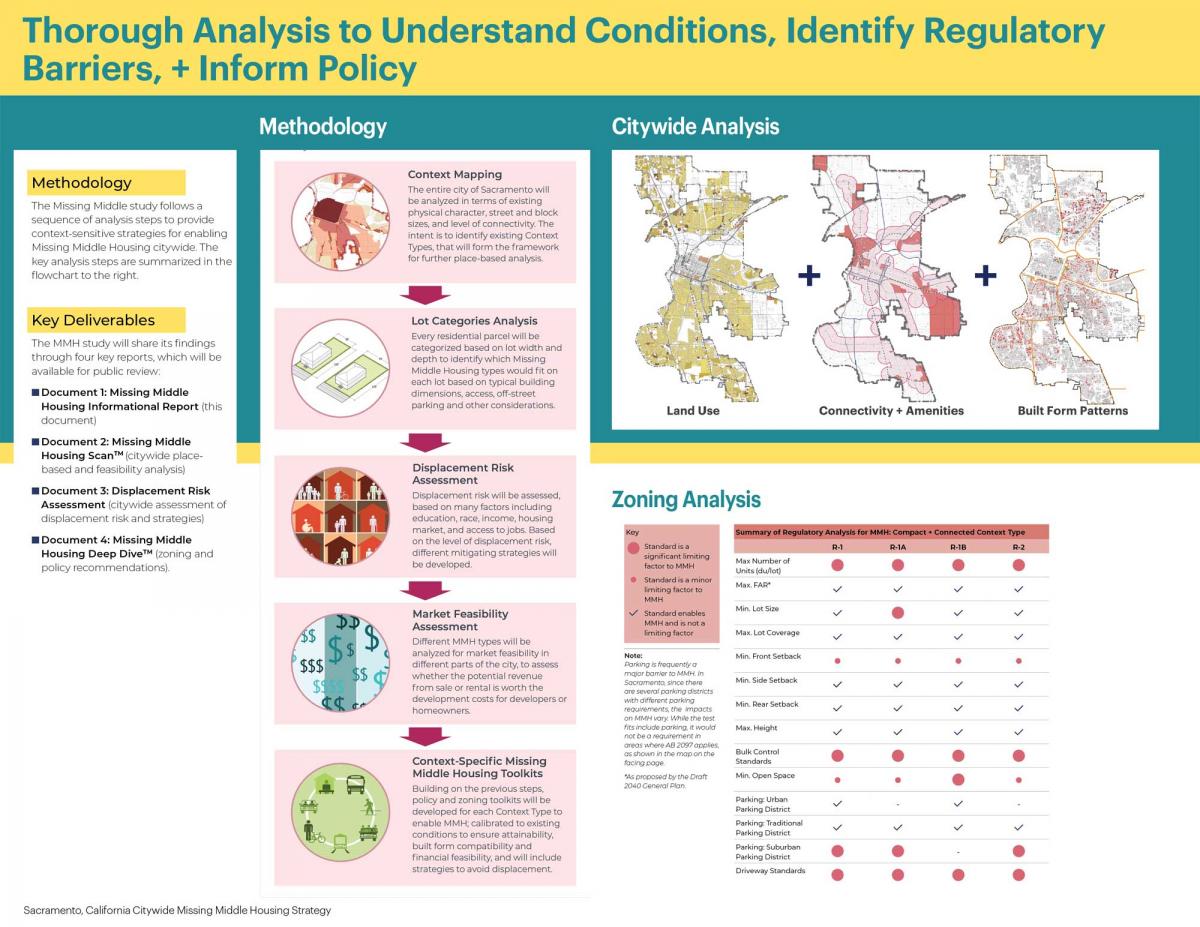
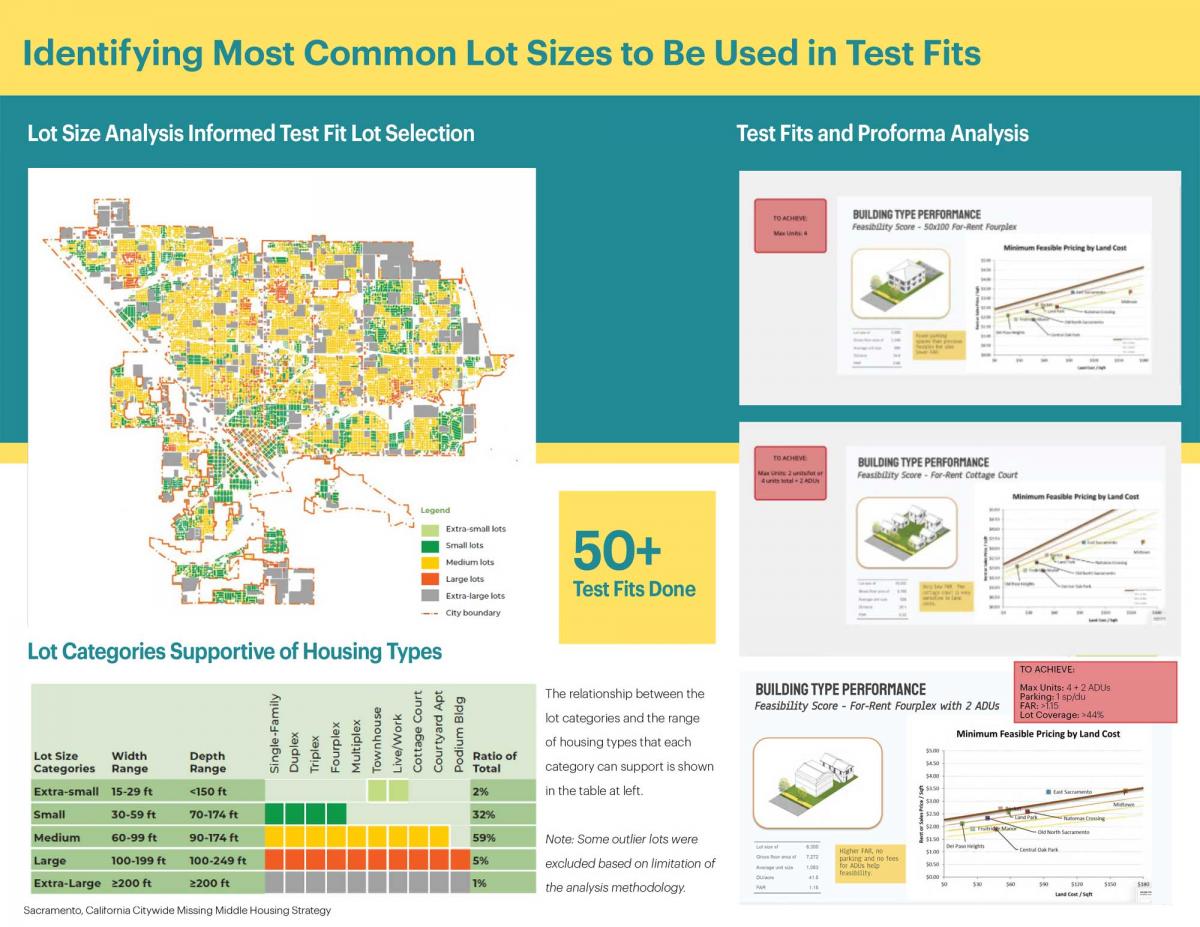
Sacramento’s physical context includes historic neighborhoods, suburban subdivisions, and transit-rich corridors. The strategy covered Sacramento’s 100 square miles, and focused on four residential zones (R-1, R-1A, R-1B, R-2), where 65 percent of housing is single-family. The team categorized every residential parcel by lot width and depth to determine which Missing Middle housing types would work. The scale of that analysis was ambitious and unusual. Visualizations and test fits demonstrated how Missing Middle types, like a fourplex plus accessory dwelling unit, can integrate into existing neighborhoods.
The team also produced a technical report on displacement risk, ensuring that policies would not push historically marginalized residents out of their communities. Displacement risk was assessed based on many factors, like education, race, income, housing market, and access to jobs. The study showed that 88 percent of new housing avoids high-vulnerability communities.
The displacement risk analysis was part of an inclusive public engagement program. The City partnered with local organizations such as Unseen Heroes to lead outreach efforts, ensuring residents were informed and involved throughout the process. This approach reflects the Charter of the New Urbanism’s emphasis on participatory planning and the importance of local knowledge in shaping policy, Opticos explains.
The projected outcomes for housing include:
- 10,463 very low-income units
- 6,306 low-income units
- 8,545 moderate-income units
- 20,266 above-moderate-income units
Initiated in 2022 and adopted in 2024, the policy eliminates single-family zoning citywide and legalizes small-scale multi-unit housing—such as duplexes, fourplexes, cottage courts, and townhouses—in every neighborhood.
“This overall policy is profoundly positive for our city,” says Mayor Darrell Steinberg. “It distinguishes Sacramento from many other cities around the nation by supporting several and creative home styles in traditionally single-family areas.”
The strategy’s core goals include:
- Expanding housing choice and attainability
- Promoting racial and economic equity
- Supporting intergenerational living and passive income
- Empowering local builders and homeowners
“It offers a replicable framework for other cities seeking to address affordability, displacement, and climate resilience through neighborhood-scale urbanism,” the design team explains.
Sacramento CA Citywide Missing Middle Strategy
- Opticos Design, Principal firm
- Cascadia Partners, Project partner, displacement risk analysis, financial feasibility analysis
- Unseen Heroes, Public engagement
- Collaborative Design + Innovation, Public engagement strategy
2026 CNU Charter Awards Jury
- Eric Kronberg (chair), Principal, Kronberg Urbanists + Architects in Atlanta, GA
- Majora Carter, CEO of Majora Carter Group in the Bronx, New York City
- Marques King, Studio Director + Senior Architect, Pure Architects, Detroit, MI
- Jeremy Lake, Principal, Union Studio Architecture & Community Design, Providence, RI
- Joanna L. Lombard, Distinguished Professor at the University of Miami School of Architecture, FL
- Rico Quirindongo, Director, City of Seattle Office of Planning and Community Development
- Ashley Terry, Director, President of Development at Pivot Real Estate, Oklahoma City, OK