The outsized impact of social infrastructure


The Impact of New Urbanism in Northwest Arkansas:
CNU is proud to present this article as the fourth of a 5-part series documenting the impact of New Urbanist principles, as presented at CNU34.Northwest Arkansas. Over five articles, we reflect on key reforms including public infrastructure investments, parking and traffic, and context-sensitive density—issues that are critical to the healthy growth of neighborhoods, cities, and towns across Northwest Arkansas, and in so many rapidly growing places across the country. This series serves as a lasting resource to those who may not have been able to attend CNU 34, and demonstrates CNU's commitment to ensuring that Northwest Arkansas has a future built on New Urbanism long after this year's transformative Congress. This series will be available for download as a complete Report on CNU 34.Northwest Arkansas following publication. ~ Mallory Baches, CNU President
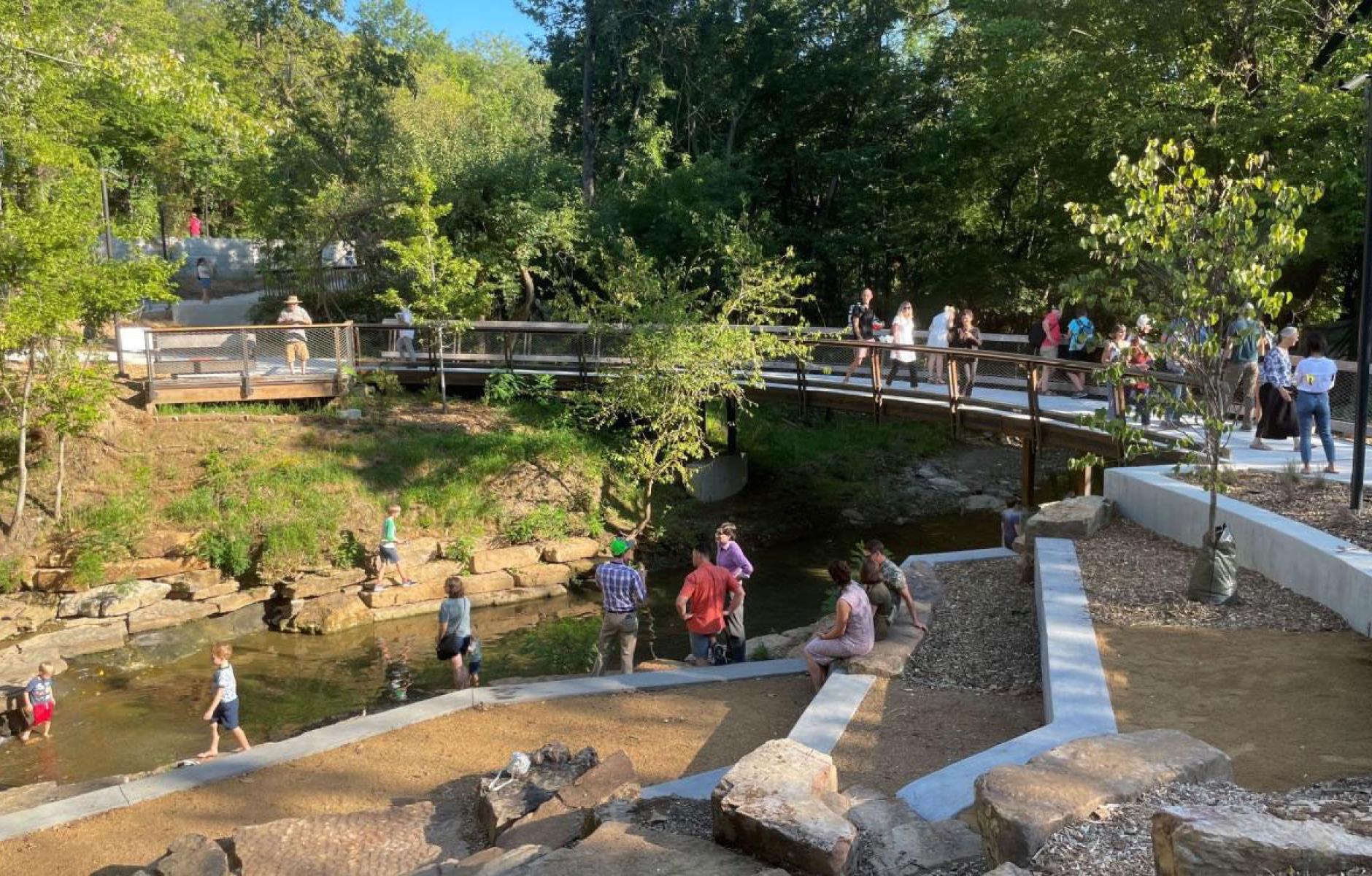
Roads, bridges, water and sewer pipes—these come to mind when we say “infrastructure.” And then there is “social infrastructure”—e.g., the parts of our built environment, such as parks, playgrounds, civic buildings like libraries, or Main Streets, that serve as shared spaces where people may meet in the public realm.
“Social infrastructure,” sociologist Eric Klinenberg told CNU 34 in Northwest Arkansas, gets less attention than asphalt, pipes, and concrete beams—engineers don’t grade it or systematically analyze whether it needs maintenance. And yet there is strong evidence that the social aspects of cities are critically important to welfare—i.e., health, happiness, and well-being.
Cities and towns are called “communities,” a term that emphasizes social interaction. There is nothing more important to health and life—as Klinenberg demonstrates in a landmark study1 of Southside Chicago neighborhoods during a historic, deadly 1996 heat wave. The Englewood death rate was 33/100,000 population, among the highest in the city. In Auburn-Gresham, where a "viable social infrastructure" survived with small commercial establishments that draw the elderly out of their homes into public life, the death rate was 3/100,000 — among the lowest in the city. “The key difference between neighborhoods like Auburn Gresham and others that are demographically similar turned out to be sidewalks, stores, restaurants, and community organizations that bring people into contact with friends and neighbors.”
Social infrastructure is not just important in a crisis. Raj Chetty, professor of economics at Harvard and director of Opportunity Insights, reported at CNU 34 on his recent work2 examining the impact of New Urbanist design on public housing. Setting the urban design guidelines for HOPE VI, a revitalization program for distressed public housing communities, was one of the greatest New Urbanist policy achievements. The $17 billion program lasted from the mid-1990s to 2010, transforming 262 public housing projects nationwide. HOPE VI reduced crime and sparked economic growth, yet the impact on individuals remained elusive and controversial.
Chetty’s Opportunity Insights used big data to study the program’s impact over a 30-year period, putting to rest any questions of the value of HOPE VI. Chetty called it “the most important effort to try to transform high poverty, low opportunity neighborhoods in the US into better places to live.” The key was HOPE VI’s impact on children's upward mobility, which took decades to measure.
Each year of childhood exposure to revitalized public housing raised children’s earnings in adulthood by 2.8 percent, the study found. Those living in revitalized communities from birth earned 50 percent more over their lifetimes. The researchers became convinced that the revitalization was causal when they found that the exposure benefits accrued to siblings. The younger siblings did better because they lived in the HOPE VI projects longer.
Opportunity Insights calculated the program costs at $170,000 per living space, each of which yielded an average annual increase in earnings of $25,000. “If I tell you there is an asset out there that will cost you $170,000, and every year going forward you are going to get a $25,000 dividend, you are going to want to buy that stock,” Chetty explains. But the cost to the government is even lower because higher earnings translate into more tax revenue. Minus $93,000 in additional tax revenues (over a 30-year period), the net cost per unit is under $80,000. “That’s an incredibly high social rate of return,” Chetty says. “This urban revitalization had enormous economic benefits.”
The team examined all HOPE VI projects to ensure they met the goals of the Charter of New Urbanism, relative to the projects they replaced. HOPE VI provided well-designed parks and public spaces throughout the neighborhood, along with a mix of housing types to serve diverse households. Designs established interconnected streets and a dense network of sidewalks to promote walking, bring different aspects of the community closer together, and, crucially, link the project to surrounding neighborhoods. Civic buildings were included, and sometimes local businesses.
The mechanism that enables upward mobility is that walkable neighborhood design reduces social barriers between different groups of people. Chetty described the public housing projects as isolated islands in cities, and HOPE VI built bridges to connect to the outside world.
If walkable designs benefit public housing, there is no reason to believe they don’t benefit children outside of public housing. Opportunity Insights identified 1,400 neighborhoods nationwide without public housing that are strong candidates for revitalization and likely offer similarly strong returns on investment.
Chetty notes that upward mobility—the notion that children can do better economically than their parents—has been declining for decades, correlated with the spread of suburbia and automobile-centric urban design. The team has mapped upward mobility in every community across the US.
There are four factors at work in places with high upward mobility:
- Lower poverty rate
- More stable family structures (two-parent families)
- Better schools
- Greater social capital.
Chetty thinks the social capital factor “may be the most important, and it is certainly the most germane to urban design.” How tightly knit the community is, how many different types of people are interacting with each other, and how much people trust each other contribute to social capital. The research into HOPE VI has led the team to map every place in the US based on its New Urbanist characteristics (neighborhoods scoring low are red; those scoring high are blue).

“You can imagine a process where we target the neighborhoods that are in the red on this map, particularly those that have lower opportunity by our economic opportunity measure, and revitalizing those areas could potentially have a transformative impact on upward mobility in those areas,” he explains.
If walkable, mixed-use design benefits children in poverty and city neighborhoods in a heat wave, how about other age groups and people in different economic and social situations? That was the question explored by a research team at Florida State University, which presented a study3 at CNU 34.
Amelia Park is a 106-acre traditional neighborhood development (TND) launched by developer Joel Embry in 1997, based on a design by DPZ, one of the founding New Urbanist firms. The report, A Survey of Community Engagement and Well-Being of Amelia Park Residents, quantifies higher levels of social engagement among Amelia Park residents compared to other residents of Amelia Island, Florida.
Specifically, residents have more informal gatherings, greater community engagement, and better self-reported health. “The findings suggest that Amelia Park residents report higher levels of health, memory, and overall well-being compared to other Amelia Island area residents,” says the research report. Amelia Park residents are generally older, including a high number of retirees. The TND, with many small parks, a connected street network, and a mixed-use main street, shares design similarities with HOPE VI projects and Chicago’s Auburn-Gresham neighborhood. For Amelia Park, the return is better health.
The region has invested a great deal in social infrastructure over the last decade or two. The region has successfully reinvested in its downtowns, spurring infill in the largest cities. As a result of development activating its downtown, Bentonville boasts one of the liveliest courthouse squares in America, active all day and into the evening. Rogers has also hit a home run with its Railyard Park, the social hub of a rejuvenated downtown. The Razorback Greenway, a 40-mile trail completed in 2015, is a piece of social infrastructure4 that connects seven cities.
But for most people in the region, these are destinations. The idea of social infrastructure can be applied to every neighborhood, bringing the benefits of health, social connections, and upward mobility to the places where people live in the region. “I think it could resonate,” says Duke McLarty, executive director of Groundwork, a nonprofit that promotes mixed-income, walkable, transit-accessible neighborhoods in NWA. “It would take some work to shift the mindset from ‘that’s a place we go to and enjoy’ to ‘that is my everyday life.’ ” When he gives talks throughout the region, he asks people if they are familiar with Seaside, a New Urbanist resort town in Florida. Most people raise their hands. He asks whether they reflect on how nice it is to park once, and they walk, ride bikes, and drive a golf cart all week. Most do. “It doesn’t have to be a vacation; it can be everyday life. But it has to be intentional, with changes in the regulatory process to make it happen.”
The City of Fayetteville, Arkansas, has launched an update of its Downtown Master Plan. One need that citizens have identified is for more “third places” where they can gather and meet people without having to spend money (as at a restaurant or bar). It turns out that design features that balance residents’ needs for both privacy and community connection are not just nice things to have; they have important implications for upward mobility, general health, and even life or death in a crisis. NWA, a rapidly growing region, has an opportunity to invest in places that offer long-term returns that could prove lucrative, both socially and economically. “The science of that shows why the work you are doing is so important,” Chetty told CNU. “The changes we make, the way we shape our communities, can really shape people’s opportunities.”
References
1Klinenberg, Eric, “Adaptation,” The New Yorker, December 30, 2012
2Steuteville, Robert, “HOPE VI reduced intergenerational poverty,” Public Square, January 29, 2026
3Steuteville, Robert, “New Urbanism boosts social connections and health,” Public Square, June 8, 2026
4Steuteville, Robert, “Trail-oriented development is transforming a region,” Public Square, February 20, 2026