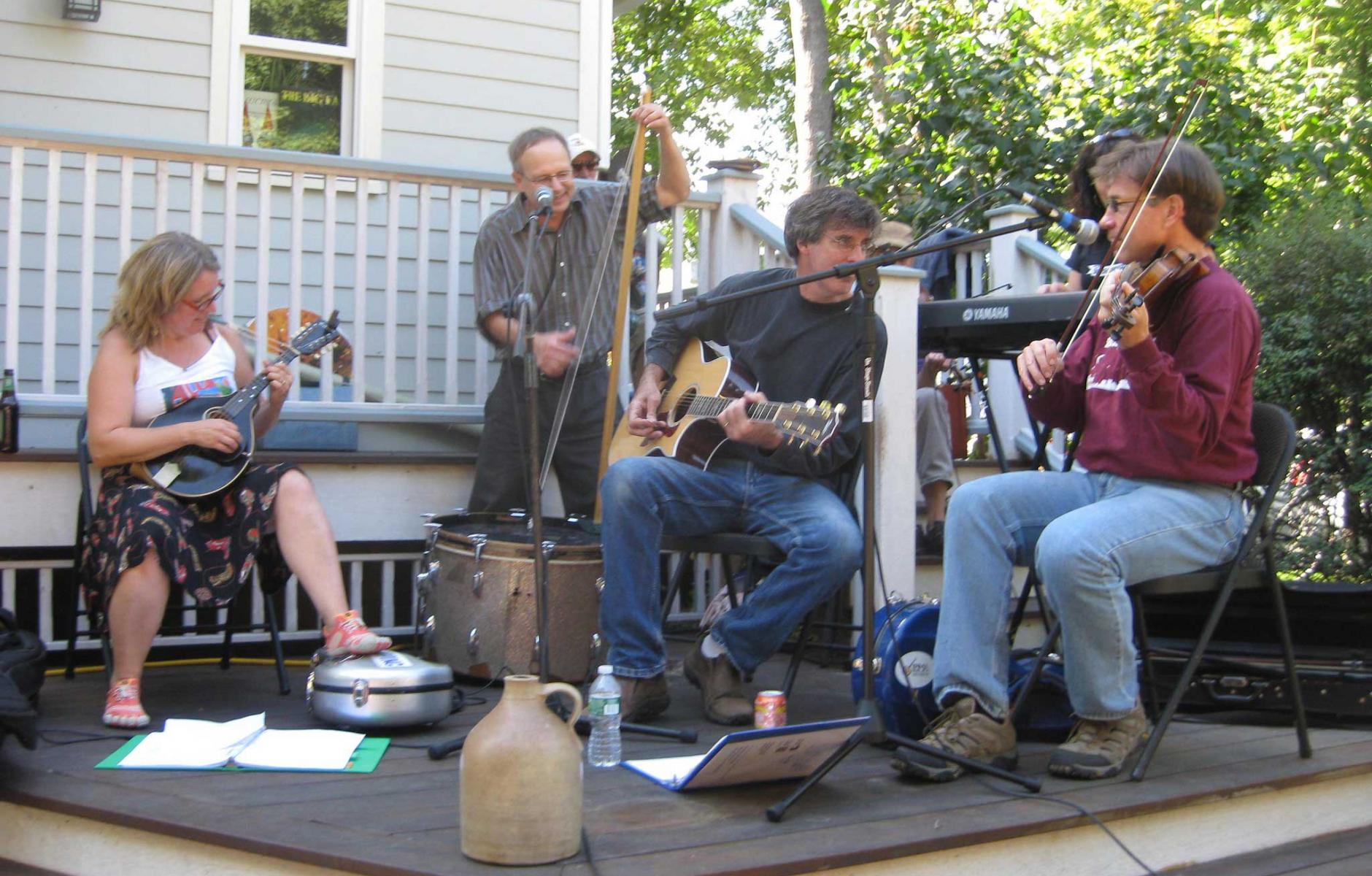
A music festival that thrives in walkable places


This past weekend, Porchfest took place in Ithaca, New York, a grassroots community event that offers lessons for urbanism. Porchfest began in 2007 and has spread across the US, into Canada, and now Australia. It would have been the 20th annual Porchfest this year if not for two years lost to COVID.
One hundred and seventy-four acts performed on porches, stoops, or the yards of houses this past Sunday, during six time slots, in the Fall Creek and Northside neighborhoods. Thousands of people walked around or rode bikes throughout the area. I was one of them, and I performed as well. The organizing group Ithaca Porchfest lists 268 Porchfests held around the world, mostly in the US, throughout the year. Those are the ones they know about. I now live in Liverpool, New York, about 60 miles north, and we have a Porchfest that began in 2024 and isn’t on the list.
To examine what this means to urbanism, I will share what I wrote about the first Porchfest in an email to professional urbanists, with the subject heading “A Great Community Event,” on September 24, 2007, a day after the inaugural event:
My walkable, urban neighborhood of about 40 blocks just north of downtown in Ithaca, NY, just had one of the best community events I have ever seen yesterday. Excuse me for gushing, but this ought to be copied. It's called Porchfest. We have a lot of musicians in our neighborhood, and somebody had the brilliant idea that they would all perform on their porches at the same time on one day. They printed up maps and distributed them in a few key locations. There were 17 porches where performers played for three hours. The event needed no venue, no security, no vendors, no permits, no money, beyond a few dollars in printing costs. A few enterprising kids had lemonade stands. I'm guessing 700 to 800 people walked or rode bicycles around from street to street on a beautiful day from 3 to 6 p.m. In many cases, the streets were entirely taken over from curb to curb with the audience. The performers had a ball. Afterwards, there was a big picnic on the only detached green in the neighborhood surrounded by houses. I met so many neighbors, and had a chance to catch up with many that I already knew. This is going to be seriously popular, and I'm guessing that people will come from all around next year. This couldn't take place in the suburbs.
My prediction about its popularity was on the money. It is a fantastic way to build community, and it remains very lean. There are still no tickets sold, and little money exchanges hands—there are now food trucks, vendors, and merchandise—an expansion from the lemonade stands. Now it requires permits from the City, and many streets are closed. But a small group of people still runs it as a labor of love.
That last point of my email, that it couldn’t happen in the suburbs, was speculative, because how did I know? It had only been tried in one place, the Fall Creek neighborhood in Ithaca. But it seemed to require a neighborhood where people could walk from house to house, venue to venue. The closer the houses are together, the better. The neighborhood itself is the festival site, which calls for a good walking place. The whole idea of the event didn’t make sense in a conventional suburb. A walkable suburb, yes, but not a conventional suburb.
Now that 20 years have gone by, it is clear that I was right. Looking over the 268 Porchfests, nearly all of them—maybe 98 percent—take place in historic, walkable neighborhoods like Fall Creek. The exceptions include a few New Urbanist neighborhoods that have many of the same characteristics as the historic places. There’s also a suburb that has been retrofitted as a walkable place (Carmel, Indiana).
Here's a map of Ithaca Porchfest, including the location of the houses that hosted performers in the 5-6 p.m. slot, when my band played.
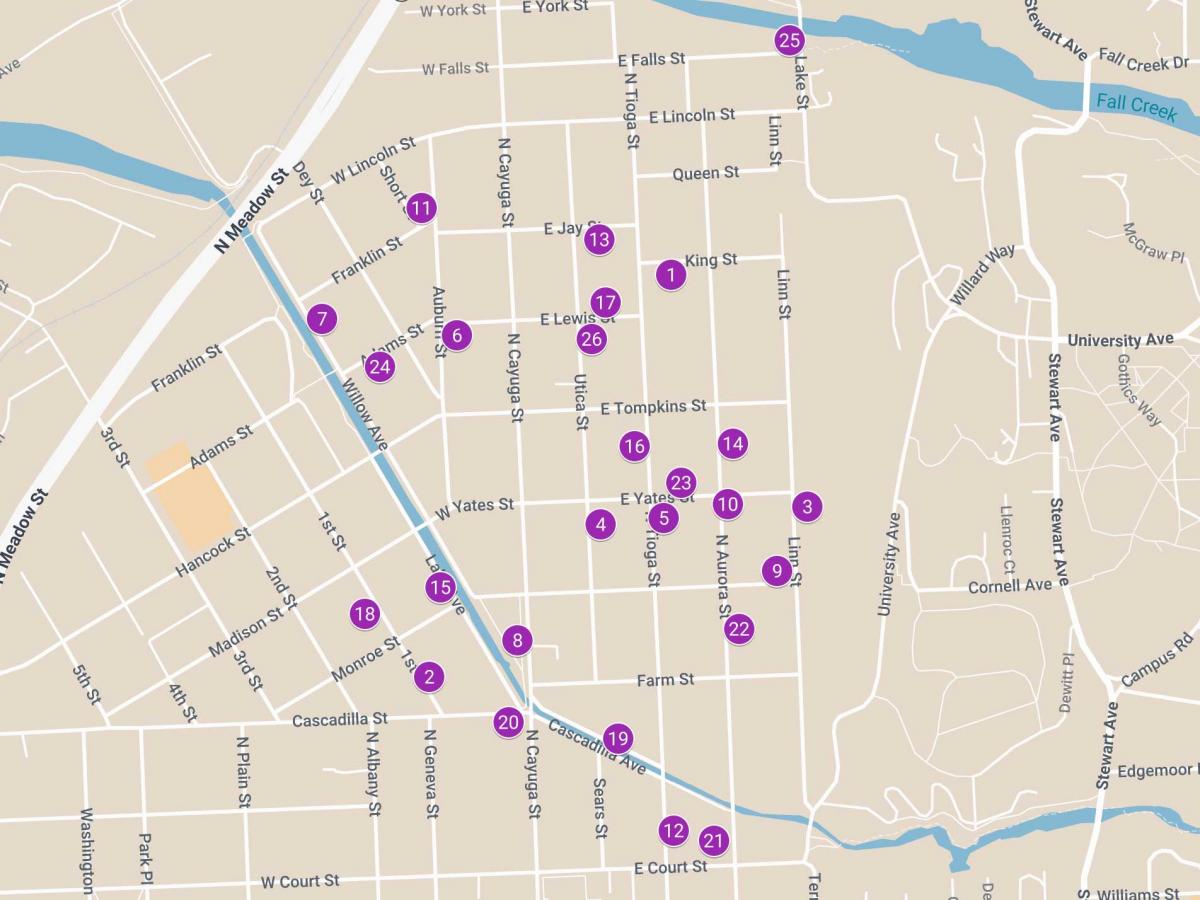
Take note: These streets and blocks were drawn on paper and surveyed in the first half of the 19th Century, and improved over time. The blocks are small and easy to navigate, with a thousand possible routes through the neighborhood. Three neighborhoods are visible on the map, and they connect coherently, despite differently oriented street grids. The disconnected streets on the right (east) are due to a very steep hill leading up to the Cornell campus.
The point is that Ithaca was built on a vision of a street network, and that’s the case for every successful Porchfest venue. Porchfest thrives in a particular social ecosystem, which depends on a specific physical environment. That’s a walkable neighborhood, preferably one that started with a street plan connecting many neighborhoods in a city or town.
These same neighborhoods promote walking and improve health. If you live in a place like Fall Creek, you walk more, double or triple the steps you would take in a conventional suburb. They also promote social connections. They support events like Porchfest, for example, which are social accelerators.
Twenty years later, none of this is surprising to me, although it is nice that time has proven my first impressions correct. One thing that has surprised me, though, is the parking. In a follow-up email in 2007, I wrote: “As far as I know, no one complained or was opposed. Parking was not a problem, as everyone walked.” But Porchfest has grown so much that People drive in from great distances. I met some people from the Hudson Valley this year, at least 100 miles away. Fall Creek has very few parking lots, and they are mostly small. Even the elementary school only has a dozen spaces.
I would have expected parking to be a problem, and I hadn’t given it much thought over the years, but this year I received an email from the organizers advising me to park on the street and noting that the neighborhood has ample parking. As I looked around during Porchfest, they were right. All these years later, with thousands of visitors, parking is not a big problem. That only shows how much on-street parking is available in these historic neighborhoods, over an area as large as 40 blocks. Fall Creek was laid out before cars, and so wasn’t designed for parking. This may be the largest event in the neighborhood (there is a parade in June, and Halloween is also a big deal). And yet, because Porchfest is spread throughout the neighborhood, parking is not a huge issue. Traditional neighborhoods never cease to amaze me.
Here's a link to a short documentary on Porchfest that was released this month. It was made by WCNY, a public radio station based in Syracuse.