How could Complete Streets policies be more effective?


In a 2011 planning advisory board meeting for a county where I lived, I delivered the exciting news about New York State’s then-new Complete Streets Act, which “requires state, county and local agencies to consider the convenience and mobility of all users when developing transportation projects that receive state and federal funding.”
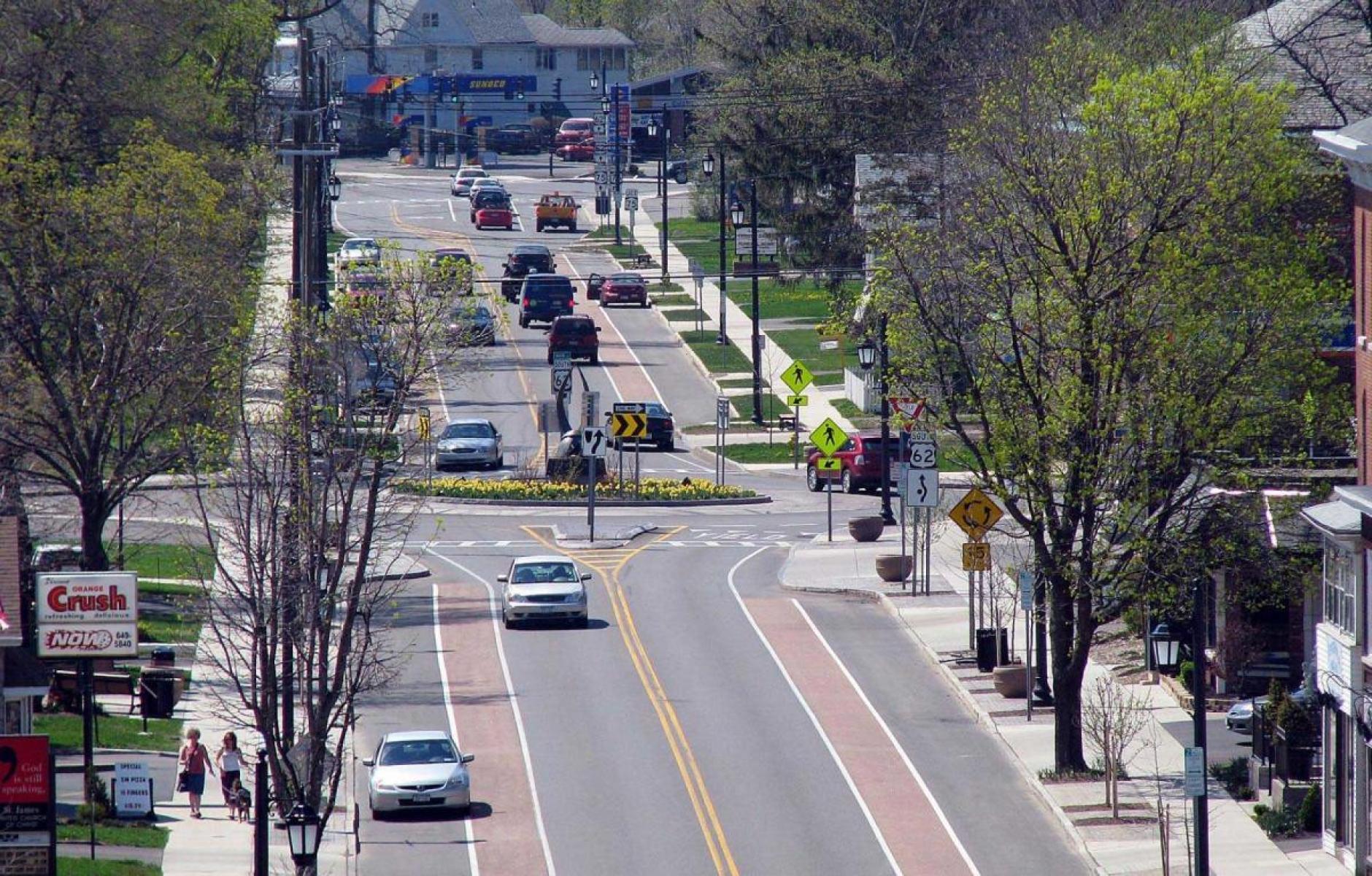
I told the group this policy would be revolutionary because it applies to all thoroughfares that receive transportation funding. The state had already funded a few good projects that served as examples of Complete Streets, such as Route 62 in Hamburg, New York, which improved safety and the local economy (see image at top). I had visions of such projects being built in every town in the state. Others in the room were skeptical. The state Department of Transportation (DOT) would never change, some said.
Fifteen years later, I can definitely report they were right, and I was wrong. The state’s thoroughfares look and function almost exactly the same in 2026 as they did in 2011. A small handful of transformative projects have been built, but they represent a drop in the bucket compared to the state’s thoroughfare system. I would have to drive at least an hour to get to a one, and I would only find it because I know where to look.
The streets in New York State are constantly maintained and reconstructed, but as far as I can tell, nobody pays much attention to the Complete Street Act, with one exception. Streets in larger cities with historic grids, such as New York City and Buffalo, are often given a makeover that includes bicycle lanes, curb extensions, and similar features. These streets had a history of serving many users, and some have been improved. But I doubt that has much to do with Complete Streets, and more to do with engineers following the NACTO design guide.
More than 1,700 Complete Streets policies have been adopted nationwide, including 37 states that account for most of the nation’s population, and a tremendous number of counties and municipalities. According to the Complete Streets Coalition of Smart Growth America, the movement is for safer streets that meet the needs of all users. At least in theory, Complete Streets policies should apply “to all new projects, retrofit or reconstruction projects, maintenance projects, and ongoing operations.” What this movement shows is tremendous political will to have streets that are not just drivable, but also accommodate pedestrians and bicyclists. In practice, the number of policies dwarfs the number of streets redesigned to meet the Complete Streets promise.
Most of these policies have been in place long enough to make a substantial impact—33 states have had policies for at least 10 years. I’ve been through enough of these states to know that most are just like New York. To give a few examples, Maryland adopted Complete Streets in 2000, Pennsylvania and Virginia in 2004, and New Jersey in 2009. I have driven, walked, and bicycled around these states a considerable amount over the last quarter century, and I would know if there has been a substantial change (I’m pleasantly surprised whenever I see Complete Street elements that have been added, which I don’t fail to notice).
I recently read a Substack post comparing Complete Streets to 1950s aircraft cockpit design changes that increased flexibility for pilots, making flying safer. Complete Streets are an “engineering principle” that acknowledges that people don’t just drive, they also switch modes and become pedestrians, transit riders, bicyclists. Complete Streets are more flexible to human needs.
And yet the writer acknowledges the reality: implementation has been “frustratingly slow across the country. Despite widespread policy adoption, most local governments have struggled to translate policies into actual street improvements. Planning and designing transportation systems for real, mode-switching humans instead of phantom average drivers creates safer, healthier, more livable communities. The question isn’t whether Complete Streets works—it’s whether we’ll finally implement it at scale.”
He's right—Complete Streets work, when they are implemented. They are not being implemented nearly enough, especially where they are most needed. The policies may even have been counterproductive—allowing planners, designers, and funders to claim that they are solving a problem, when they are doing almost nothing. In fact, pedestrian deaths skyrocketed in this period. From 2010 to 2023, pedestrian fatalities rose nationwide from 4,302 to 7,314. In light of that, I’d say Complete Streets have been effective in policy adoption, but have failed in practice. So, how could Complete Streets policies and the movement be more effective?
- Start with a network.
Almost all great streets, even good streets, are part of a well-connected network of small blocks and streets. That is the fundamental condition that allows for human-scaled streets. Christopher Alexander explained this in his seminal 1965 essay “A City is Not a Tree.” Modern street networks are dendritic—i.e., tree-like—rather than variations on a grid, and therein lies the rub. Well-connected networks are a prerequisite for Complete Streets.
As a recent study shows, only 12 percent of US census blocks are walkable. Geographically, these are small, dense census blocks in traditional cities. The vast majority of these walkable census blocks are built on a street grid. The Charter of the New Urbanism acknowledges this reality by stating that “Interconnected networks of streets should be designed to encourage walking, reduce the number and length of automobile trips, and conserve energy.”
The idea that we can create many genuine Complete Streets without establishing better street networks is pure fantasy, yet that is what the Complete Streets movement proposes. The Complete Streets Coalition offers 10 essential policies and 10 physical elements, but none of them address networks. Street networks are the system that allows Complete Streets to function. I get it that sometimes you just want to build a Complete Street. But that effort won’t get you far unless the government is simultaneously trying to establish better networks. Without doing that, you are missing the forest for the trees and doomed to fail.
Complete Streets policies need to acknowledge that street networks are not just an element of Complete Streets (they mostly don’t even go that far) but a prerequisite for the movement’s success. Crosswalks, sidewalks, bus lanes, bicycle lanes, and similar measures will not make much difference if the underlying street network is poor. In many places, these improvements will be rejected because the network doesn’t support them.
- Respond to the present and future context
The lack of network understanding highlights a larger problem with Complete Streets policies: their failure to adequately address context. Every street in America is part of a context as defined by the Rural-to-Urban Transect. Maybe it’s a main street or a downtown core, a walkable neighborhood, a suburban commercial district or subdivision, or a rural area. A street needs to be designed differently according to this context.
Users and how people use a street will change depending on the context. At the very least, Complete Streets policies need to acknowledge that reality. No Complete Streets policies that I am aware of mention the Transect.
And there’s another problem, maybe a bigger problem, regarding context when you are trying to build streets that accommodate a wide range of uses. And that is that streets have two contexts: The existing context and the context that the community is trying to create. That’s the future context.
The present and future contexts are often not the same. Many communities are trying to create walkable places where there is currently little or no walkability. That is understandable and admirable, especially in communities with very limited walkability (most of America). In such cases, the future context is walkable, but the existing context is not. I would add that creating more walkable places is aligned with building more Complete Streets. At the least, there is significant overlap in the two goals.
Street design is a critical component to creating walkability. Complete Streets policies should be tools for meeting that goal. A football analogy is in order: the quarterback throws the ball where the receiver will be, not where the receiver is when the ball is thrown. Similarly, the street design should meet the needs of the kind of place the community is trying to create—especially since streets are a critical component of that place.
Recall that Complete Streets projects are mostly implemented in older communities that were historically walkable. DOTs have come around, sometimes reluctantly, to the idea of restoring walkability to historic streets.
However, when a community tries to create a walkable place from scratch, or transform a place without a history of walkability (the vast majority of our built environment), DOTs generally won’t even consider it. I have sat in meetings when DOT representatives made this exact point. If you had a historic Main Street, they might consider an alternative design. Trying to create a Main Street where there never was one? That’s not their job. They will not throw the ball to where the receiver (the community) is headed. The result, in football, is an incomplete pass or an interception. For a community, it might be the death of a pedestrian or driver.
That explains why Complete Streets policies have failed. In most of America, DOTs simply ignore them, because the existing context is not walkable and the network, built with outdated transportation ideas, is poorly connected. These are the places that need Complete Streets the most. That assertion is supported by the stubborn rise in pedestrian fatalities nationwide and by numerous knowledgeable observers.
For the Complete Streets movement to be effective, it must start by acknowledging that well-connected street networks are essential to support. And it must respond to both present and future context. Both networks and context must be incorporated into the Complete Streets movement to fulfill its promise.