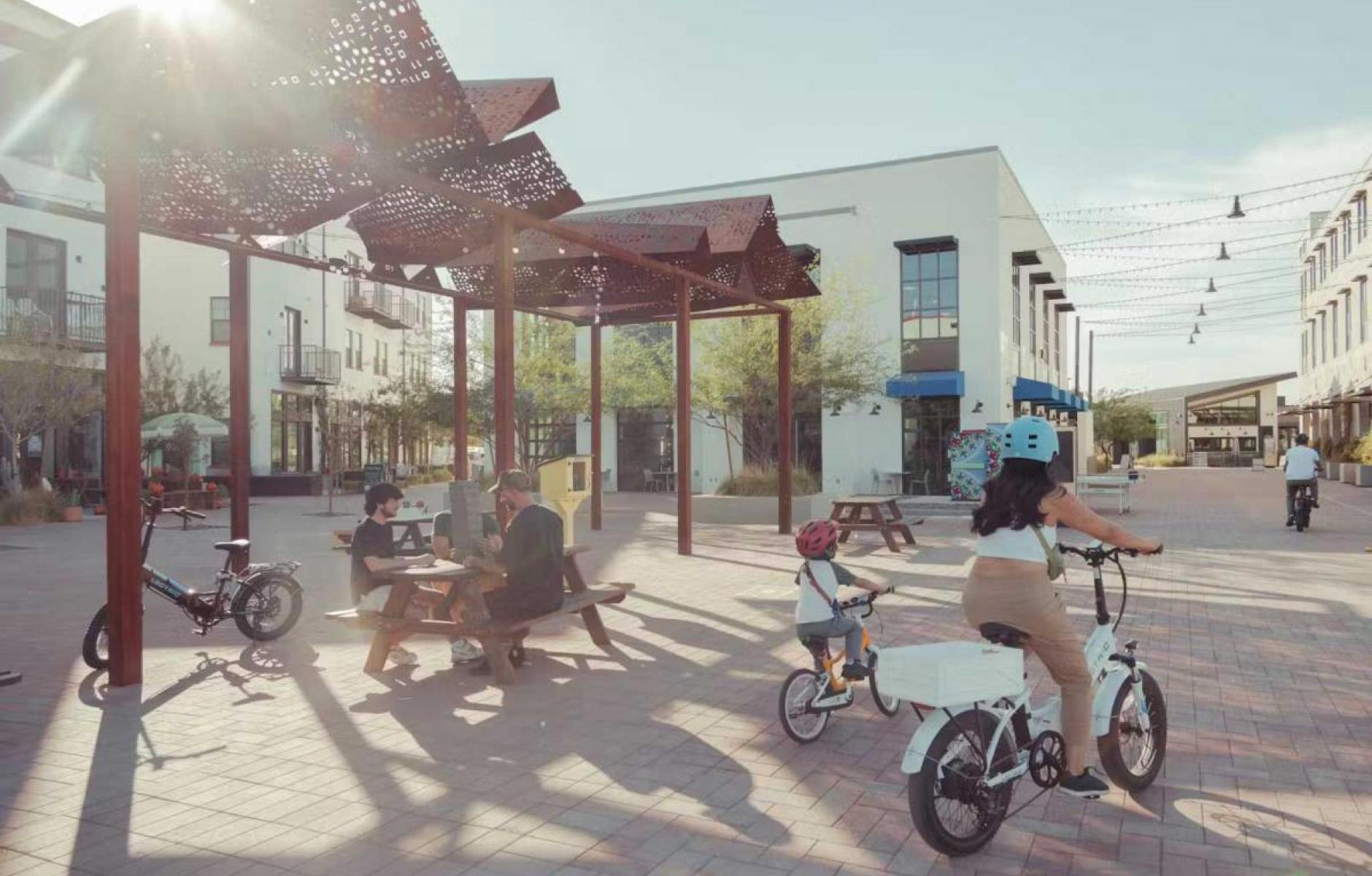
Nearly one in five is interested in car-free living


In a first-of-its-kind national survey, 18 percent of US adults express interest in “car-free” living, and an additional 40 percent are open to the idea. That is in addition to 10 percent of US households that currently live without a car. The research is conducted by the planning and economics departments of Arizona State University in Tempe, the city that is home to the nation’s most prominent car-free development, Culdesac Tempe.
Car-free living is defined as not owning a car by the authors of the report: “Who is interested in car-free living in the US? Findings from a nationwide survey.” Car-free households may still make use of automobiles. No previous research has sought to estimate demand for this lifestyle, although past studies have shown a substantial unmet demand for living in neighborhoods that allow for reduced automobile use (52 percent of Americans prefer that option, according to ULI in 2015).
The current built environment makes car-free living impractical throughout much of the US. “High-quality car-free living opportunities are limited to walkable neighborhoods, which account for only a small fraction of the country—around 12 percent of census block groups,” the researchers report. Walkable neighborhoods tend to be concentrated in urban cores, where the cost of living is higher. These include major portions of cities like New York, Boston, San Francisco, Chicago, and DC. “Many US cities lack the infrastructure needed to make car-free living a feasible or attractive option,” the authors note.
The tenth of households that don’t currently own a car are largely living this way out of financial necessity. The authors call the segment that can’t afford an automobile “car-less.” Fewer are living this way by choice, which would be truly “car-free.” Nevertheless, substantial demand for development exists in walkable neighborhoods, including redeveloped downtowns and adjacent neighborhoods. Such development reduces car use and, in theory, allows households to eliminate cars if they so choose. In addition, some cities are enabling developers to build car-free communities without parking for personal automobiles, such as Houston, Charlotte, and Tempe, the researchers note.
While zero-car households today tend to be concentrated in lower-income levels, those who express interest in car-free living come from diverse backgrounds, “with few significant associations between interest in car-free living and key socioeconomic or demographic variables,” the authors explain.
While the true market demand for car-free living is unknown, the survey indicates a substantial need for development that meets this lifestyle. “Given the sizable unmet demand for car-free living, we conclude that planners should allow and facilitate car-free and car-lite developments. In practice, this can be done by embracing zoning reform, investing in alternative transportation infrastructure, lowering parking requirements for development, and encouraging mixed land uses, including in residential neighborhoods,” the researchers note.
Five key factors are associated with interest in car-free living: having prior experience living without a car, using alternative modes of transportation for at least five percent of trips, lower car dependence, riding transit regularly, and having less enjoyment of travel by private car.