Legalizing single-stair, a path to affordable housing


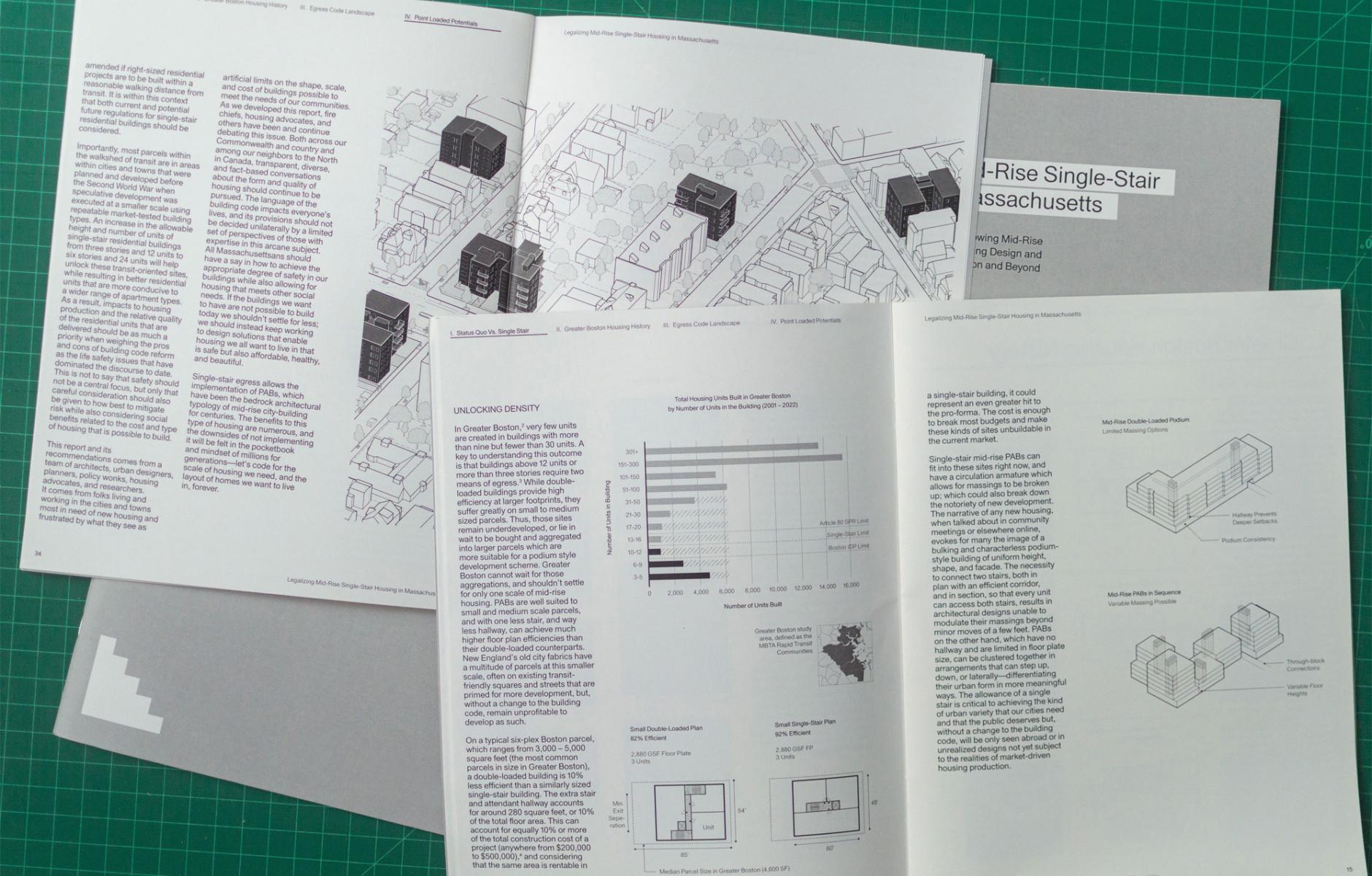
Loosening the rules against single-stair buildings could significantly increase the supply of much-needed housing in Massachusetts. Utile Design, in collaboration with Boston Indicators—the research arm for the Boston Foundation—and Harvard's Joint Center for Housing Studies, published “Legalizing Mid-Rise Single-Stair Housing in Massachusetts.”
While the state building code now allows single-stair buildings of up to three stories and 12 units, the report makes the case for six stories and 24 units. The report “suggests that in Greater Boston alone, an additional 130,000 new homes could be built if single-stair construction were allowed in four- to six-story buildings,” The Boston Globe editorial board stated in September, 2025.
The report, published in late 2024, has spurred state-level action to reform the building code to meet the state’s housing production goals. “There are now two bills in the Massachusetts House and Senate to study this issue further, as well as a formal proposal before the State building code review board,” the report team notes.
The report uses plain English to delve into the issue of single-stair buildings—and it could be useful for similar campaigns across the US. Architectural drawings, diagrams, and data-based graphics illustrate the complex and spatial issues that arise from single-stair housing.
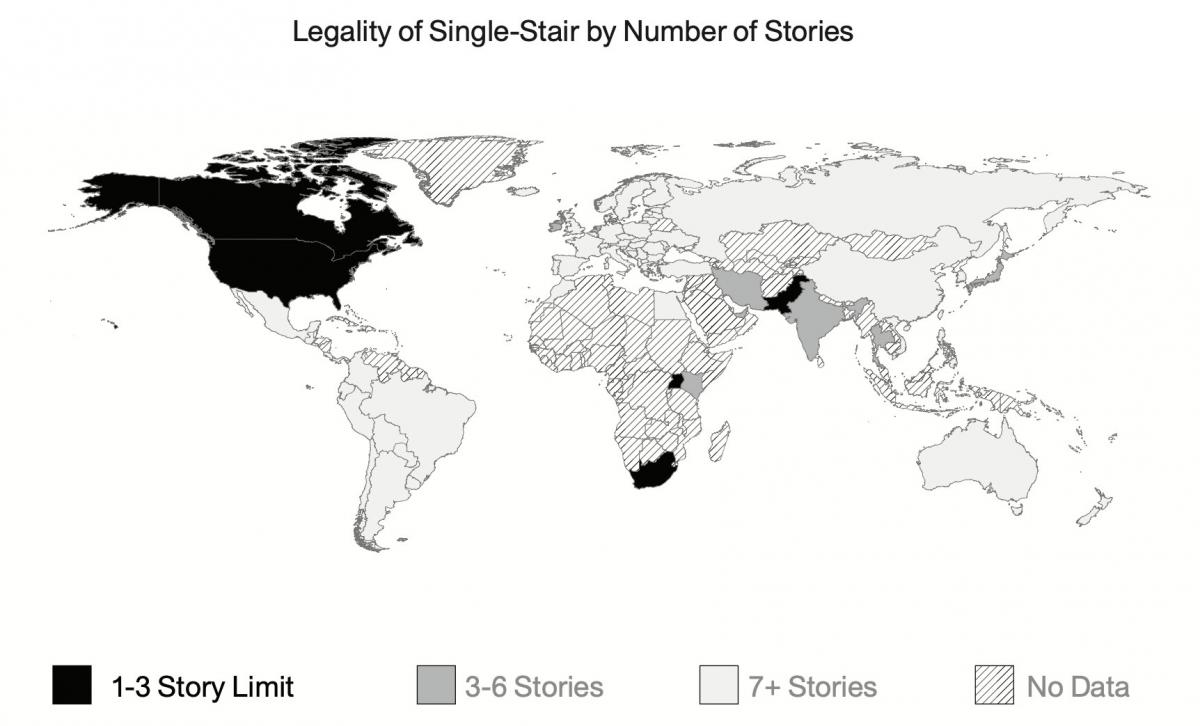
Most of the world allows mid-rise single-stair buildings without any increase in fire deaths. In fact, most of the countries identified as having lower fire risk (and there are many) allow single-stair buildings exceeding three stories.
The regulations against single-stair buildings represent a hidden but significant cost added to mid-sized urban buildings—and a barrier to building affordable housing. “Single-stair buildings have much higher efficiency than two-stair buildings,” the authors note. “This is evidenced by our report findings, but also their prevalence in US pre-mid-century buildings and the majority of contemporary housing the world over. Higher efficiency means these buildings can fit into smaller parcels, or even, when on larger parcels, be aggregated together into larger massings. In either scenarios their scale more closely matches the scale of pre-war architecture, rather than the sprawling facades of contemporary podium multifamily. This scale is important to creating a legible urban environment, a vibrant streetwall, smaller more resilient residential communities, and more variation in urban form. The change proposed by our report makes possible the exact kind of urbanism the CNU stands for.”
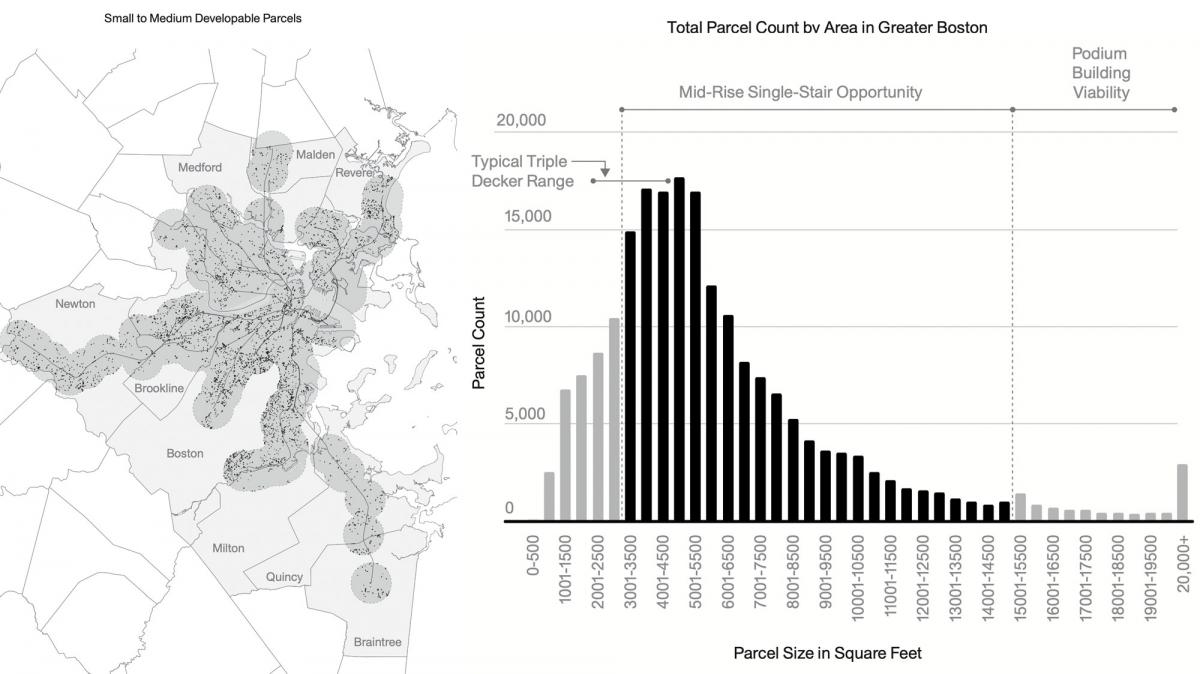
The team analyzed housing capacity that could be unlocked through reform. It highlights over 5,000 development-ready parcels located near transit and of ample size to host infill single-stair housing. Those buildings could generate up to 130,000 new living spaces in the Boston region. The findings were bolstered by an analysis of what has been built—notably lacking in mid-sized buildings, a true “missing middle” of multifamily housing. “In Greater Boston, very few units are created in buildings with more than nine but fewer than 30 units. A key to understanding this outcome is that buildings above 12 units or more than three stories require two means of egress. While double-loaded buildings provide high efficiency at larger footprints, their performance suffers on small to medium-sized parcels.
In the most common parcel size in Boston, a double-loaded building is 10 percent less efficient than a single-stair building—that is to say that the stairway and hallway accounts for 10 percent more space. “This can account for equally 10 percent or more of the total construction cost of a project (anywhere from $200,000 to $500,000), and considering that the same area is rentable in a single-stair building, it could represent an even greater hit to the pro-forma. The cost is enough to break most budgets and make these kinds of sites unbuildable in the current market.”
Single-stair design would also make apartment buildings more livable, the team explains. In single-stair buildings, more units have more than one outside wall, which adds light and ventilation.
The report was authored by an interdisciplinary design research practice (Utile), with editorial input from Harvard research center, and funding provided by Boston Indicators, the regional civic data organization.