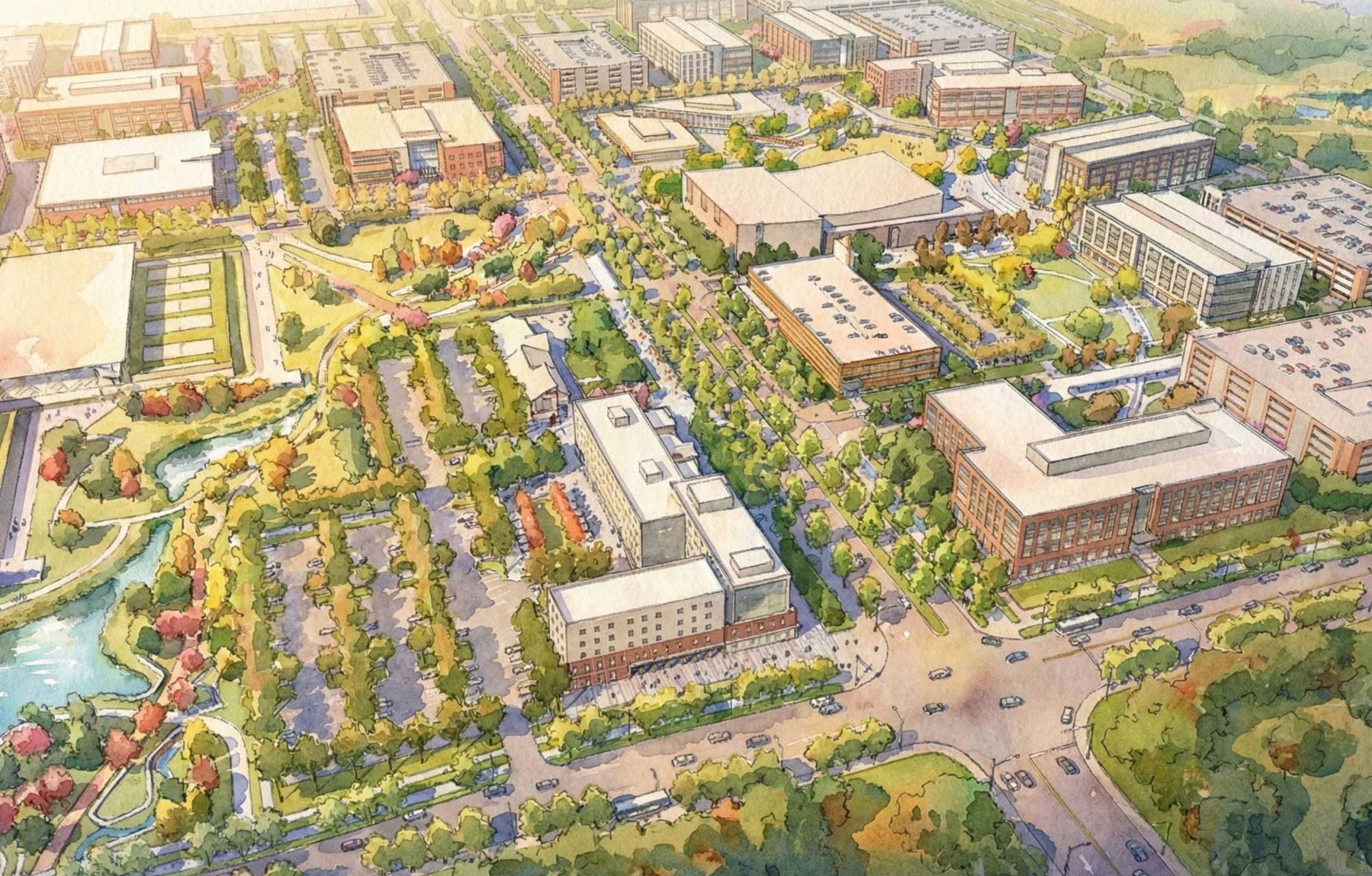
New Walmart headquarters embedded in urban fabric


Visitors to Northwest Arkansas can't help but notice the pervasiveness of Walmart. The largest corporation in the world by revenue with 2.4 million employees, Walmart is everywhere in the US. But around Bentonville, it is different. Buildings all over—massive buildings—bear the Walmart logo.
Stores, distribution centers, office buildings, what have you. Walmart employs more than 60,000 people in Arkansas, concentrated in Northwest Arkansas, a region of just under 600,000 people.
The new Walmart Home Office opened in 2025, about a mile from downtown Bentonville, a small but rapidly growing city. Walmart’s headquarters stand out for several reasons:
- The use of mass timber construction for buildings.
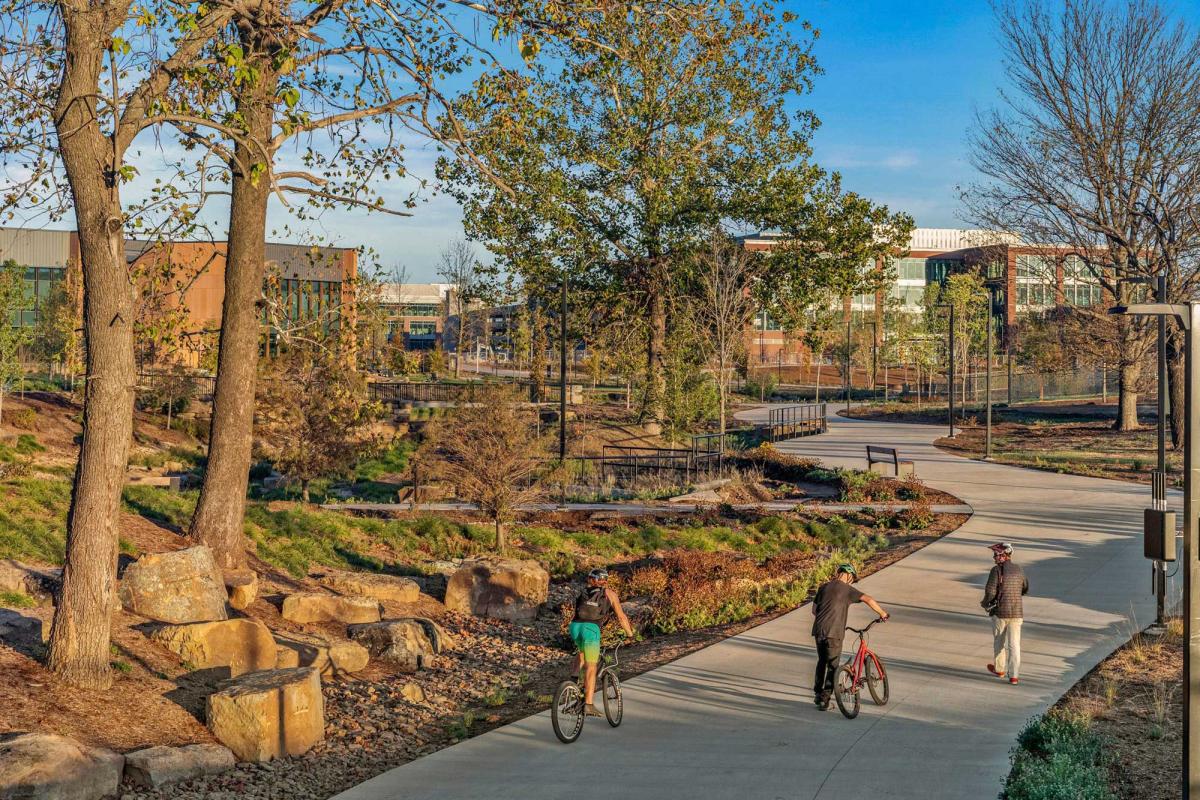
- Nearly seven miles of bike-ped trails—open to the public.
- The campus is embedded in the city. In that, it is different from the modern headquarters of many other enormous US firms, such as Apple and ExxonMobil. In place of a closed campus, the Walmart Home Office is built on the city’s open street network with links to the larger region via a greenway.
The design aim can be summarized simply and ambitiously: a headquarters not as a building but as an urban fabric that contributes to city life. The Home Office buildings top out at four stories, creating more surface area than taller buildings would, helping to define the pedestrian realm while allowing for daylight to penetrate throughout the landscape and streetscapes.
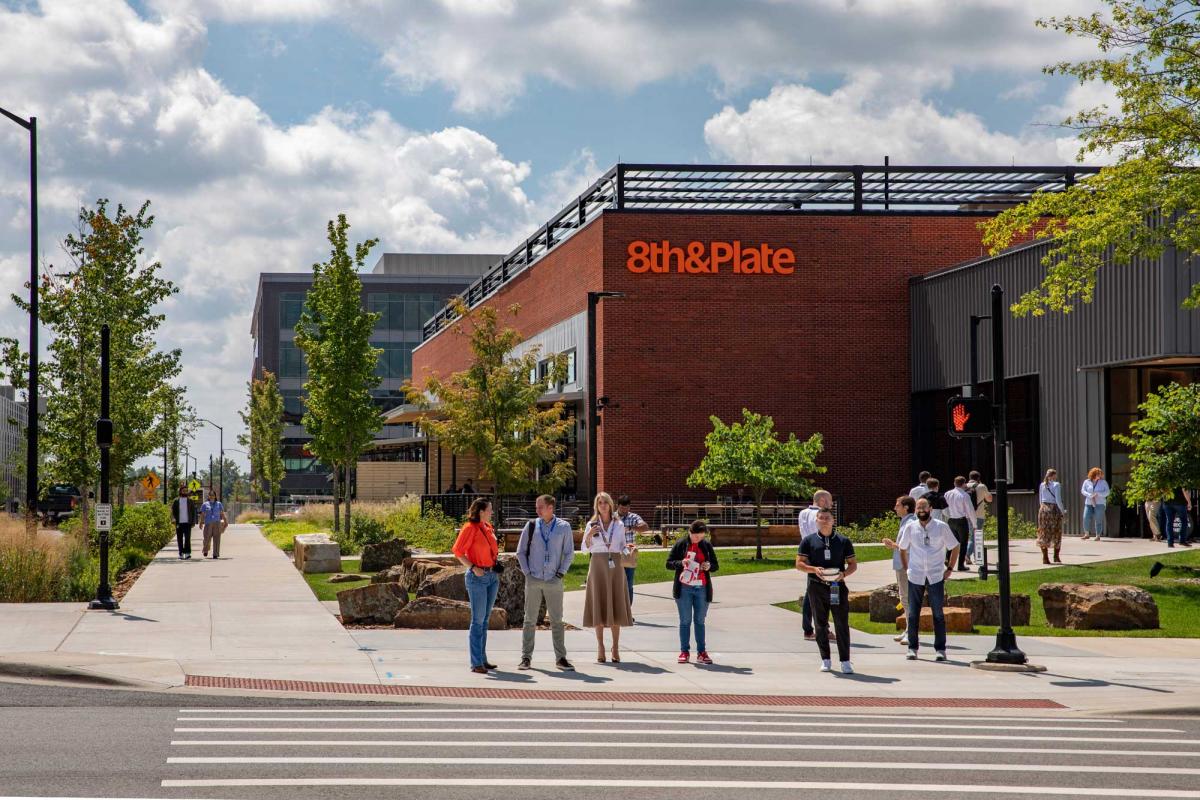
The campus straddles Eighth Street, an important thoroughfare that extends east and west through Bentonville. Formerly a generic five-lane arterial, Eighth Street has been converted to a new main street, a front door for the campus. Walmart and its designers did a good job with a kind of transformation that remains rare anywhere in America. The street is mixed-use with active frontages. There are three rows of trees, including a central median, that will grow in time to create a canopy over the street. Because of the median in the middle, the thoroughfare is easy to cross. I crossed mid-block, although that’s probably not recommended when traffic is heavy. Nobody told me not to “jaywalk,” or even noticed, as far as I could tell.
On a weekday morning, with 15,000 Walmart headquarters employees in a dozen recently opened office buildings on or near Eighth Street, the traffic was light.
Also, the Razorback Greenway, a 40-mile north-south trail that links Bentonville to other important cities in Northwest Arkansas (NWA), runs through the center of the Home Office. These two design moves, organized along two corridors, place the campus in the municipal and regional network, inviting the wider community in. I walked a few miles around the new campus and didn’t see a single security guard, although there were no doubt cameras. A few Walmart employees were zipping around on bikes and scooters. Even fewer community members walked around, but it was mid-March and chilly.
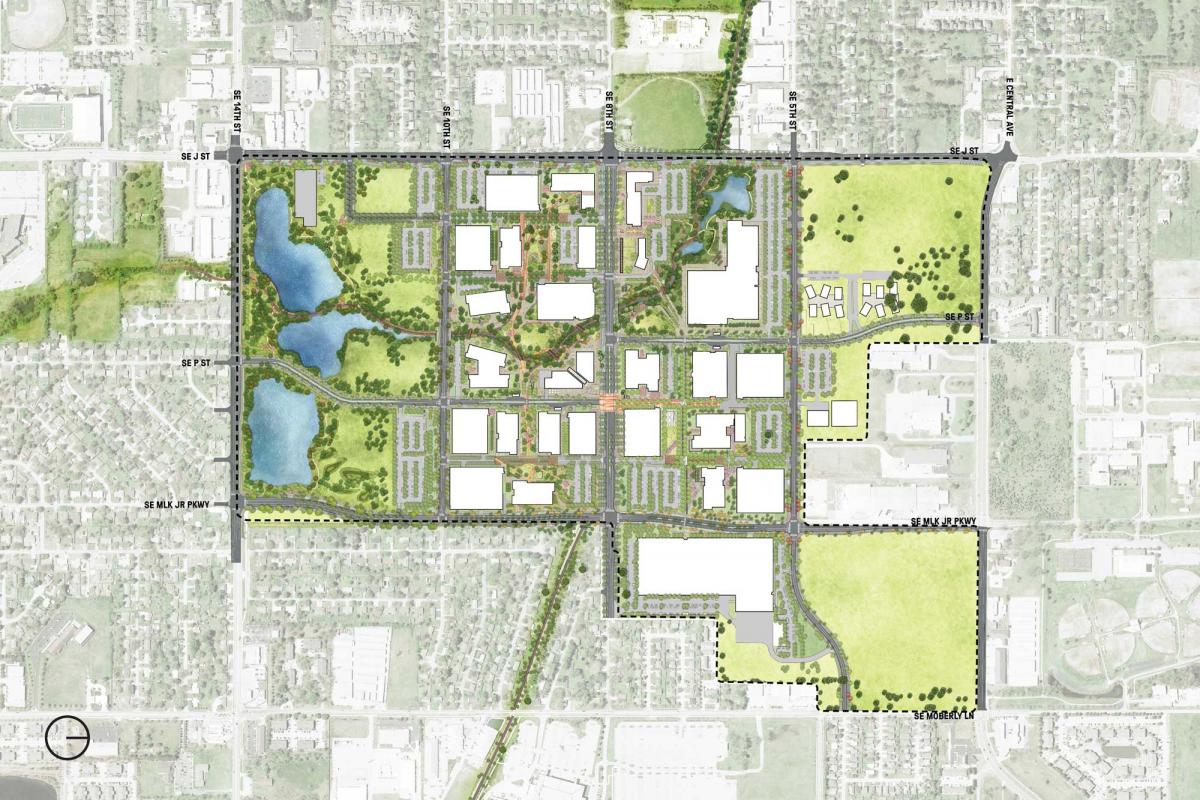
The District is designed with overlapping five-minute walksheds—one centered on mixed-use Eighth Street with the food hall and auditorium, another on the Walton Family Whole Health and Fitness facility, and another on the parklands.
“The new Walmart Home Office Campus embodies the Charter of the New Urbanism by prioritizing walkability, mixed-use development, sustainable storm water management, and human-scaled design within an integrated street and open space network,” explains Tyler Overstreet, City planning director. “Through this, the campus has shown itself to be an extension of the larger downtown area and naturally fits within the broader context of Bentonville.”
The 350-acre Home Office is a walkable District focused primarily on a single use—housing Walmart’s executive associates. As such, the buildings tend to be larger in scale compared to typical buildings in the city. The district has no housing, although retail and civic uses and spaces are included that serve the wider community. The concentration of large buildings is necessary at the headquarters of such a corporate entity. And yet, this will be a campus frequently visited by the community as a whole: To shop at retail stores and to walk and ride the trails, especially the Razorback Greenway, which is widely used not only in the City, but throughout the region. The investment in the Greenway and other trails is impressive, with multiple bridges, including tunnels under the busy thoroughfares that form the southern and western boundaries of the campus. The public spaces of the Home Office feel like a city park; much of the southern portion of the campus consists of lawns, clusters of trees, trails, and a lake.
The Home Office is an infill plan; residential neighborhoods and commercial development surround the site. The public space and mixed-use created by the plan will benefit these older residential areas. Significant resources were invested in making the edge intersections navigable on foot.
The urban plan follows four goals:
- Integrate a large single-tenant campus into Bentonville’s street grid;
- Privilege active transportation by threading a regional trail spine through the site;
- Shape an identifiable district with public-facing frontages and civic spaces;
- Phase delivery so the campus reads as a place from the first occupied buildings onward.
The campus is about 95 percent built, with ongoing construction of the parklands that will likely be complete in the spring. The planning process began in 2018 with a long-term, on-site design effort involving multiple firms with complementary strengths. City zoning approval was granted during the pandemic. Portions of the campus were incrementally developed during the first four years of this decade. Buildings mostly popped out of the ground in 2025, with office buildings opening monthly, in keeping with the fourth goal listed above. This coordinated, simultaneous build included stream restoration, landscaping, public streets and trails, bridges, and buildings.
The lead urban design firm was Sasaki of Boston, Massachusetts. The local architectural and urban design partner was MBL Planning of Fayetteville, Arkansas. SWA Group of Los Angeles provided landscape architecture. Gensler is the lead architect for the office buildings.
MBL Planning, which has been doing design work on the Razorback Greenway for the Walton Family Foundation, introduced the idea of bringing the Greenway through the heart of campus. “We believed it was imperative to connect the campus to this important cycling and pedestrian infrastructure,” notes Roger Boskus, MBL president. The firm also suggested the four-story maximum, which helped determine the campus character. MBL had designed the first mass-timber building in Arkansas, the University of Arkansas Library Annex in nearby Fayetteville—that led to the choice of mass timber for the Walmart campus, Boskus says.
A dozen mass-timber office and amenity buildings, totaling 2.4 million square feet, mark one of the largest mass-timber developments in the US. Built from engineered structural wood, mass timber is more fire-resistant than conventional wood, offering a lower-carbon alternative to steel and concrete. Interiors take advantage of the warm look of exposed wood. The prefabricated panels also reportedly save time and labor in construction.
The timber construction was part of an overall emphasis on sustainability. The 12 Office Buildings are designed to achieve LEED Platinum certification. Thirteen acres of constructed detention lakes and bioswales function as a large-scale stormwater management system. These features handle up to 52 million gallons of annual stormwater, protecting the regional watershed while doubling as a large natural parkland.
The Home Office features some cool facilities, including the Sam Walton Hall, a large auditorium and meeting space; the 8th and Plate Food Hall, and the Layout Center, all designed by MBL. The latter is a 400,000 square-foot facility where Walmart and vendors can design merchandising and place it on shelves that simulate a real store before the goods ever go out to actual stores.
Many employees will drive to the home office, but the 16,000 parking spaces are distributed in many structures throughout the campus, and some of them have liner retail on the first floor, especially along Eighth Street and the edges of the campus. The campus also has more than 1,000 bicycle parking spaces, a rentable bike fleet, and 300 EV parking spaces.
Street front commercial space includes: Bentonville Bicycle Company, Flyway Brewing, Gearhead Outfitters, The Gents Place, Hatch Early Mood Food, Jamba Juice, Riserva Bar + Tapas, Swig, Walmart Pharmacy, Wright's BBQ, Yokozuna Sushi, and the 151-room AC Hotel. These and other amenities are located between where employees park and where they work, within a five-minute walk.
The previous Home Office featured outmoded buildings on widely scattered sites, located on the other side of town. “The New Home Office truly is a testament to what we can accomplish together,” says Cindi Marsiglio, senior VP of Corporate Real Estate for Walmart. “It’s more than just a place to work.”
Note: When CNU gathers for its annual Congress, which will be held May 12-16 in Northwest Arkansas, attendees will be able to tour Walmart's new home office.