Chattanooga is chugging along


I was recently in Chattanooga, one of the first cities in America to be transformed by New Urbanism. An industrial city and railroad hub (celebrated by Glenn Miller’s “Chattanooga Choo-Choo”), the City was in economic and demographic free-fall by the latter part of the 20th Century.
But Chattanooga has the Lyndhurst Foundation, funded by a local Coca-Cola bottling magnate. Lyndhurst has money and political influence, and almost alone among regional American charitable foundations in the early 1980s, took steps related to urban design by seeking help from the University of Tennessee architecture program. That led to the hiring of architect Stroud Watson and the creation of the Chattanooga Urban Design Studio, funded by Lyndhurst and the City.
The urban design studio operated for a quarter century, bringing in New Urbanist practitioners like Koetter Kim Associates and Dover, Kohl & Partners, who encouraged citizens and practitioners to realize the potential of the city’s public realm. “What we were able to do we did by sharing visual images of what Chattanooga could be, and sticking steadfastly to our principles,” Watson told CityScope, the city’s urban magazine. “We were focused on the urban public realm, and the community came to understand that.”

The Urban Guild, which held its summit in Chattanooga and brought me to the City, gave the foundation its Stewardship Award. “With an overarching focus on the public realm, the Lyndhurst Foundation has established a long legacy of working with partners who are committed to the revitalization and regeneration of Chattanooga’s downtown core, the surrounding neighborhoods, and small downtowns throughout the region.
“Funding initiatives include the planning and development of pedestrian-oriented public spaces, mixed-use downtown cores, complete streets and neighborhoods, parks and green infrastructure, smart growth and zoning, fair and affordable housing, sustainable building practices, renewable energy and efficiency, transit and multi-modal transportation, and historic preservation.”
The design focus helped to turn the City around. Chattanooga began regaining population in the 1990s, on the strength of a cleaned-up riverfront with new public spaces, and a core that became livable again. “For over 25 years, the Design Studio helped create the ideas behind some of Chattanooga’s most recognizable and impactful landmarks like the Tennessee Aquarium Plaza, Miller Plaza, the Creative Discovery Museum, and the 21st Century Waterfront,” CityScope reports.
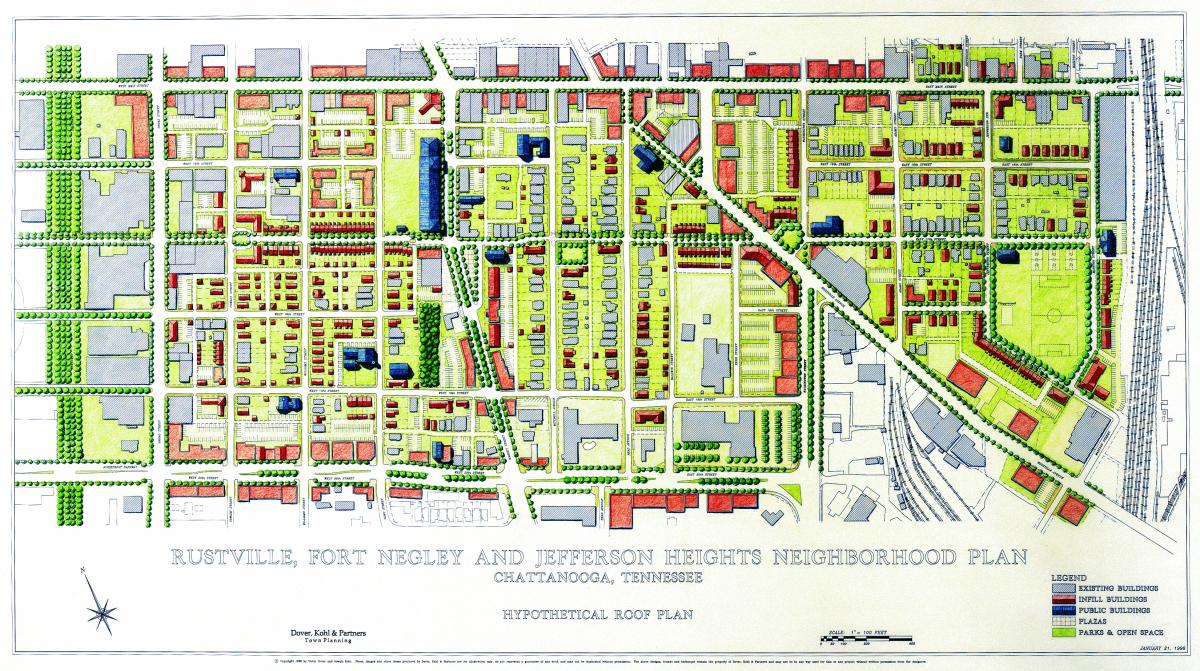
New landmarks put the City back on the map, but the more important focus was to make streets and neighborhoods livable. On the first morning of the Guild summit, we toured a nearby neighborhood, Rustville, that was 90 percent vacant 30 years ago. Walking around this attractive urban neighborhood today, walkable to downtown, it is scarcely possible to visualize what it looked like in the 1990s.
Lyndhurst partners with Chattanooga Neighborhood Enterprise (CNE), a nonprofit developer that has led many redevelopment initiatives. The nonprofit developer built the first housing in Rustville, based on an early plan by Dover, Kohl & Partners, hired by the urban design studio. The private sector took over after CNE proved the viability of new housing in Rustville and other Southside neighborhoods, Fort Negley and Jefferson Heights.

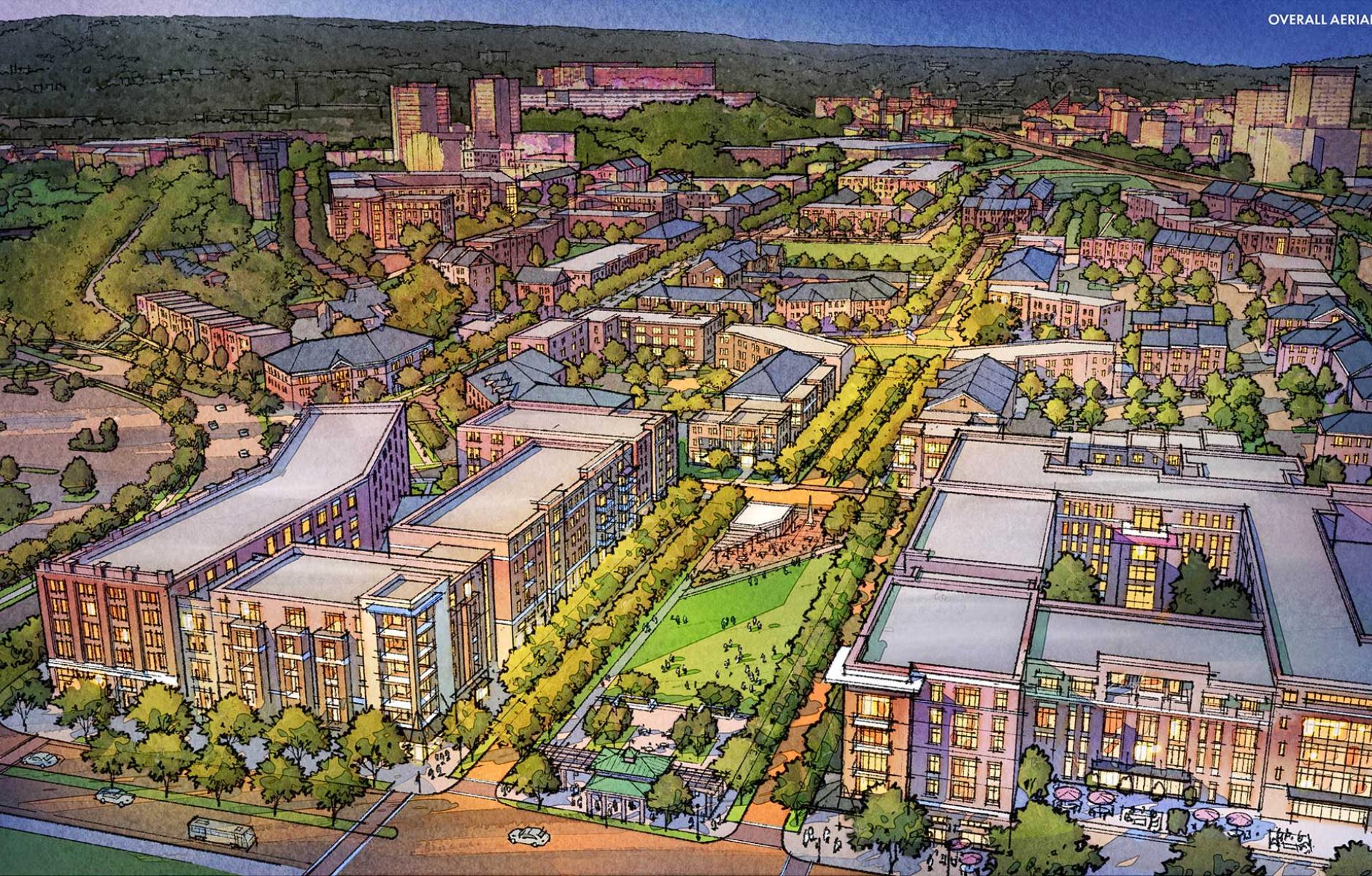
The original design studio closed its doors in 2005 when Watson retired, but the Chattanooga Design Studio opened ten years later, also funded by Lyndhurst and the City, carrying out the same mission. The track record of the design studio and New Urbanism in Chattanooga has led to a culture of urban design that is allowing major projects to move forward today, particularly on the City’s Westside. The 127-acre Westside Evolves plan sits between a revived downtown and a major new urban riverfront brownfield redevelopment called The Bend. Westside is physically segregated from downtown by a highway, and the street network was severed with the construction of 1940s barracks-style public housing on superblocks. According to the City’s $680 million plan, the aging infrastructure and deteriorating housing will be replaced by a grid of blocks and streets, punctuated by public spaces framed by architecture. The project, which broke ground in 2024, tackles the challenge of concentrated poverty while ensuring little or no displacement through a 10-year roadmap for equitable development. Westside Evolves, and the design team led by EJP Consulting, was recognized by the 2022 Charter Awards jury. Clients include the design studio and the Chattanooga Housing Authority.
Also in the early stages, The Bend is described as “Chattanooga’s next great urban neighborhood.” On disused riverside industrial sites, The Bend is designed to have the mixed-use and density of an urban center. In addition to riverfront public spaces, the Dover Kohl plan includes cool features like a canal street.

Walking around Chattanooga today, one gets the sense of possibility. The city is by no means filled up. There is room to grow in former manufacturing and warehouse sites, even though the city still has a manufacturing and service economy. The city has gotten more expensive, but it is still relatively affordable compared to the US as a whole, with median house sale prices around $350,000 and average rents around $1,470.
This balance between quality of life, growth, history, and affordability is a credit to a four-decade focus on urbanism that operated as a partnership between the City, a nonprofit design studio, and private developers. Many factors have contributed, but urban design has tied it together.
As CityScope reports: “Chattanooga’s rebirth as a thriving and vibrant city can be credited to a number of influences including environmental reform, the growth of the outdoor industry and tourism, an active and forward-thinking network of local foundations and non-profits, and the rebranding of Chattanooga as an emerging tech hub and fertile entrepreneurial ecosystem. But certainly one of the most significant factors has been Chattanooga’s incredible history of urban design and the role of the Chattanooga Urban Design Studio.”
A balanced urbanism is not all that easy to find, and I hope Chattanooga can keep it. The City seems to be on the right track.