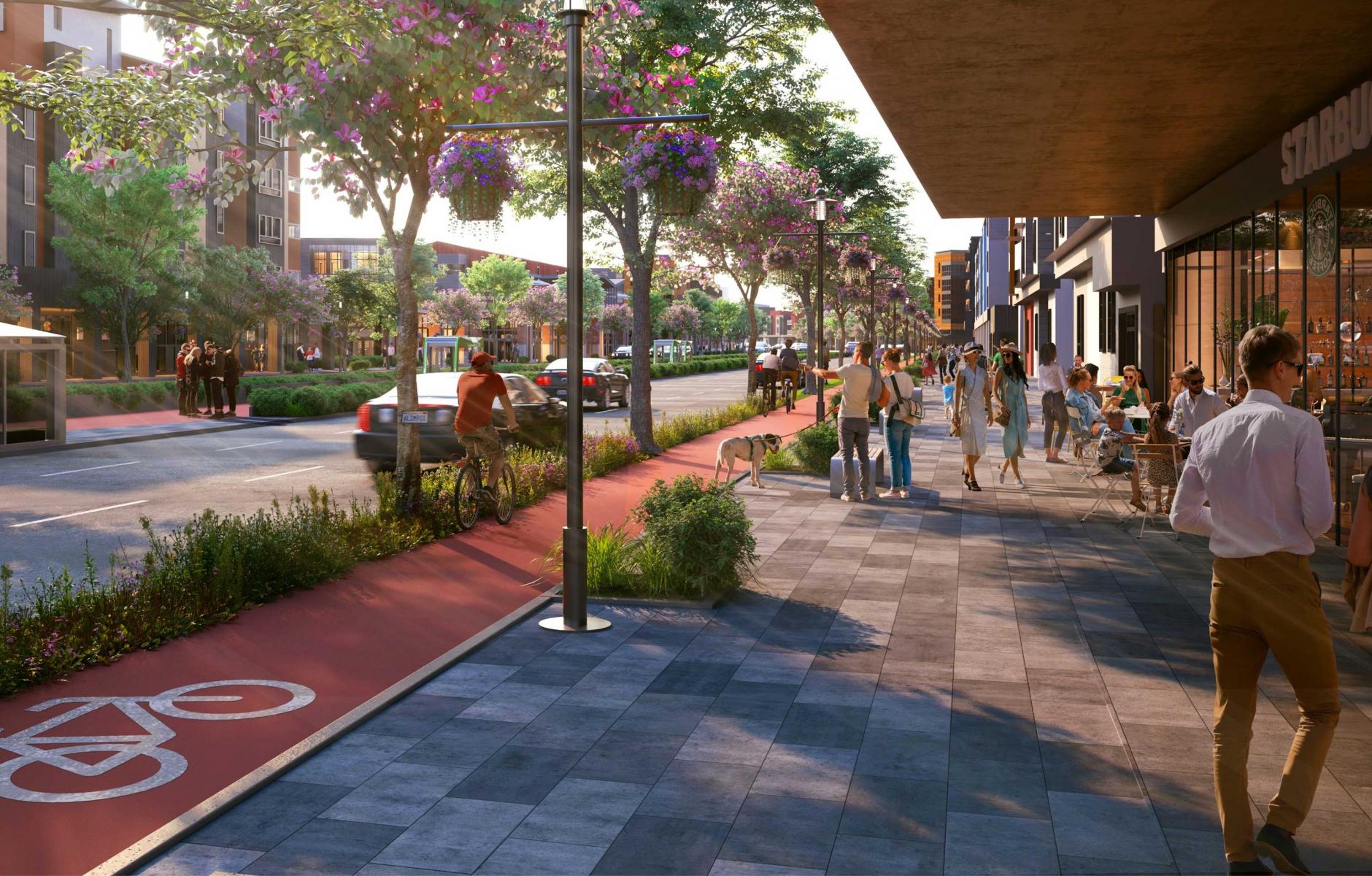
‘Grand Boulevards’ promoted for affordable housing on commercial strips


HDR and Peter Calthorpe are promoting the idea of Grand Boulevards, commercial arterials redeveloped with dense, mixed-use housing and bus rapid transit (BRT), as a solution to the nation’s housing crisis. I wrote about this idea in 2024 after a Calthorpe presentation at CNU 32 in Cincinnati. Since then, thousands of units have been implemented in California. With the right policy and infrastructure support, Grand Boulevards could have a significant impact.
HDR has conducted two Grand Boulevard studies—one in California and the other in the Portland-Seattle-Vancouver corridor in the Pacific Northwest (Cascadia). Both studies take advantage of the under-utilized potential of commercial arterial frontages in every US metro area. The studies offer a vision for converting the ubiquitous 4- to 6-lane arterials, fronted by parking lots, to mixed-use buildings that front walkable streets served by transit. The potential value increase from that conversion is enormous.
Meanwhile, the US has a problem with overbuilt retail on these corridors, and in many cases the retail is failing, Calthorpe says. “America has six times more retail per capita than the European average at the same time online shopping and big box retail is accelerating its decline. The result is falling strip commercial values, eroding local tax revenues, and spreading wastelands of asphalt and empty parking lots across the inner suburbs of virtually every American city.”
Grand Boulevards use form-based codes, streamlined entitlements and tax incentives, streetscape and bike-ped improvements, and no parking requirements along commercial strips. Just one corridor, El Camino Real in the Bay Area, could generate 250,000 housing units, according to HDR. Calthorpe, a co-founder of CNU, has been with HDR since 2019. EPS is the financial consultant, and Challenge Seattle was the client for the Cascadia study.
“The project highlighted how a comprehensive solution anchored by commercial corridor rezoning can unleash the potential for 1.4 million new homes in Cascadia over the next 20 years,” says Christine Gregoire, former Governor of Washington State.
“It has the potential for a seismic shift,” Buffy Wicks, California State Assemblymember. “My hope is that in five to ten years we have transformed a lot of our communities in California. Where we used to have empty strip malls, we have multifamily housing with commercial on the ground floor, walkable communities where people can pop down to the cafe to get some coffee or go to the grocery store right there in their neighborhood.”
HDR’s Grand Boulevards analysis in California identifies the capacity for approximately 430,000 housing units feasible for near-term redevelopment, with long-term capacity supporting up to 1.3 million new units, including approximately 260,000 affordable units over time. Assembly Bill 2011 in California, supporting this vision, was adopted in 2022 and implemented in 2023. In 2025, the state adopted AB 2243, which builds upon AB 2011. In Washington State, Senate Bill 5755 is in progress to support the idea.
In the Golden State, 23 projects totaling more than 5,800 units were submitted for approval under the law from mid-2023 through 2024, according to the Terner Center for Housing Innovation at UC-Berkeley. Economic factors, including higher interest rates, have slowed implementation. The law also requires prevailing wages, based on local union wages, which can be much higher than typical wages. Prevailing wages for carpenters in the Sacramento area, for example, top $60/hour, according to the report in State Affairs California. That makes market-rate housing difficult to pencil, which may be why more than half of the AB 2011 projects through 2024 called for 100 percent affordable housing. Nevertheless, AB 2011 has been an effective tool for quickly getting projects approved, according to the publication.
HDR describes Grand Boulevards as an alignment of public policy, urban design, and economic analysis into a scalable framework for housing and transportation. The Cascadia Grand Boulevards Study analyzed more than 2,000 miles of arterials across three metro regions, identifying over 42,000 acres of qualifying strip commercial land. The California Grand Boulevards Study examined approximately 700 miles of arterial corridors in the San Francisco Bay Area and identified roughly 15,400 acres of underutilized strip commercial land.
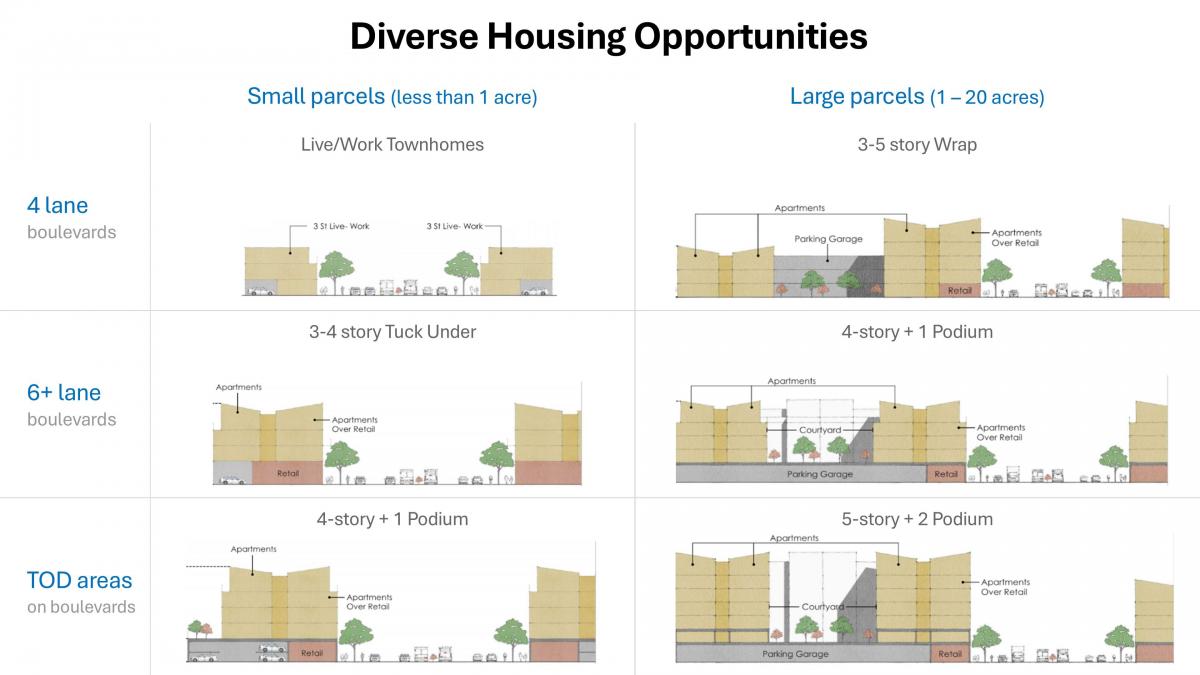
Grand Boulevards supports a diverse mix of residential types, including workforce and affordable apartments, mixed-use mid-rise buildings, missing-middle housing such as
multiplexes and townhomes, live-work units, and transit-oriented residential buildings with ground-floor services. The studies focus on BRT, assuming that rail transit is cost-prohibitive in many cases.
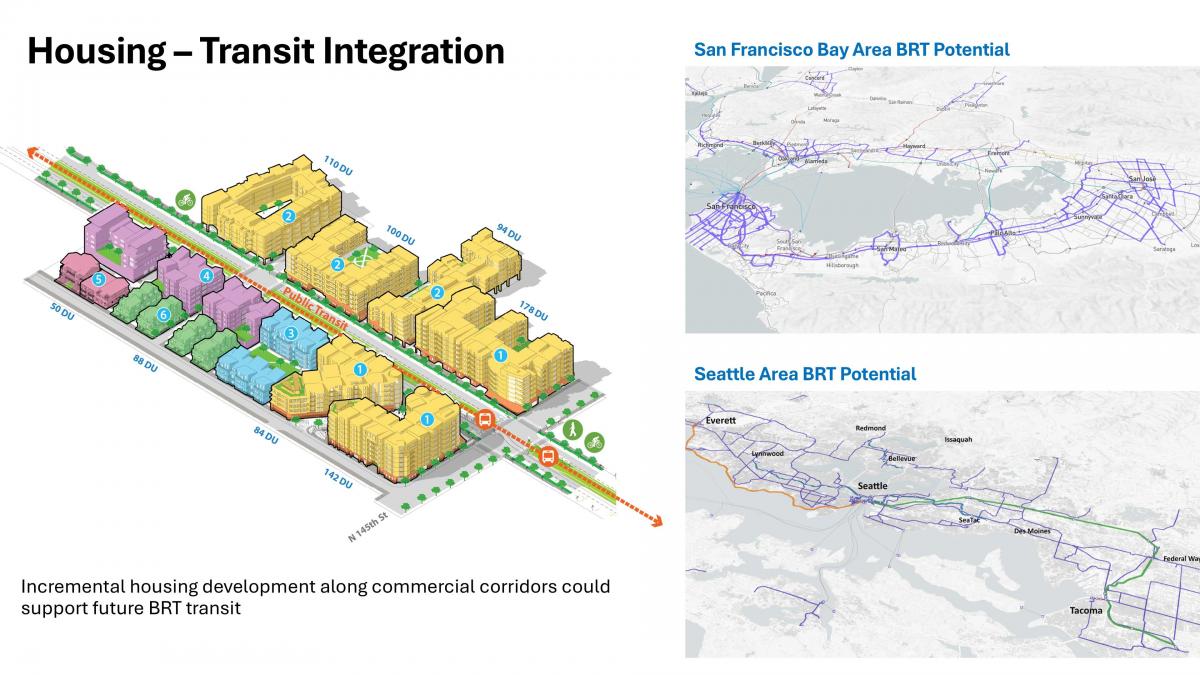
Infill housing along commercial corridors addresses the need for both affordable housing and transit service in metro areas. Incremental development allows sites to transition over time, with infrastructure changes occurring when there is a critical mass to pay for them. Housing development could, for example, pay for the construction of BRT lines, HDR explains.
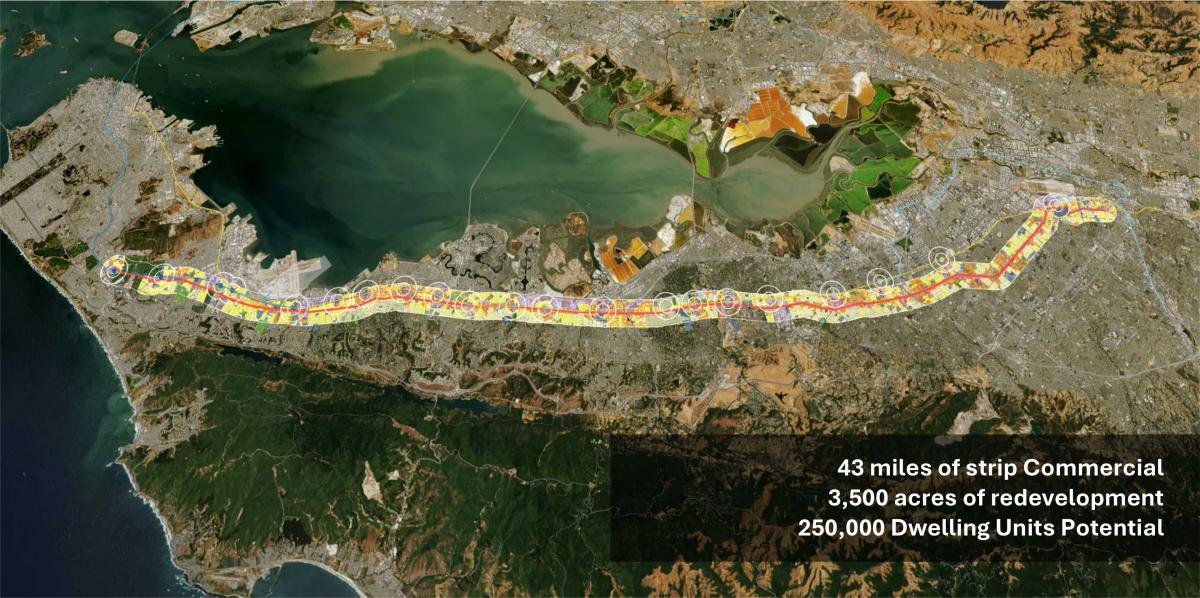
“Both studies applied a consistent set of geospatial analyses,” HDR says. “Parcels fronting four- to six-lane arterials were identified and evaluated based on size, context, and environmental constraints. A building-to-land value ratio was then used to identify underperforming sites with high redevelopment potential. Finally, development capacity was tested using form-based envelopes calibrated to roadway width and proximity to transit.”
The economic analyses show that boulevard redevelopment could increase property values by 20 to 30 times current levels, contributing to local tax revenue, municipal fiscal health, and bonding capacity to support reinvestment in public, HDR reports.