Not quite urban, an ‘intentional neighborhood’ breaks ground


Today I highlight a project that is not New Urbanism. It is a hybrid between NU and conventional design. Polestar Village, scheduled to break ground in February in Fort Collins, Colorado, is described as “semi-urban.”
“We call it an ‘Intentional Neighborhood’ and it will include a walkable Village Center, Mixed Uses, Common Dining Hall and Kitchen, Car and Bike Share Programs, LEED Gold Net Zero Energy Buildings, and Sacred Space for Yoga and Meditation; the culture is based on ‘spirit, community and lifelong learning,’ says Michael Gornik, the director of Polestar.
The developer is a non-profit called Polestar Gardens, Inc., dedicated to the “physical, mental, and spiritual well-being of students of all ages.” Capital was raised through crowdfunding: many of the 40 investors will live in the village. Polestar ran a wellness and spiritual retreat on the big island of Hawaii until volcanic eruptions and molten lava forced its evacuation in 2018. The group searched for a new site and settled on a 20-acre property in Fort Collins, on the Front Range of the Rockies. It has been a long road to put shovels in the ground.
What is New Urbanist?
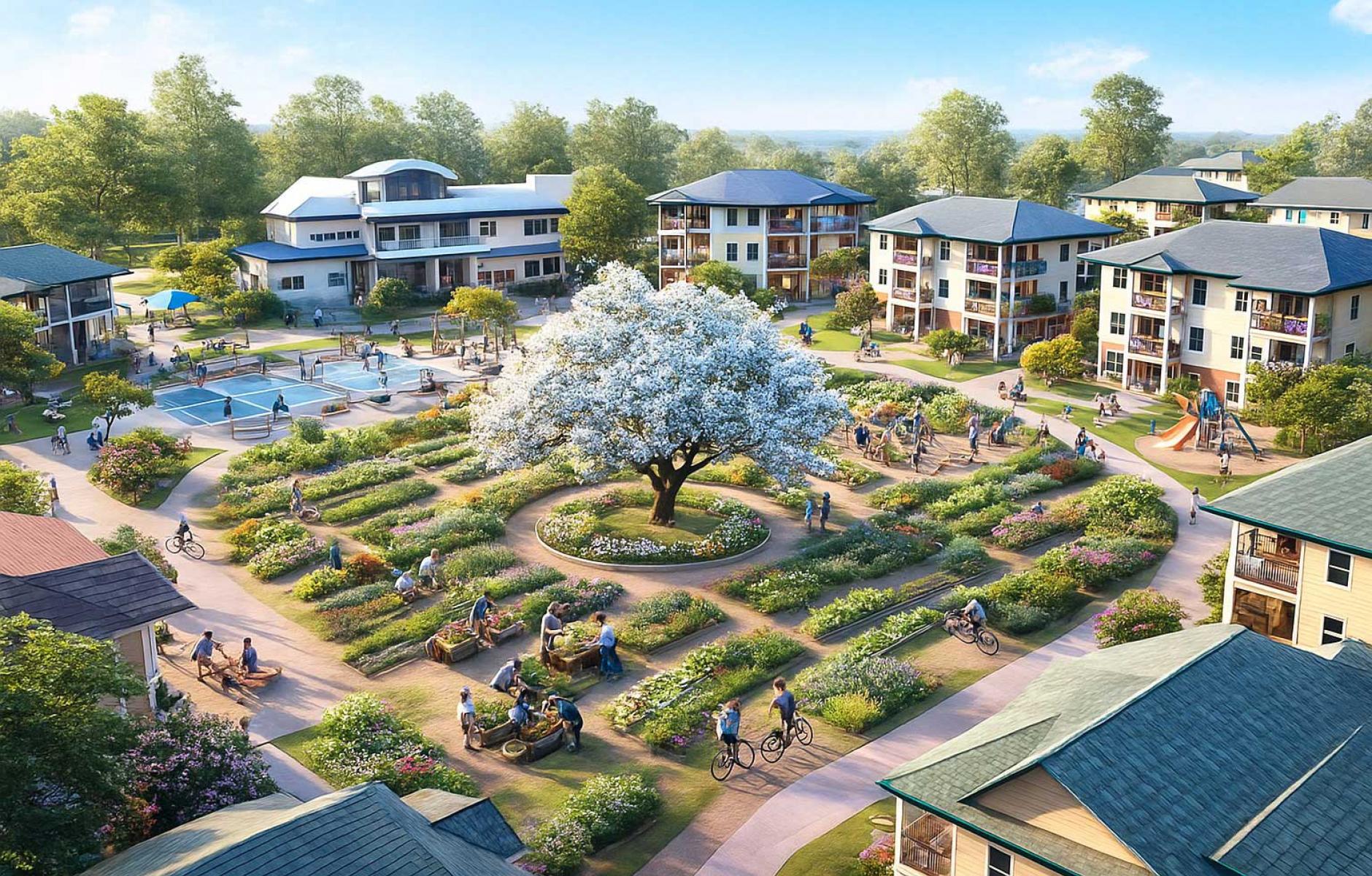
The mixed-use village center is focused on community gardens and includes a community center, playground, pavilion, pickleball courts, wellness center, “agricultural building,” greenhouse, and a commercial building with apartments above. Small apartment buildings and townhouses also front the gardens. The project has a mix of housing types, largely of the "missing middle" variety. The center has walking and biking paths that connect to surrounding residential areas. The primary through street is narrowed at multiple crossing locations to ensure that cars move slowly.
What isn't New Urbanist?
The block structure, at a glance, is similar to that of conventional suburbia. The single-family lots look conventional and are separate from the other building types. For townhouses that have garages (many don’t), they face the rear, along the streets, which serve the purpose of alleys. The fronts of the units face block interiors. In this way, Polestar Village draws on the Radburn planning concept (1929).
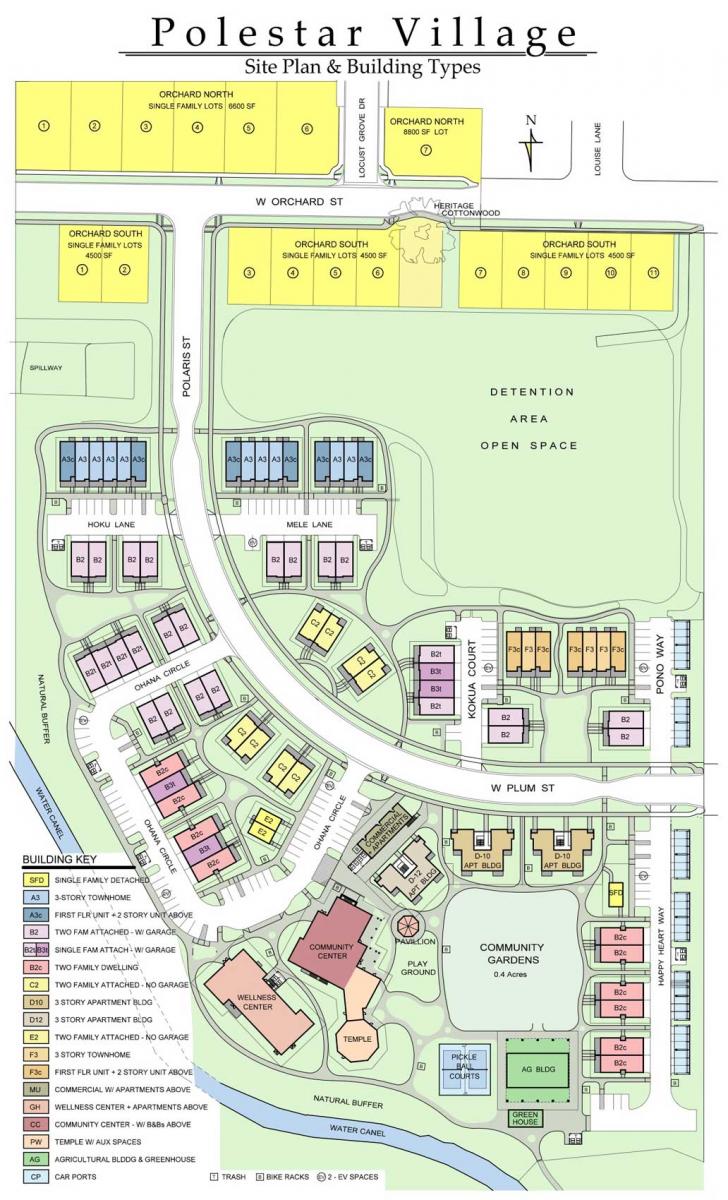
Also, as in Radburn, the interior of the blocks, away from the street, are where the pedestrian walkways are located. No cars are allowed to cross these walkways, which often pass by inner-block public spaces. The walkways are extensive—a significant infrastructure investment for the community. The many pathways will offer a wide variety of routes for a stroll—or to head to the village center.
Most of the community’s parking is in head-in spaces on the street, many along the edges of the development, with some spaces covered. The apartments, many townhouses, and community buildings do not have attached parking. There are no parking lots.
Radburn, New Jersey, was, in some ways, the beginning of modern suburbia. But it had higher ideals and better design than later suburbs. Polestar Village harkens brings back some of those suburban ideals, and adds a few of its own.
Polestar heavily emphasizes healthy living, food production, and community. The programmatic focus on health and community aligns with New Urbanism. Also, the development connects several suburban streets that are now dead ends. It will improve the overall connectivity of the area.
Gornik explains, “It took us four years to get through entitlements, but it was worth it for the location. With the 'Maxline' bus service one block away, along with our car and bikeshare programs (Fort Collins is a platinum-rated biking city), it would be very easy to live here without a car.”
Asked why the entitlement took so long, he said: “This was a complex project and the city process was difficult to say the least! The costs associated with such an extended timeline significantly reduced our ability to deliver affordable and attainable housing.”
Yet the location is ideal because Fort Collins is a college town, where the Polestar philosophy will be appealing. On the west side of the city, the village is nestled against the foothills of the Rockies, with miles of trails, the Horsetooth reservoir, and a state park nearby.
The 144-unit village is sincerely focused on community building, with many practical components designed to ensure that people connect, maintain an active lifestyle, and eat well. Typical New Urbanist design is more sophisticated than Polestar Village, and yet there is something relaxed and appealing about the plan. You can tell that walking would be pleasant and easy, like on a campus. The lack of parking lots and/or housing dominated by garages makes a big difference.
Centering a village on community gardens is clever because gardens are social. Vegetables and gardens are a center of conversation, and the owners will be motivated to keep their plot weeded and looking good, because all the neighbors will know if they don’t. The adjacent pickleball and playground should make for a lively gathering spot.
My guess is that Polestar Village will appeal to people who want a stronger sense of community. However, much of the village will need to be built for it to come together as envisioned. Until that happens, they will need to sell the dream of living in a place that offers a healthy lifestyle and neighborly support.