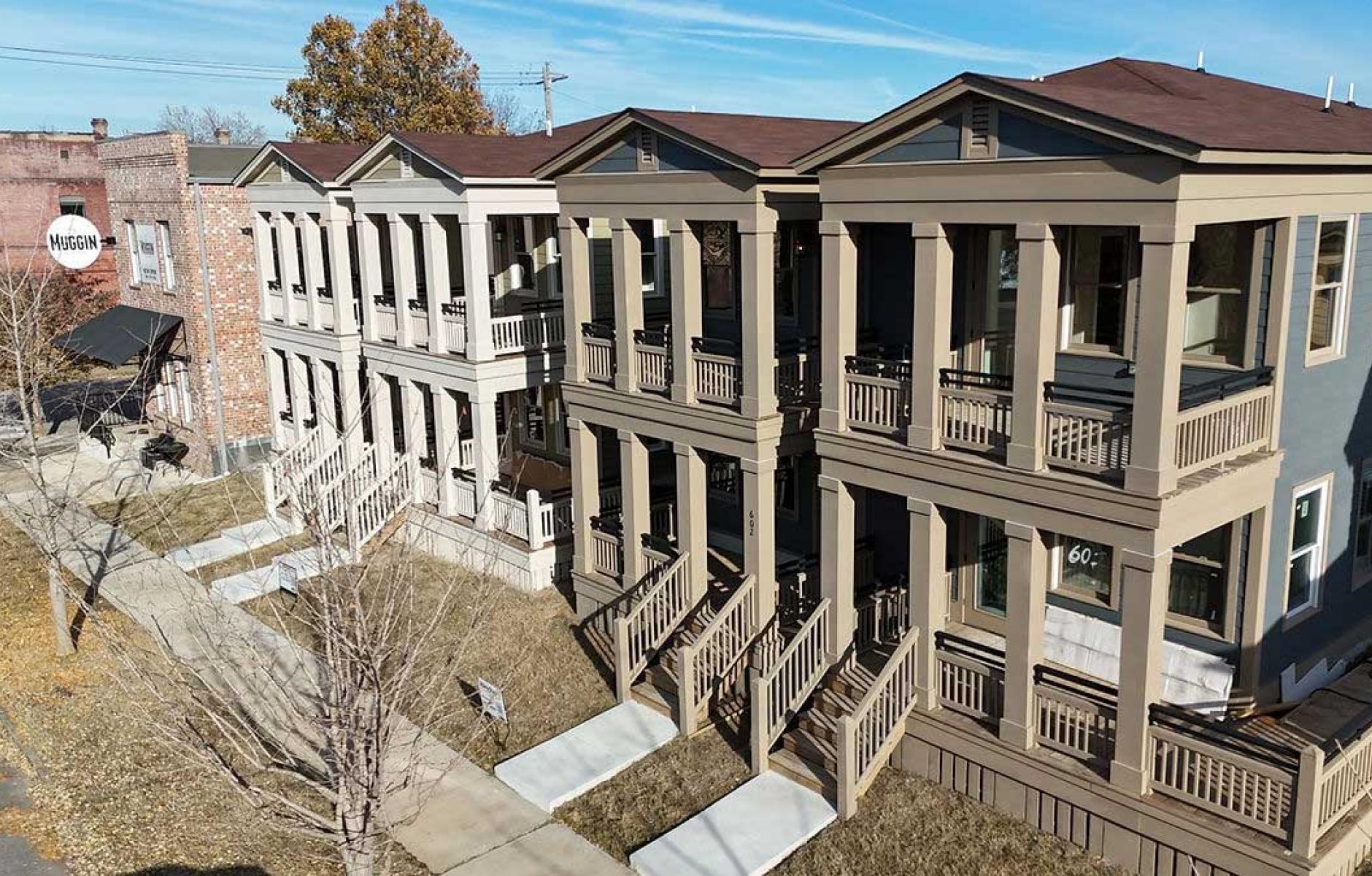
Your city legalized triplexes. The building code said no


The urbanist movement has won real fights on zoning, parking, and single-stair reform. But there’s a bottleneck that doesn’t get enough attention: the building code draws a hard line between two dwelling units and three.
Once you cross that line, you leave the International Residential Code and enter the International Building Code, which governs everything from triplexes to skyscrapers. A fourplex builder faces the same commercial-grade design process as a 200-unit apartment project. So, builders who could be filling neighborhoods with triplexes, fourplexes, sixplexes, and small apartment buildings stick to duplexes, or skip straight to large multifamily. The reforms we’ve passed on paper aren’t producing the buildings we expected.
The fix is straightforward: expand the IRC to cover small apartments.
The divide
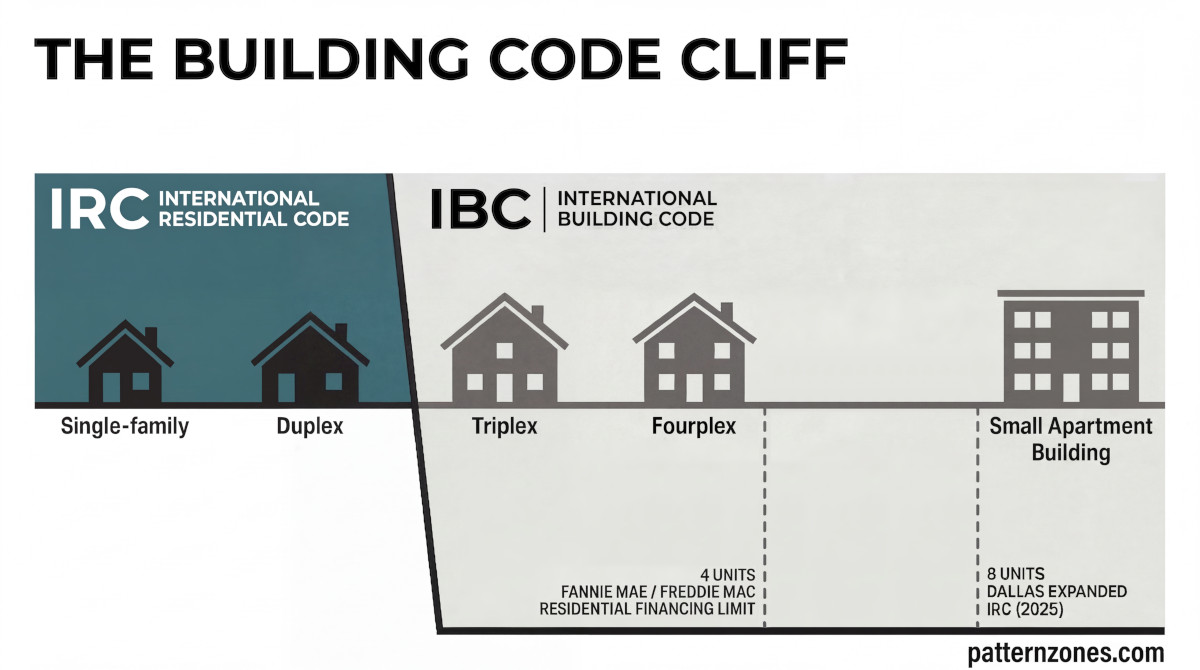
The IRC currently covers one- and two-family dwellings and townhouses. Everything with three or more units that isn’t configured as townhouses falls under the IBC.
Townhouses are supposed to stay in the IRC regardless of how many units are assembled, but in practice, local building officials interpret the rules differently depending on how utilities are routed and whether there are shared service lines. Some officials will place townhouse projects in the IRC but require sprinklers (and, in some states, architect licensure) as a compromise. The inconsistency itself is part of the problem. When the model code leaves gray areas, builders face unpredictable requirements from one jurisdiction to the next.
For someone trying to build a triplex or fourplex or other small apartment building, the IBC means commercial-grade engineering studies, longer permitting timelines, and higher design fees. This isn’t a marginal cost increase. It’s a different class of project entirely. As Dallas council member Paul Ridley put it: “Our code today treats a four-plex the same as a 200-unit apartment building. That doesn’t make sense.”
Residential builders know the IRC. Their loan products are built around it: Fannie Mae and Freddie Mac offer residential mortgage products for up to four units. Many residential builders simply won’t take on IBC projects. They don’t have the staff, the consultants, or the margins.
The multiplier
Expanding the IRC isn’t one more item on the reform wish list. It’s the reform that makes the others work.
Start with zoning. States and cities across the country (Oregon, California, Washington, Minneapolis, Portland, Raleigh) have legalized triplexes and fourplexes on formerly single-family lots. But if adding a third unit triggers the IBC, most residential builders won’t do it. In Austin, even with fourplexes allowed by right, local builders prefer to build a single duplex rather than cross into IBC territory. Expanding the IRC closes the gap between what zoning allows and what actually gets built.
Pre-approved building plans tell the same story. Several jurisdictions are creating portfolios of pre-approved residential designs to speed up permitting. This works under the IRC, which is prescriptive and standardized. The IBC requires project-specific review, a poor fit for standardized plan sets. If you want pre-approved triplexes and fourplexes, you need them in the IRC.
Single-stair reform follows the same logic. The IRC already permits single-stair construction. Moving triplexes, fourplexes, and other small apartments into the IRC resolves the single-stair question for those buildings without a separate reform, complementing the 19 states that have introduced or passed single-stair legislation for taller IBC buildings.
And cities that have removed parking minimums or reduced minimum lot sizes are creating smaller, tighter infill sites that only work financially if you can build simply and cheaply. The IBC’s design overhead eats the cost savings these land-use reforms were supposed to create.
Each of these reforms is stronger with an expanded IRC.
The case for national reform
The national model code needs to change. The IRC’s scope is limited to one- and two-family dwellings and townhouses, and expanding it requires action by the ICC Board of Directors. As part of developing the 2027 IRC, Proposal RB1-25 tried to bring triplexes and fourplexes into the IRC. It was voted down 10-0 in committee. The committee maintained that expanding the IRC’s scope is a Board decision and raised safety concerns about increasing the number of allowed units without enhanced life-safety features. The board votes on the 2027 code in May.
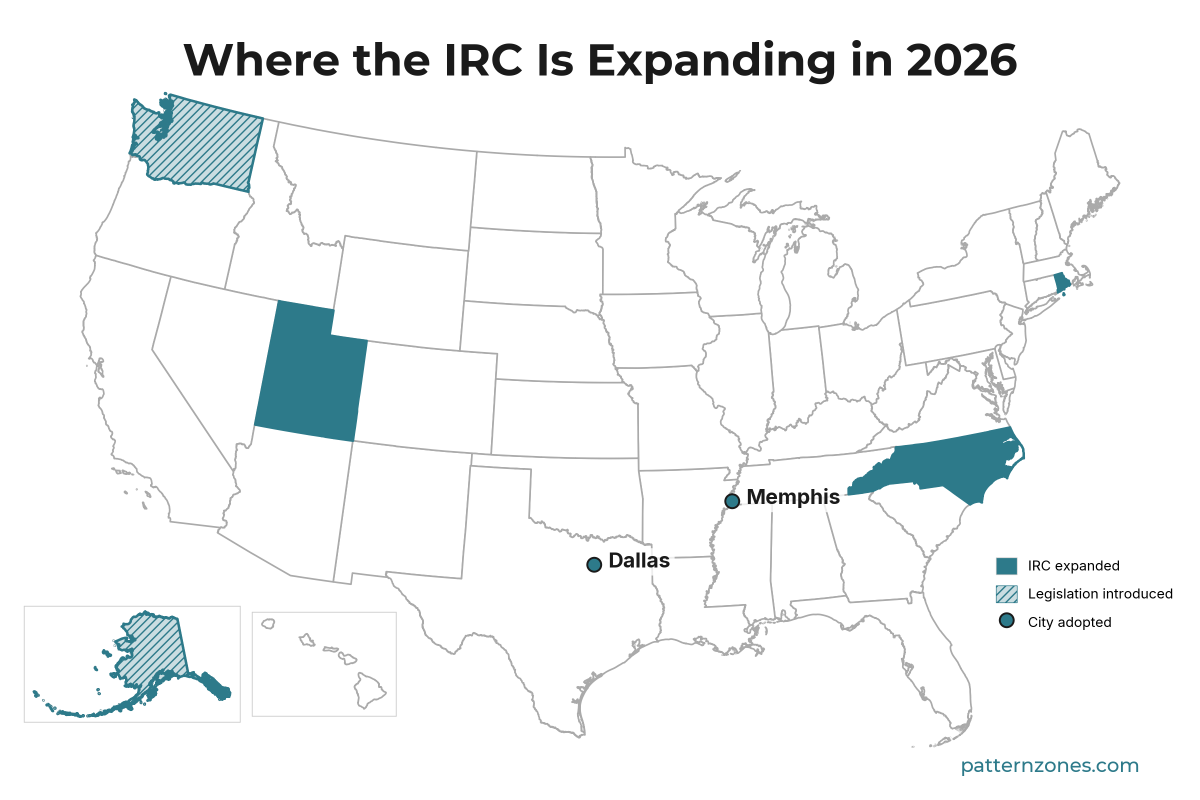
This rejection matters. Without a change to the model code, reform depends entirely on local and state workarounds. Several places have shown this can work. Dallas passed a “1 to 8 Dwelling Units” ordinance in April 2025, unanimously, allowing up to eight units under a modified IRC. Memphis has allowed up to six units since 2021, using tiered fire protection. North Carolina adopted HB 488 to bring triplexes and fourplexes under the state residential code statewide. Alaska, Rhode Island, and Utah have introduced similar legislation.
These local and state efforts are valuable: they prove the concept, and they produce housing now. But a patchwork of local amendments is not a solution at scale. Builders who work across jurisdictions need a consistent standard. The model code is where that standard gets set.
There’s also a question of how far to expand. The RB1-25 proposal only covered triplexes and fourplexes. Dallas went to eight. There are good reasons to push further.
The first is financing. Fannie Mae and Freddie Mac’s residential mortgage products top out at four units. At five and above, a project crosses into commercial lending: different underwriting, larger down payments, fewer loan products. Expanding the IRC to at least four units would align the building code with residential financing thresholds.
But the second reason pushes higher. Research from the Terner Center at UC Berkeley found a roughly 10 percent cost premium when projects cross from two to three units and trigger the commercial building code — and that even with fee reductions and residential code eligibility, fourplexes require stacked policy interventions to pencil. Infill stress tests conducted for cities including South Bend, Kalamazoo, and Overland Park corroborated that multifamily infill typically requires six to eight units per parcel to pencil as a conventional private investment. That’s why Dallas’s move to eight units matters as a precedent, and why there’s reason to push further still. Traditional neighborhoods have always included small apartment buildings alongside houses and duplexes. The IRC’s scope should be broad enough to cover them.
The safety question
Fire safety advocates have focused their opposition on sprinkler protections, but sprinklers are one element of a much larger regulatory burden. The IBC imposes commercial-grade engineering, dual-egress requirements, fire-rated corridor systems, and extended plan review. These requirements were designed for large multifamily and commercial buildings. Even if every sprinkler requirement stayed in place, removing these other IBC-sourced burdens would be a significant win for housing advocates.
On fire protection itself, the question is what’s appropriate for buildings of this size. Memphis has offered a working answer since 2021: fire-rated separations between dwelling units as the primary strategy, with sprinkler requirements scaled to building size. Buildings under 5,000 square feet use NFPA 13D systems with one-hour rated fire separations; larger buildings up to 8,000 square feet require NFPA 13R systems. Add interconnected smoke and CO detection, non-combustible cladding, and fire-resistant framing as appropriate.
A fourplex is not a high-rise. A sixplex is not a commercial tower. Safety requirements should match the actual risk profile of the building. A tiered approach shows that urbanists and fire safety advocates can write code that is both protective and proportionate.
What comes next
This calls for action at three levels.
Push for national model code reform. The RB1-25 rejection happened in part because the urbanist movement wasn’t in the room. CNU members should become ICC governmental members and attend the hearings where the next IRC gets written. Code hearings matter as much as zoning hearings — it’s time to treat them that way.
Support state legislation. North Carolina’s statewide approach is the strongest model so far: it creates uniform standards and preempts local resistance.
Keep pushing local reforms. Dallas and Memphis show that cities can move now. Every city that adopts an expanded IRC builds the evidence base for national reform.
We’ve gotten good at fighting zoning battles. The building code deserves the same energy. Expanding the IRC to cover triplexes, fourplexes, sixplexes, and small apartment buildings is what turns our zoning wins and stair reforms and pre-approved plan programs into actual housing.