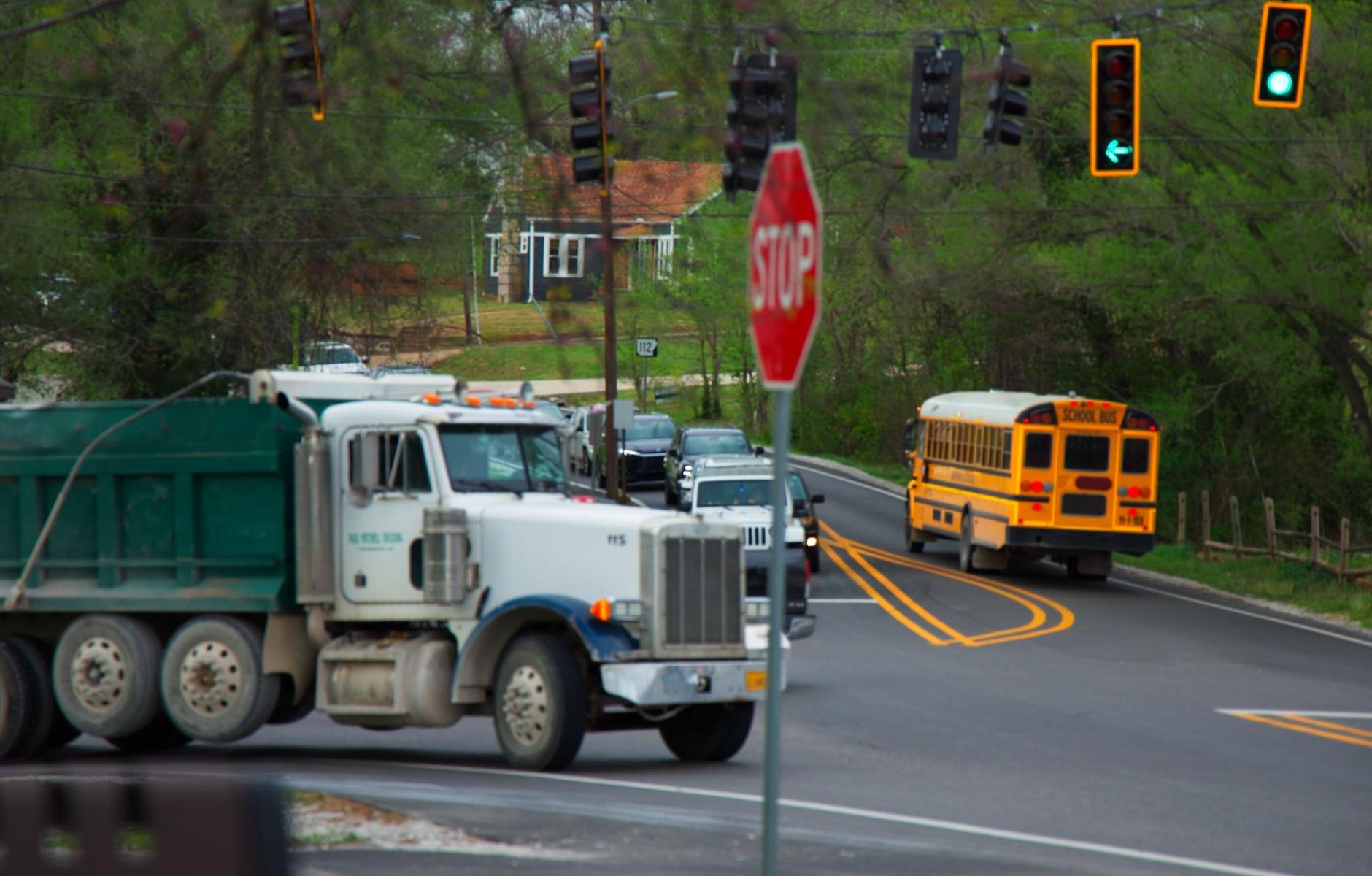
Reversing the vicious cycle of parking and traffic


The Impact of New Urbanism in Northwest Arkansas:
CNU is proud to present this article as the second of a 5-part series documenting the impact of New Urbanist principles, as presented at CNU34.Northwest Arkansas. Over five articles, we reflect on key reforms including public infrastructure investments, parking and traffic, and context-sensitive density—issues that are critical to the healthy growth of neighborhoods, cities, and towns across Northwest Arkansas, and in so many rapidly growing places across the country. This series serves as a lasting resource to those who may not have been able to attend CNU 34, and demonstrates CNU's commitment to ensuring that Northwest Arkansas has a future built on New Urbanism long after this year's transformative Congress. This series will be available for download as a complete Report on CNU 34.Northwest Arkansas following publication. ~ Mallory Baches, CNU President
The population of Northwest Arkansas (NWA) is expanding by about 40 people a day. As double-digit growth in the region has continued for six decades, two of the visible issues are traffic and parking. Most of the growth has occurred in low-density, single-use subdivisions disconnected from job centers, where every trip must be made in automobiles.
Sprawling development is built on dendritic (tree-like) road networks, where routine travel is concentrated on large arterial roads that carry most of the traffic. As growth occurs, people drive more—to and from work and for daily trips like shopping. The destinations are single-use commercial and office buildings, often lining corridors with large surface parking lots. The region has paid the price in congested traffic on Interstate 49, carrying both local and long-distance travel, and on major thoroughfares. Cars are visible everywhere on wide asphalt roads lined with parking lots. Day-to-day trips become more difficult as drivers compete for limited road space.
The response has been to widen these thoroughfares and require more parking, which adds to stormwater runoff and pollution. Wide roads and surface parking, with limited connections in between, don’t support other mobility options like walking and bicycling, and transit options are scarce. The parking increases the distance between destinations, generating ever more traffic, which soon congests any additional lanes built as new subdivisions come online. NWA has been trapped in a vicious cycle of traffic and parking issues for decades.
City planner and author Jeff Speck, who spoke at CNU 34 on walkable cities, defines the concept of “induced demand” as the phenomenon whereby widening roads or building new lanes lowers the time cost of driving, which attracts more cars and quickly fills the new capacity, leaving traffic congestion as bad or worse than before. This is especially true where roads are built in disconnected, spread-out patterns, where other mobility options are scarce or nonexistent. CNU 34 was held in mid-May in Bentonville and Fayetteville, with events and tours throughout the region.
“Across Northwest Arkansas, many daily trips are forced onto major corridors because local connections are limited,” according to Growing Home NWA1, a regional growth strategy report that was presented at CNU 34. “Congestion is common not only on I-49 but also on key routes such as Walton Boulevard and SE 14th Street in Bentonville, Pleasant Grove Road in Rogers, Sunset Avenue in Springdale, and College Avenue in Fayetteville. These roads carry both regional traffic and short local trips because nearby streets often do not connect.”
Mixed-use, walkable development, on the other hand, tends to capture trips within a neighborhood, reducing strain on regional infrastructure. This trip reduction in New Urbanist communities, and in walkable historic places, can be calculated using formulas based on observable patterns. So, the investment in certain kinds of thoroughfares, a connected network of streets, does not induce traffic. These networks reduce traffic and disperse it.
When more local routes are available, people can reach nearby destinations without entering the busiest corridors, as Growing Home explains. A connected network reduces pressure everywhere by giving traffic more paths, not bigger bottlenecks. The network is comprised of many kinds of thoroughfares, all serving specific purposes.
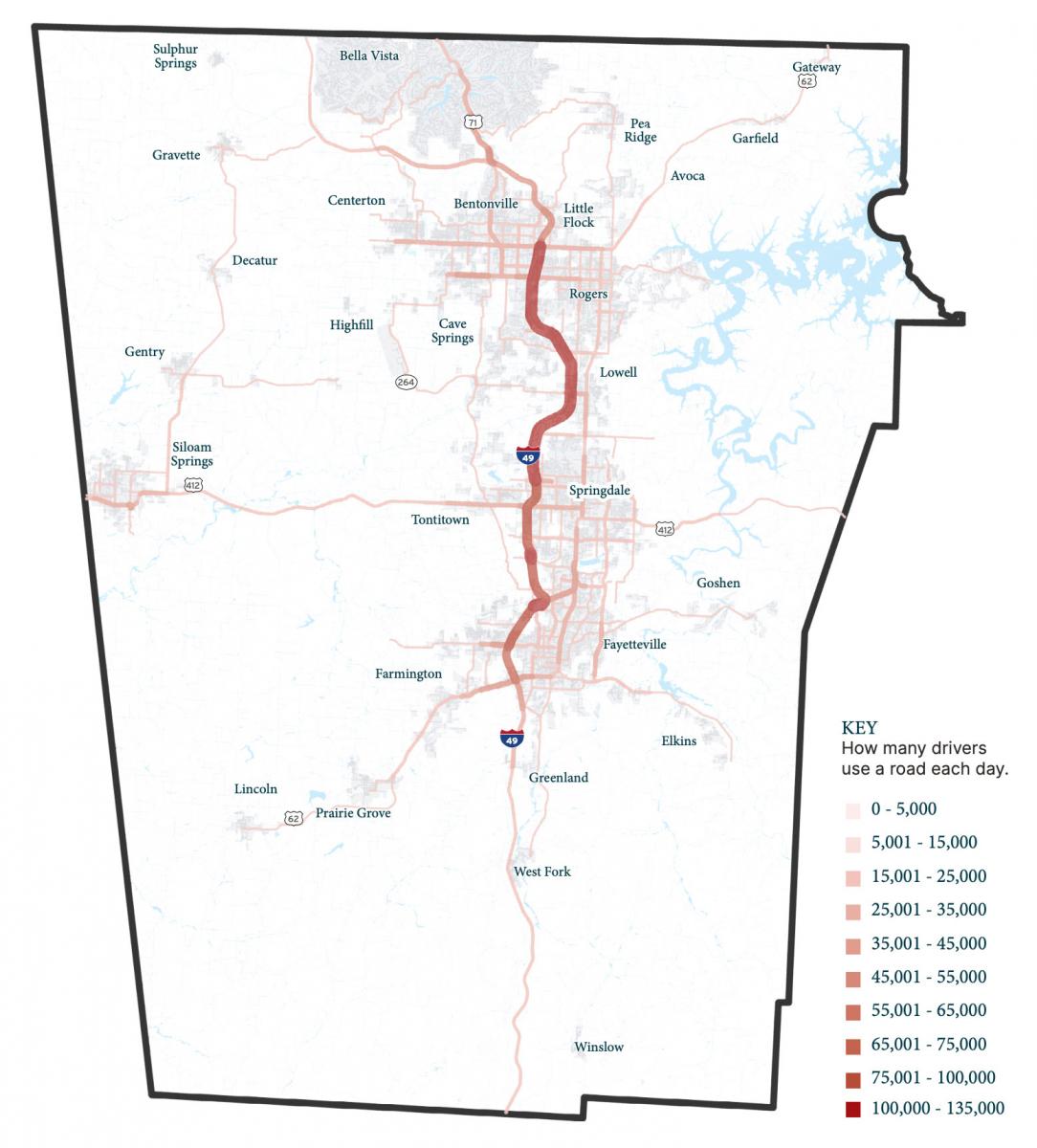
“A connected transportation network works best when each part plays its role,” notes Growing Home, funded by the Northwest Arkansas Council with lead planner DPZ CoDesign. “Interstates are meant to carry long-distance travel and freight, while major roads connect cities and job centers. Local streets handle everyday trips such as getting to school, the store, or a neighbor’s house. When these layers work together, traffic spreads across the network instead of concentrating in a few places. … Growth in places with connected networks reduces congestion.”
Most trips in Northwest Arkansas will continue to be made by car, but improving travel means providing more options, not just wider roads. Building in a way that expands mobility options, improves connectivity, and mixes uses eases traffic problems even as regional growth continues. “When homes, jobs, and services are closer together and routes are better connected, trips become shorter and traffic pressure is reduced. Additional connections help spread traffic rather than concentrate it on a few corridors,” Growing Home explains.
CNU 34 attendees learned firsthand about the limited alternatives to driving across the region. CNU created its own temporary transit system between Fayetteville and Bentonville during the Congress to move attendees between venues 35 miles apart. NWA needs better transit service to provide mobility options to reduce traffic on congested roadways. Bus rapid transit (BRT) is planned in a number of corridors, but compact, walkable development will make those lines work better.
The traffic issue is tied to housing affordability. Since new housing is being built far from job centers, transportation costs rise for households that must drive to the region’s larger cities to work. The region needs a wider range of housing options closer to where the jobs are. This will allow households to reduce their transportation costs, putting less strain on household budgets.
Parking
Surface parking spreads buildings out, making walking less convenient and more unpleasant because you have to walk past parking lots. So, people drive more, which means that you have to build more parking. This makes walking even less convenient. If you reduce off-street parking requirements and build structured parking, on the other hand, that enables walkable, mixed-use development, and the whole process runs in reverse. In an urban environment, you get reduced demand for driving and parking. NWA has already begun to make that shift.
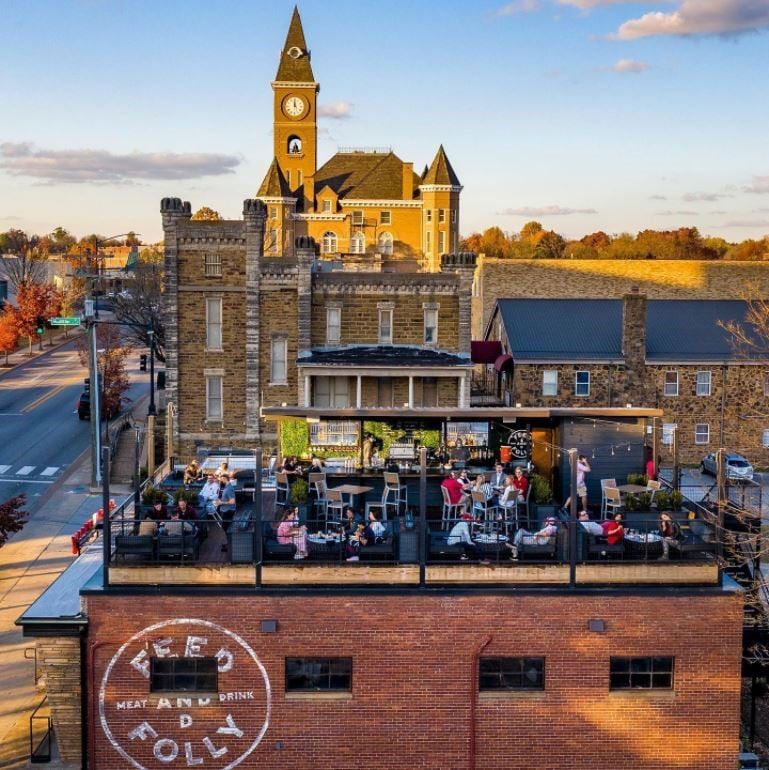
Two of the region’s larger cities, Rogers and Fayetteville, have enacted significant parking reform. Rogers eliminated minimum parking requirements citywide. Fayetteville eliminated minimum parking requirements for commercial properties, while residential parking minimums may be reduced through transit provision and bicycle and micromobility parking.
The elimination of commercial parking minimums in Fayetteville has enabled properties near the central square to be reoccupied with active uses. They became viable business locations close to the heart of town. Fayetteville also enacted parking maximums. In conventional suburban parts of the city, far from the square, some businesses want to build more parking than the maximum allows. But they must request an exception. For Fayetteville, the change has generally been positive, because many businesses stay within the cap. Business owners and citizens have become more conscious of the negative effects of parking, particularly the implications of impervious surfaces on stormwater management.
Eliminating parking requirements has helped revitalize Rogers’ downtown, with important implications for municipal finance. Surface parking doesn’t generate much tax revenue. Walkable urban places don’t need as much parking. And they can use on-street parking, which is the most efficient option because it is entirely flexible and can be shared 24 hours a day. It also psychologically protects pedestrians from moving traffic and even calms traffic by creating friction between parked and moving vehicles on multifunctional urban streets.
A more difficult parking challenge is presented along the region’s commercial corridors, which take the form of unsightly, generic strips that look like “anywhere, USA.” Growing Home NWA reports: “US 71 business is lined with parking lots and low-scale buildings that don’t deliver the tax revenues and community-centered character that the region’s downtowns provide.” If some of these parking lots were developed with mixed-use, these corridors would perform better from a fiscal standpoint and also provide housing that doesn’t occupy more of the countryside.
Even cities in NWA that have not reformed their parking regulations are becoming more aware of the positive effects of reducing surface parking on stormwater, community character, and municipal finances. Yet parking remains a challenge. The region still has many developers who specialize in sprawl and want to provide a lot of parking. In some cities, there are perceptions of parking problems—particularly in neighborhoods with high concentrations of students in Fayetteville. And yet parking reform is becoming a popular bipartisan issue, and this is true in many parts of the US.
The State of North Carolina, with a Republican legislature and Democratic governor, adopted a law2 in July that lifts minimum parking requirements in cities. The idea is that this law is expected to open up some properties for development, reduce costs in other projects, and lower overall housing costs. It allows developers to decide how much parking to offer—in some cases, a lot; in others, none. The law may also reduce stormwater runoff problems. “Parking proved to be an issue that could bring North Carolina together,” notes Governing magazine.
As NWA grows, parking and traffic are important issues that could bring the region together on the road to more sustainable growth. Better connected, mixed-use development tends to reduce overall traffic problems. That land-use pattern supports reduced surface parking and better utilization of on-street parking. Overall, NWA is moving toward more fiscally sustainable policies related to traffic and parking. Continued movement in that direction will be key to healthy regional growth in coming decades.
References
1Growing Home NWA website, www.growinghomenwa.com, 2026
2Brey, Jared, “North Carolina Finds a Consensus Issue in Parking Reform,” Governing, August 5, 2026