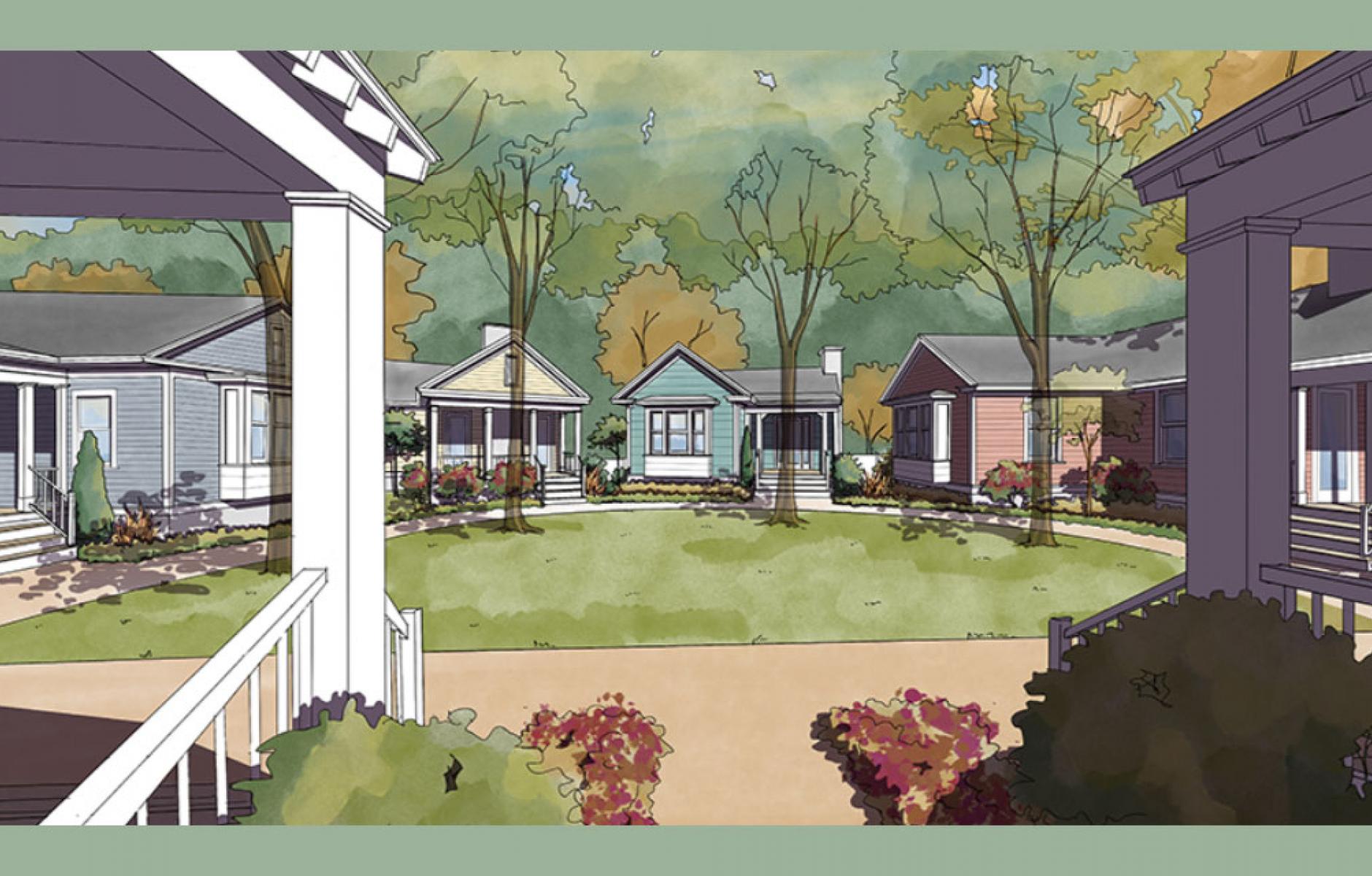
Three courts, three conditions, one neighborhood


Selah is a traditional neighborhood development outside Norman, Oklahoma. Sommer Design Studios was part of the original masterplan team from the beginning — working alongside Brown Design Studio as lead, Moser Kelly Design Group on landscape, and Thompson Placemaking on the urban design framework. Together the team laid out the street grid, the open space system, the mix of lot types, and the organizing principles that give Selah its character as a place.
A couple of years later, we came back.
The southern section of the neighborhood needed refinement. The market had spoken — buyers wanted product diversity, and certain parcels in the southern section had conditions that conventional lots would have handled clumsily. Awkward geometries. Edge conditions along alleys and streets that didn't suit standard residential development. And a growing appetite for a smaller, more affordable entry point that the existing lot mix couldn't provide.
We knew the neighborhood intimately — we'd helped design it. That familiarity shaped everything that followed.
A few meetings with the Selah Development Group team. Some back and forth on programming — what each court needed to do, who it was for, how it fit into the southern section's overall mix. Then a few days of refinement work. Three courts, ready for development.
That efficiency is worth noting, because it's not accidental. It's what happens when a plan collection exists, when the design intelligence is already built in, and when the architect knows the neighborhood from the ground up. The cottage court isn't a complicated building type to design well — if you have the right tools and the right context. The answer was three cottage courts. Each responding to a different site condition. Each serving a different program. All drawing from the same kit of parts. Same plan collection. Completely different experiences.
The Kit of Parts
Before describing the three courts, it's worth explaining what we mean by a kit of parts — because it's central to how this project works.
The SDS plan collection is a library of traditionally-designed residential plans developed over years of practice. Individual cottages. Small houses. Larger homes. Each plan is designed to work within a traditional neighborhood framework — appropriate setbacks, porch relationships to the street, plans that feel like homes rather than units. Each is drawn for a specific transect zone, so the architect and developer know exactly where each plan belongs within the TND's organizing framework.
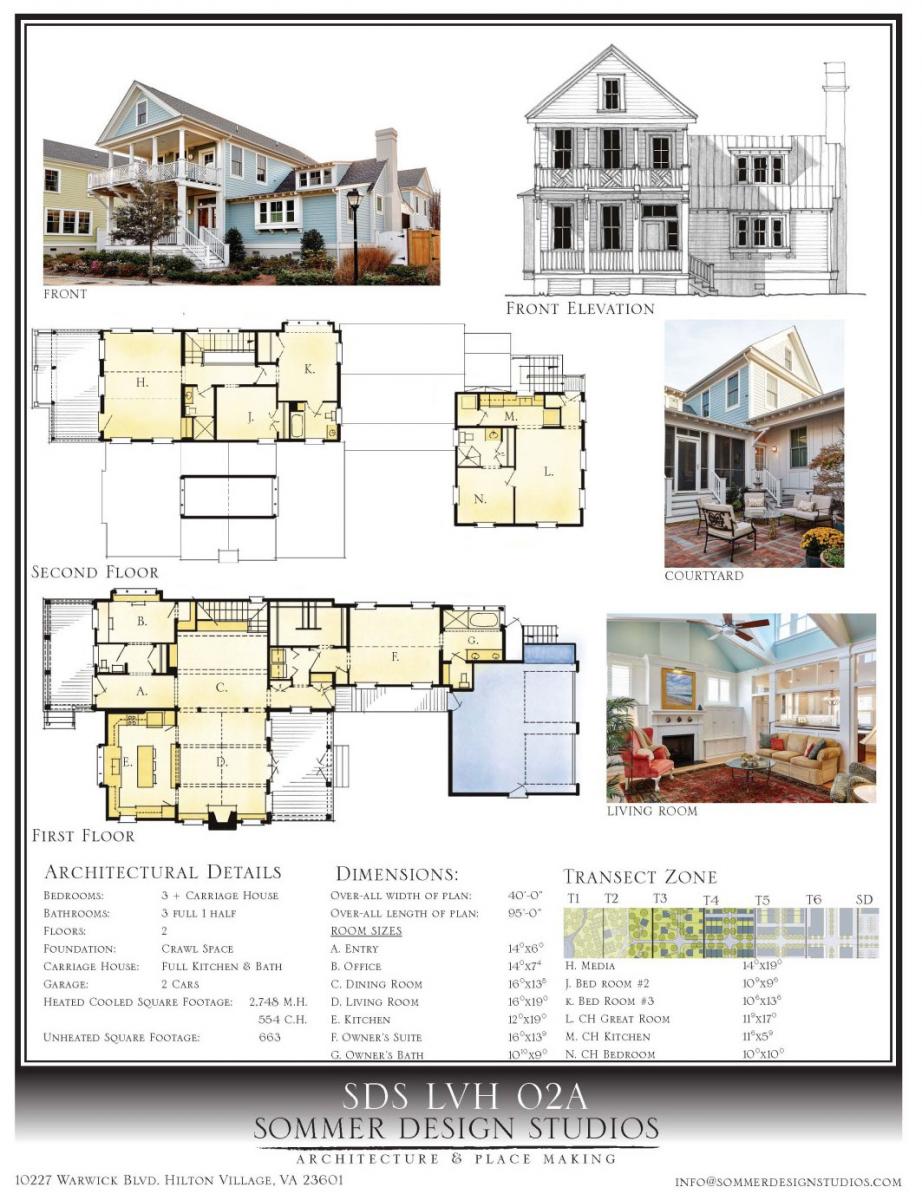
Using a plan collection on a cottage court project does two things. It compresses the design process — the developer isn't waiting for custom plans on every unit. And it produces a kind of coherent variety that's actually harder to achieve with fully custom designs. The plans share a design language. They look like they belong together. But because they have different footprints, different roof forms, different porch configurations, they create visual rhythm rather than repetition.
Three courts. Same collection. Three different results.
Court 1: The green street
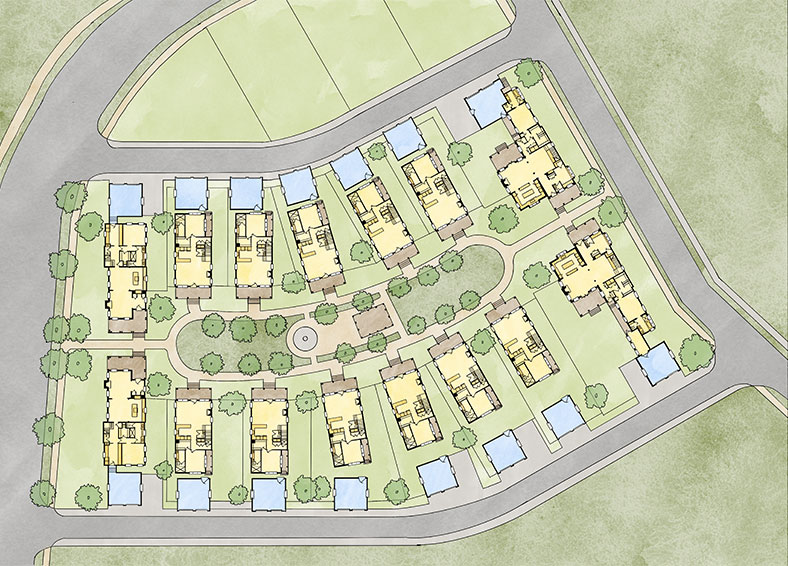
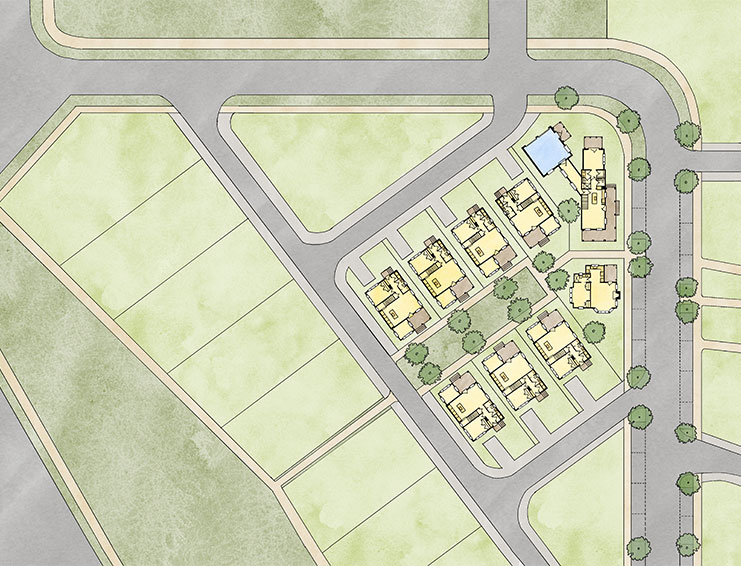
Court 1 is the largest and most park-like of the three — 1.94 acres, 15 units, 7.7 dwelling units per acre (DUA). That density figure is modest by missing middle standards, and deliberately so. The developer and the design team wanted this court to feel like a green street — a landscape-first condition where the cottages open onto a shared green that is as much park as it is shared yard.
The site is bounded on either side by streets and alleys along the length of the block. That double-frontage condition gave us something valuable: the cottages could be accessed from the alley, leaving the green entirely car-free. The result is a linear park with cottages on both sides, each with a front porch facing the green, a pedestrian path connecting the whole composition, and a shared fire pit at the center.
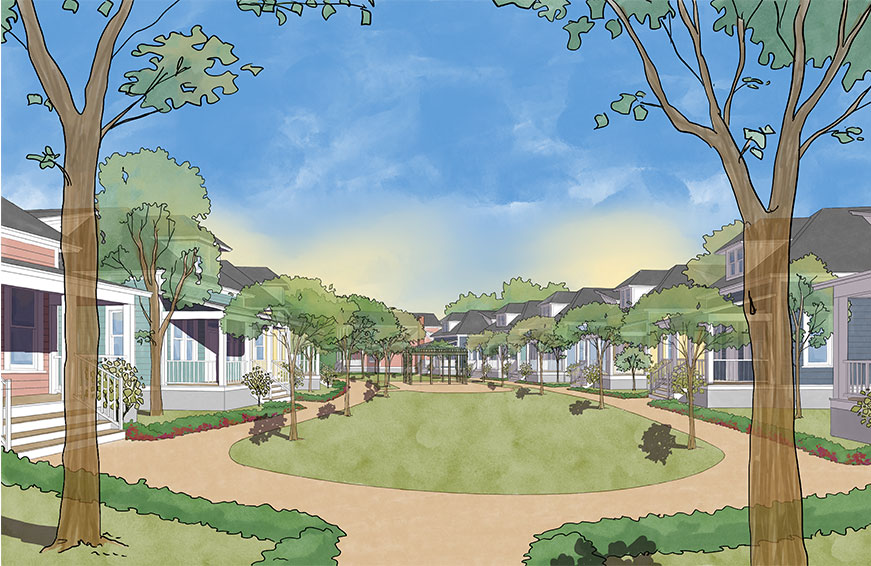
Four larger homes anchor the ends of the green — different plans from the collection, deliberately chosen to frame the entries into the space and provide a sense of enclosure at the terminations. This is a detail worth noting: the framing homes aren't an afterthought. They're doing urban design work, giving the green a beginning and an end, signaling to someone approaching from the street that they're entering something intentional.
A 7,000-square-foot park is woven into the court's landscape — shared picnic space, the fire pit, enough room for the incidental community moments that make a neighborhood feel alive.
At 7.7 DUA, this is gentle density in the truest sense. A visitor walking through wouldn't guess they were in a development at all. It reads as a neighborhood green with homes around it — which is exactly what it is.
Court 2: The rectilinear green
Court 2 is the most intimate of the three. Nine units on 0.63 acres — 14.3 dwelling units per acre. Nearly double the density of Court 1, on less than a third of the land.
The site was bounded on three sides by alleys, which solved the parking problem immediately: vehicles access every unit from the rear, leaving the entire interior of the court pedestrian. The two lots that face the public street do something more sophisticated than simply turning their backs on the neighborhood — they address both the street and the green simultaneously. One is a small cottage with a bedroom bay window looking out to the green and a porch facing the street. The other is a variation on a small house with a wraparound porch and a garage addition that mediates the corner condition.
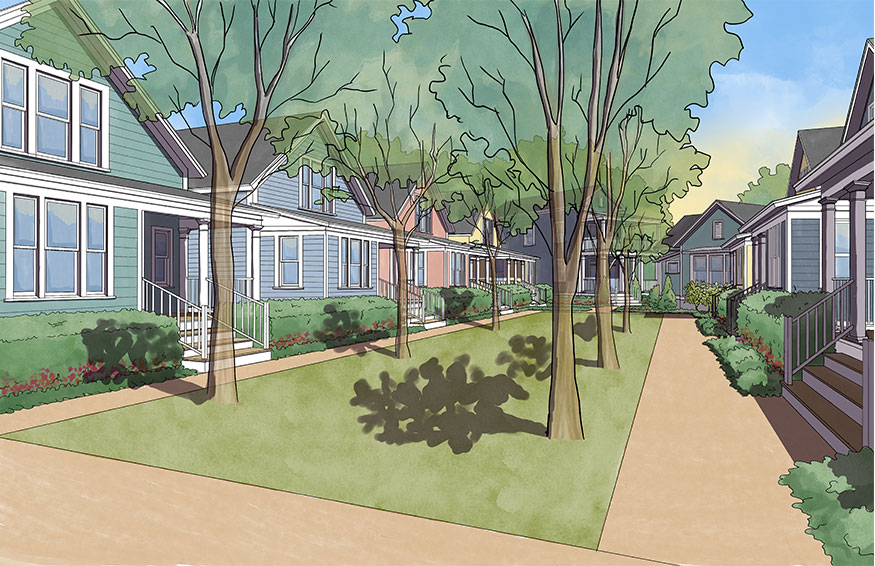
These two street-facing units frame the entry to the court from the public sidewalk — you can see into the green from the street, enough to understand what's there, not so much that the interior world is exposed. It's the right calibration between invitation and enclosure that makes a cottage court feel like a destination rather than a development.
The rectilinear green is tighter than Court 1's linear park, which changes the social dynamic entirely. At nine units, everyone knows everyone. The green is small enough that a gathering at the fire pit is a neighborhood event, not a coincidence. This is the most community-oriented of the three courts — and it achieves that not through programming or amenities but through scale.
The green connects at the rear to a public path that leads to a larger community park beyond — a sequence of outdoor rooms that links the intimate scale of the court to the broader neighborhood framework. Cottage garden to neighborhood park to TND open space. Three scales of public life, connected.
Court 3: The crescent
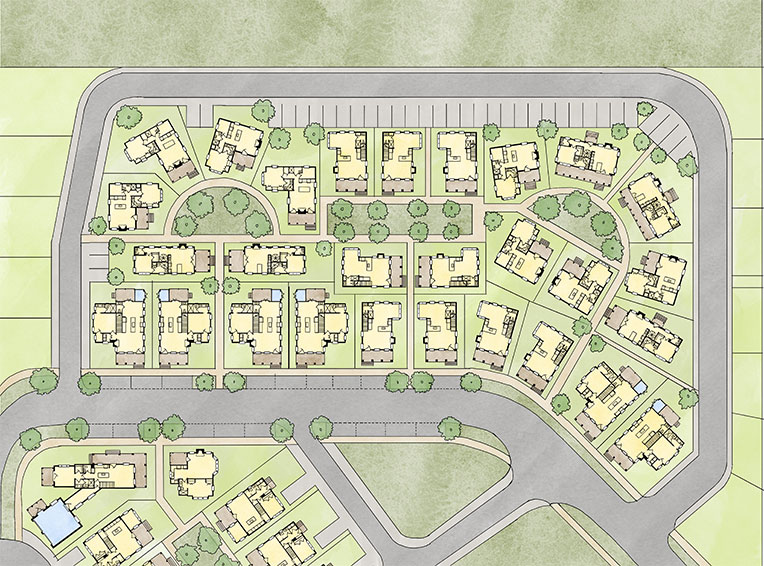
Court 3 is the most complex and the most urban. Twenty-eight units on 1.69 acres — 16.6 dwelling units per acre. This is meaningful density, delivered in a form that reads as neighborhood rather than development.
The site presented an edge condition — bounded on three sides by alleys while the front runs along the street. The design solution: a series of homes facing the street that maintain the neighborhood's continuous streetscape while providing three entries into the back cottage courts. Those entries are thresholds — moments where the public street gives way to the semi-private world of the greens.
Behind the street-facing homes, the courts are organized around three distinct crescent-shaped greens, connected by a series of paths. Each crescent is its own community — small enough to have its own identity, connected enough to be part of something larger. The parking lives entirely at the site's edge, accessed from the alleys. Not a single car touches the pedestrian world of the greens.
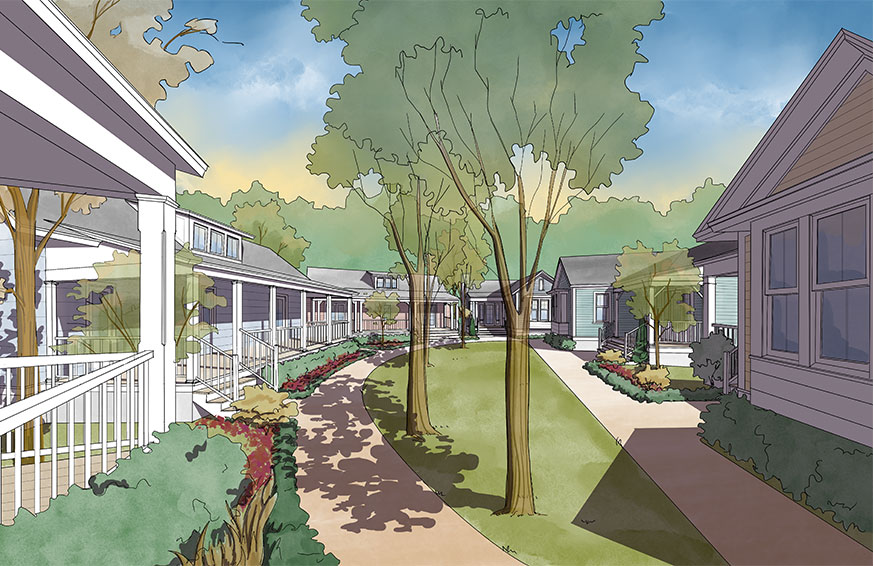
Court 3 is programmed as short-term rental — specifically designed for University of Oklahoma game day weekends and extended stays near Norman. That program shaped specific design decisions: parking at the perimeter becomes essential rather than optional when you're managing multiple arriving and departing parties simultaneously. The plans selected from the collection are slightly larger than the Cavalier cottages — guests need more room than permanent residents in small homes. The street-facing homes that maintain the streetscape are full residential plans, not cottages, which adds a layer of scale variation that makes the composition read as a real neighborhood block rather than a resort.
The game day program is worth lingering on, because it illustrates something important about the cottage court typology's flexibility. The same design principles that create community for permanent residents — shared greens, individual entries, car-free pedestrian spines, varied plans from a coherent kit of parts — create a genuinely memorable hospitality experience for short-term guests. The cottages feel like homes because they are designed like homes. Guests don't arrive at a resort. They arrive at a neighborhood.
What three courts teaches you
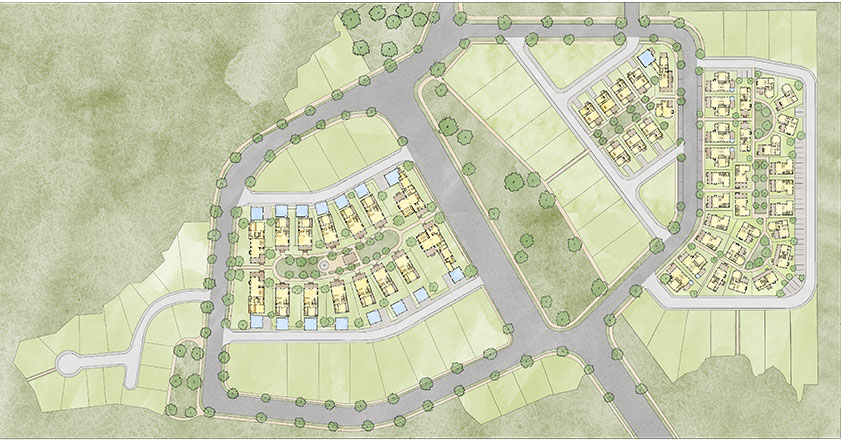
Looking across the three Selah courts, the density range tells the clearest story: 7.7 DUA, 14.3 DUA, 16.6 DUA. Three completely different density outcomes from the same typology, the same design team, and the same plan collection.
That range is not accidental. It's a direct expression of how responsive the cottage court is to site conditions and program. A larger parcel with a park requirement? 7.7 DUA and a green street. A tight alley-bound parcel serving a walkable block? 14.3 DUA and an intimate rectilinear green. A complex edge condition serving a mixed short-term and residential program? 16.6 DUA and a crescent sequence.
The kit of parts is the constant. Everything else adapts.
This is what I mean when I say the cottage court is a toolkit, not a formula. Most housing types are relatively inflexible — a duplex is a duplex, a townhouse is a townhouse. The cottage court is a set of organizational principles: car-free shared green, individual entries, pedestrian connectivity, plans that read as homes. Within those principles, an enormous range of outcomes is possible. Different densities. Different programs. Different spatial experiences. Same design intelligence.
The Selah courts are still under design. They represent what this typology can do at development scale — not one well-designed court on a sensitive historic site, but a family of courts woven through an entire neighborhood, each doing something different, all belonging to the same place.
That's the argument for the missing middle at its most practical. Not a single building type but a design approach. Not a density target but a set of principles. Applied consistently, across different conditions, it produces neighborhoods that feel like neighborhoods rather than developments.
The regulatory window for this kind of building is opening. The question is whether developers and architects will use it well.
Note: This article was posted by Jeremy Sommer on LinkedIn.