Why single-stair reform leads to more livable, adaptable infill


The way we design and build multifamily housing in the US is an anomaly. The typical US multifamily building is a double-loaded corridor—a building with a corridor down the middle and units on either side. This means our multifamily housing is designed and built like a hotel or dormitory. In most of the world, those typologies are the rare instances where you find double-loaded corridors. The knock-on effects of our status quo development are significant and negatively affect livability, public health outcomes, residents' quality of life, and even our ability to adapt to a changing climate. Strangely enough, this anomaly is due to one requirement: that multifamily buildings taller than 3 stories, or having more than 4 units per floor, must have two staircases. Outside of the US and Canada, this requirement is practically non-existent.
Most European countries allow single-stair buildings to reach eight stories or more – even without sprinkler requirements. South American cities are full of single-stair, mid-rise buildings and towers. Asian cities and Australian ones as well. But they are rare in the US. Our building codes typically limit single-stair buildings to three stories. New York City has allowed single-stair multifamily housing up to six stories for over a century, and several NYC Housing Authority projects are chained single-stair buildings. Seattle’s single-stair legislation was enacted by city council in 1977 to induce more development on smaller lots as a means of addressing a growing housing shortage. When it initially passed, there was surprisingly no height limit.
The dual-stair requirement has several effects. It leads to a dearth of family-sized homes in new multifamily housing in the US. In Seattle, roughly 2 percent of all new apartments over the last 20 years have three or more bedrooms. Our zoning codes typically allow significantly more FAR or buildable area for height than in peer countries, which leads to squat, bread-loaf buildings with wide floor plates. Bisecting this building with a corridor connecting all the units with two stairs, ensures that the majority of units are narrow and deep – like a bowling alley. They typically are single aspect, only having windows on one end – unless one is fortunate enough to live in a corner unit. The deep floor plates mean that family-sized homes are significantly larger in area than those typically found in other countries. For example, 2-bedroom corner dwellings in the US have a similar floor area to comfortably-sized 3-bedroom homes in single-stair buildings in Switzerland, Denmark, or Germany. This is a hidden penalty that increases the cost of family-sized development.
If a dwelling is facing west or south, chances are it gets quite warm in the summer. There is no functional external solar protection industry in the US, and the double-loaded corridor prevents dwellings from cross-ventilating in shoulder seasons or during power outages. If a home is on a loud and toxic street, as most density in the US is limited to dangerous arterials, there is no possibility of escaping the noise and grime.
Our building and zoning codes induce a quality of life in urban multifamily housing that is far inferior to what is typically found in other countries, even ones with a far lower GDP than ours.
The single-stair building, or Point Access Block, is the workhorse of urban housing the world over. This is a building with a handful of units wrapped around a stair. These can range from 3 floors to skyscrapers. The limitation on the number of units per floor induces larger units, so 2-, 3-, and even 4-bedroom dwellings are the norm rather than the exception. They facilitate development or redevelopment on small parcels, allowing for urban infill that maintains the fine-grained nature of a block. It also allows for development without raising the costs and timelines of parcel assembly. These buildings tend to be far thinner than development in the US – a typical single-stair development in the EU maxes out at 45 feet deep—we have new double-loaded corridor buildings in the US that are exceeding 100 feet in depth, with single aspect studios or windowless 1- and 2-bedroom homes up to and even exceeding 50 feet deep. This thinness not only lends itself to more livable dwellings—it also leaves far more space for nature, for trees, for community. Our development patterns ensure that new development exacerbates the urban heat island effect—whereas point access blocks allow for new development to mitigate it.
Single-stair buildings allow for homes that can cross ventilate with daylight and views on two, three, and even four sides of a home. This allows for livability that is more commensurate with living in a detached house, than a hotel room. Larger development found the world over largely is achieved through connected or chained single stair buildings, forming a larger complex. Often these also have substantially larger courtyards over the thick floor plates of double-loaded corridors—allowing for better daylight, along with more acoustic and visual privacy.
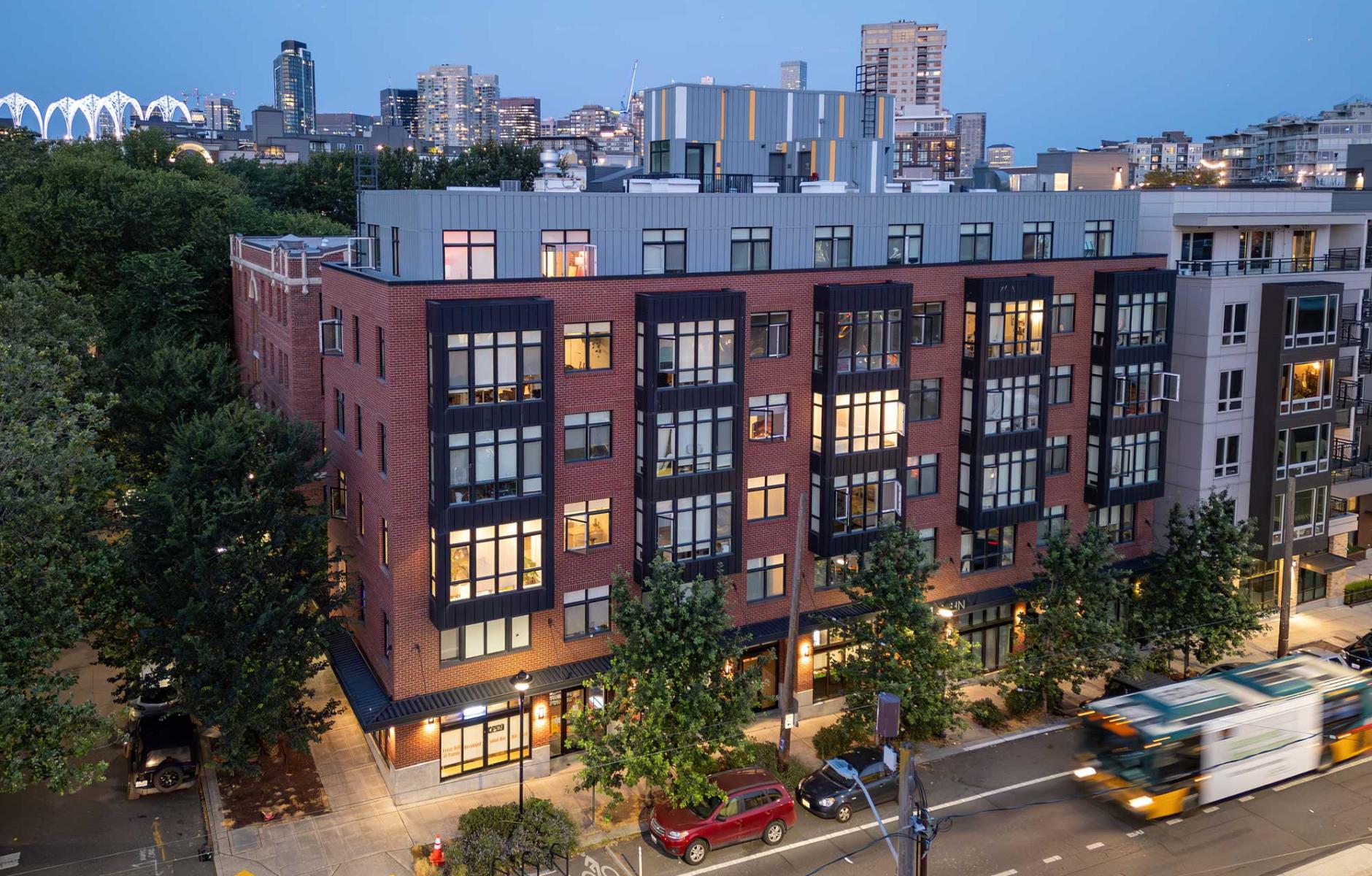
Single-stair buildings allow for more flexibility, by breaking away from the nonsensical and rigid regulations that permeate our building codes. It took me moving to Bayern, Germany, to really understand how different our codes were, and coming back to Seattle—where 6-story single stair buildings have been allowed for nearly 50 years—to realize the effects this small tool has on affordability, livability, and quality of life.
We are seeing more development leaning into this for infill projects, and even Habitat for Humanity is utilizing single-stair infill for 5- and 6-story affordable projects in dense neighborhoods. In 2023, I worked with State Sen. Jamie Pedersen on a Washington State Senate Bill to allow Seattle’s single-stair condition to be used statewide. Since that bill passed, numerous housing activists—many of them architects and developers—have been leading the charge in their own states. The Center for Building in North America, led by Stephen Smith, has become an organizing force around single-stair and other building code elements that limit dense affordable housing. Stephen’s report on elevators was eye-opening—the cost of an elevator in a mid-rise building is magnitudes more expensive than in peer countries. Countries like Greece and Spain, with GDPs and populations far lower than the US, have far more elevators installed.
For decades, people understood how our zoning codes prevented the flourishing neighborhoods and abundant housing found in other countries. But we have since realized it is not just an issue of zoning codes—our building codes may be even worse. Housing activism around single-stair buildings is leading to a large body of research that will, it is hoped, begin to disentangle our insular codes and standards.